

“After many years of unsuccessfully trying to kill each other, it is starting to look more and more likely that we might actually start working together.”
I am an old-school liberal. I embark from the position of tolerance, the capacity to handle complexity, and the courage to make difficult compromises. With social media gaining traction as a news source, whilst legacy media loses its central position as gatekeepers of opinion, we are blessed with a wide range of outlooks as colourful as the rainbow and as expressive as a Gauteng thunderstorm. I sample widely across podcasts, traditional news sources and in-person contacts, sometimes to guide my thoughts, but mostly to be aware of what my fellow countrymen are thinking, so I can understand the bigger picture. While regularly doing these exercises, what strikes me is not only the differences, but more so, how often we agree on the most important things.
For this article, I asked people for forward-thinking, good vibes messages for the country. I gathered input from left, right, and centre.
John Endres, CEO of the IRR (Institute for Race Relations) was interviewed by Dr Mbuyiseni Ndlozi on The African Renaissance Podcast. It was a terrific interview, with the clashes between communism and free market capitalism on clear display, albeit in a dignified manner. Ndlozi is impressive in this role as podcast host. He is articulate, extremely well read, calculated and gracious, a far cry from the incendiary figure in a red overall disrupting parliament as an opposition EFF member. The podcast is a project of the TMF (Thabo Mbeki Foundation). They paint a hopeful view of the future and want to be a part of it, aiming to bring about an African rebirth by ‘supporting platforms for dialogue and reflection.’ On the IRR’s own Daily Friend Show podcast afterwards, Endres encouraged people to listen to a variety of inputs and to avoid echo chambers. This is a great guidance for all of us. He remains encouraged that South Africa can transform itself through rapid economic growth and jobs for all. “It simply means the government taking the brakes off the economy. If the ANC switches to a light-touch regulatory framework, we should be well on our way. My greatest wish for South Africa in 2026 is that we lift our eyes to the stars: that we recognise South Africa’s enormous potential and understand how close we are to unlocking it.”
Endres fits the demographic of a middle-aged, white male in the upper LSMs with a liberal political worldview. I would not quite use the term gin-soaked old colonial as a descriptor, but it is an entertaining contrast with Sama Sambit: young, black, barely 21, and squarely conservative. He calls himself a ‘realist’ and is a rising voice in social and political commentary. At 60,000 subscribers, his YouTube channel has more followers than the IRR and TMF combined. One man, one voice, one cell phone. He does regular podcasts from his bedroom via his cell phone; such is the shifting nature of digital influence. To him, Apartheid is not a relevant framework, and history is not a meaningful way to plan a future. “I was born pre-loadshedding, in a prosperous country. What happened to it? The ANC has brought the country to the brink of collapse. We have to fix it. Start by getting rid of corruption and making some policy changes.” Sambit is keen to be part of a future where the youth are inspired and mobilised, and has started youth education programmes aimed at promoting business skills. “I don’t want to see a nation of workers. I want to see a nation of free thinkers and entrepreneurs.”
The Rational Standard is one of the few voices in the crowded, centre/centre-right space with an openly libertarian inflexion. The tone of the podcast can be very technical, with a lot of constitutional terms and legalese, but calling the government ‘dim-witted’ will suffice when more technical terms are not necessary. Podcast host Martin van Staden, Head of Policy at the FMF (Free Market Foundation), says there is hope for South Africa if more citizens take responsibility for themselves. “What remains is for South Africans to stop seeing the boundaries of formal politics as the extent of what is possible: the extent to which you can liberate yourself from poverty and anxiety is directly linked to the extent to which you stop caring about whether the political elite approves of your plans or not.’
Van Staden’s plan is great, but not if you are a poor person without resources or agency, like the old car guard I interviewed for this piece. I offset the learned and financially secure with random people I run into, asking them the same questions. “This country is dirty,” said the man with the missing teeth, knyping his stompie between his withered fingers. “It is filthy from the tsotsis who are running this place. The biggest ones are in parliament. Rampahosa is tsotsi number one.” The man had no good vibes available at this stage. He said nothing can be done. “I am the lowest of the low (in society)”, he said. ‘What can I do?”I suggested we could vote them out, but that suggestion didn’t as much as raise a flicker of light in his eyes. He shook his head and shuffled his feet. I noticed his shoes had no laces and that he basically agreed with many other commentators on basic premises, just using different words.
I have more capacity than the car guard, but not as much fire and ambition as Sambit, so the views of Frans Cronje will take me into the new year. As an analyst and scenario planner, he strides across history and the future with equal ease. Speaking on the State of the Nation podcast, he reminds us that we have had a spectacular history with much to be celebrated: we transitioned to democracy in peace, made massive improvements in wealth transfer and upliftment during the first 15 years of the new government, and the GNU, despite having problems, still holds. Cronje also has a message to the people of KZN, which I shall adopt. “Do you remember, during the 2021 riots, how you thought the whole system had collapsed? That it was the end? It wasn’t. You took the matter in hand, largely by yourself as a community, and turned it around. Then you had the devastating floods of 2022, where much of your beautiful city was destroyed. You rebuilt from that. You remain the second-largest economy in South Africa. That is who you are.” It is a message of resilience and active positivism, rather than passive hope, that sits well with me.
Mike Sham, host of the State of the Nation, summed it up like this: “Dr Frans Cronje has painted a positive picture. A foundation has been laid for a better future if we just keep on making some sensible decisions.” He concludes, as shall I, with this: “We are at an inflexion point. After many years of unsuccessfully trying ot kill each other, it is starting to look more and more likely that we might actually start working together.”
Viva!
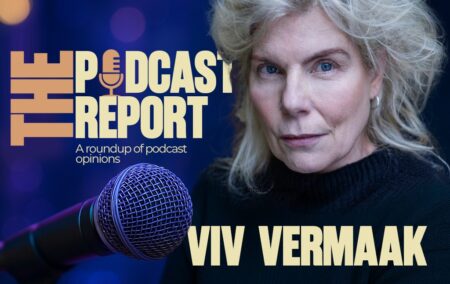
[Vivienne Vermaak is an award-winning journalist and public speaker. The Podcast Report appears monthly in the Daily Friend as a column, as well as in podcast form on the Daily Friend Show. This episode will appear on the Daily Friend Show this week.]
The views of the writer are not necessarily the views of the Daily Friend or the IRR.
If you like what you have just read, support the Daily Friend