

The Department of Basic Education wants to introduce a new history curriculum for Grades 4 to 12. On 20 March 2026 it released a draft that is hundreds of pages long for comment within the absurdly short period of 30 days. At the last minute, it extended this period for another 30 days.
The draft was seemingly drawn up by a “History Ministerial Task Team” appointed by former basic education minister Angie Motshekga. It reflects a deep determination on the part of the African National Congress (ANC) to provide future pupils with a false portrayal of the past. That aim is particularly evident in the proposed syllabus for the “matric” years (Grades 10 to 12) in which history might also be made a compulsory subject.
When public criticism of the draft mounted, the present minister of basic education, the Democratic Alliance’s Siviwe Gwarube, responded: “Our history curriculum should not exclude key events or perspectives on political grounds, nor should it impose any particular ideology on learners.” However, if Ms Gwarube is to achieve this, the draft curriculum will have to be substantially rewritten.
The draft’s brief account of South Africa’s political transition is particularly dishonest. It says, for example, that ANC president Oliver Tambo was “instrumental in the ANC’s adoption of what the ANC called the ‘Four Pillars of the Struggle for National Liberation’, namely (1) the Underground Struggle; (2) International Solidarity; (3) the Armed/Military Struggle; and (4) Mass Mobilisation’.”
This brushes over the fact that these four “pillars” were vital elements in the formula for people’s revolutionary war, as developed by North Vietnamese strategist General Vŏ Nguyén Giáp. Giáp’s formula – which was based on the Soviet Union’s Unified Military Doctrine for the defeat of all capitalist countries – was successfully used to establish communist rule in North Vietnam in 1954 and then, in 1975, in South Vietnam too.
It was largely because of these victories that a delegation headed by Tambo – but mainly comprising leaders of the South African Communist Party (SACP) – visited communist Vietnam in 1978. Their aim was to learn Giáp’s formula and use this to wage a people’s war that would so badly weaken the ANC’s political rivals as to give the ANC/SACP alliance hegemony over post-apartheid South Africa.
The draft curriculum also overlooks the fact that the “four pillars” in practice included:
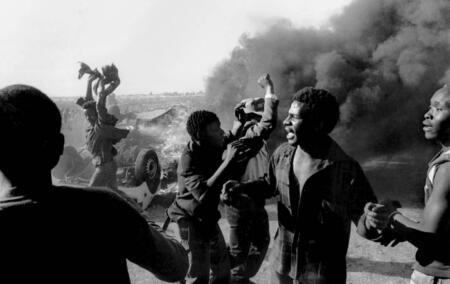
- terror attacks on black civilians, often in the form of necklace executions in which a petrol-filled tyre was hung around the victim’s neck and then set alight;
- intimidation and coercion of black people reluctant to participate in ANC “stayaways” sure to result in lost income and perhaps also in lost jobs; and
- targeted attacks on the leaders and members of the Black Consciousness movement and Inkatha, many of whom were killed during the people’s war.
The draft curriculum is also wrong in claiming that the ANC abandoned its “four pillars” when it was unbanned in February 1990. In fact, the ANC not only persisted with its people’s war throughout the negotiations period but also intensified it. This explains why political killings tripled in the period from 1990 to 1994, rising to some 15,000 from the 5,500 recorded from 1984 to 1989.
South African pupils deserve to know these important aspects of the past. The draft curriculum should not help conceal the ANC’s people’s war. Nor should the draft endorse a major ANC propaganda campaign intended to deflect the blame for violence on to the organisation’s rivals.
This propaganda campaign focused mainly on the “third-force” explanation for the tripling of political killings from 1990 to 1994. This third-force theory had two main aims. The first was to divert public attention from the 13,000 armed and trained Umkhonto we Sizwe (“MK”) fighters the ANC had brought back into South Africa, under the cover of the peace process, by March 1991. The second was to put the blame on the ANC’s rivals – and especially on Inkatha, now renamed the Inkatha Freedom Party (IFP).
These 13,000 MK fighters (whom the ANC refused to disarm or disband) had both the means and the motive to attack the IFP, which in 1990 had roughly 1.8 million members in KwaZulu/Natal and on the Reef and was the largest black political organisation in South Africa. However, the ANC successfully deflected public attention from MK’s possible culpability by blaming mounting political violence on a sinister “third force.” This “third force” was said to comprise the IFP and its allies in the South African Police (SAP), who were supposedly working together to destabilise the ANC and derail the transition to majority rule.
Repeated coverage made the “third force” theory a household term. The theory was also buttressed by the fact that both the police and the IFP were undoubtedly involved in political violence (even though this was generally in response to prior intimidation and attacks by the ANC.)
However, despite its superficial plausibility, the Third Force theory had two major weaknesses which most commentators ignored. First, the theory could not explain the killing of hundreds of IFP leaders and thousands of IFP supporters, many of whom were gunned down in premeditated ambushes. In addition, the theory could not explain the large number of police deaths (roughly 1,000 between 1990 and 1994) and police injuries (more than 1,700 in the first six months of 1993 alone). A third force that killed a small number of its own supporters to stir up hatred, provoke counterattack and try to derail the negotiations process might have some logic behind its actions. But a third force that killed or wounded thousands of its own supporters made no sense at all.
Second, though both the IFP and the police arguably had the means and the motive to attack and destabilise the ANC, they drew no benefit from the mounting political violence. On the contrary, every attack that could be dubbed a third-force one weakened State President FW de Klerk and undermined his credibility. Every attack of this kind also stigmatised IFP president Chief Mangosuthu Buthelezi as an apartheid “collaborator” and isolated him from his support base. There was thus no political advantage to either the IFP or the SAP in persisting with their alleged “third-force” attacks. By contrast, the only organisation that gained politically from the violence was the ANC.
Again, pupils deserve to be given a more accurate and honest account of the political transition. The draft curriculum claims that its aim is to help young South Africans “come to terms with the past.” Its real objective, however, is to whitewash the ANC. If it is adopted in its present form, it will further suppress all knowledge of the roughly 20,500 people – most of them ordinary black civilians – who were hacked or burnt or shot to death during the people’s war to give the ANC and its communist allies the domination they were determined to achieve.
[Image: https://en.wikipedia.org/wiki/Vaal_uprising#/media/File:Anti-Apartheid_Protest_02_F.jpg]

If you like what you have just read, support the Daily Friend