

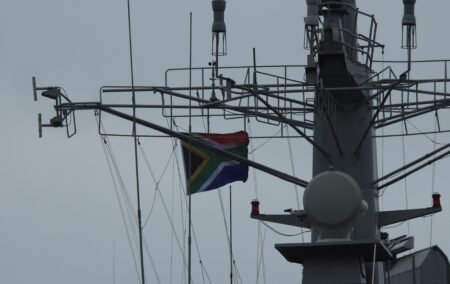
The hijacking of a fishing trawler in the Mozambique Channel in 2011 forced Southern African states to act. The result was Operation Copper, a joint anti-piracy mission involving Mozambique, Tanzania and South Africa under the SADC banner.
From the outset, South Africa carried the heaviest load, with the SANDF deploying navy vessels, Maritime Reaction Squadron teams and, at times, aircraft from the air force. Fourteen years later Pretoria still props up this mission, but its capacity for maritime search and rescue remains threadbare.
A recent attack on a Russian research vessel off northern Mozambique highlights the issue.
South Africa can patrol against pirates, albeit intermittently, but it cannot guarantee the rescue of ships or crews in distress. That is not a temporary gap, but the product of underfunding, poor planning, bureaucratic turf wars and a complacency that has shaped maritime security policy for more than a decade.
On 10 May, a Russian fisheries research vessel was attacked by armed Islamist militants near the Quirimbas archipelago in Cabo Delgado. The ship, with forty people on board, had been conducting environmental research when two speedboats approached. At first the crew assumed they were encountering a military patrol. It quickly became clear they were not. Masked men armed with guns and machetes opened fire, speaking in Arabic as they closed in.
The militants chased the ship for nearly twenty minutes. Bullets ripped through its cabin, one striking an electronic display. Video footage captured the panic on board as the attackers tried to disable the vessel. The ship eventually escaped into deeper waters, not because of naval intervention but because rough seas discouraged the pursuit.
Despite repeated distress calls, the Mozambican navy failed to respond. Promises of helicopter support came to nothing. No other ships in the area offered assistance, and authorities only contacted the crew the following day. The anti-corruption NGO, Centre for Public Integrity, accused Mozambique’s defence and maritime agencies of negligence. The government waited ten days before commenting, and insisted the matter was still “under investigation”. For the researchers it was a harrowing ordeal. For the region it was a stark reminder of just how fragile maritime security remains.
Reality of its preparedness
Ironically, the incident occurred in waters meant to be patrolled by Operation Copper. It exposes the gap between South Africa’s claims of maritime leadership and the reality of its preparedness. The mission itself was born of crisis. The hijacking of a Mozambican trawler in 2011 revealed how vulnerable the channel had become, echoing the Somali experience further north. SADC acted quickly, with Mozambique and Tanzania committing forces, but South Africa carried the burden, providing the ships, personnel and, occasionally, aircraft.
The operation achieved some success. Piracy incidents in the channel fell sharply, with persistent patrols deterring would-be attackers. Yet the mission also exposed a central weakness. Pretoria has relied on improvisation rather than deliberate capability-building. The navy can place a vessel in the channel, but it struggles to sustain deployments. The air force can dispatch an aircraft, but not consistently, given chronic maintenance failures. And when a genuine emergency arises, as it did in May, the region’s ability to respond collapses into inertia.
Pretoria has become adept at presenting half-measures as progress. Naval modernisation projects such as Project Biro, which procured three Multi-Mission Inshore Patrol Vessels, and Project Hotel, which is building a new hydrographic survey vessel, are trumpeted as achievements. Yet Project Biro was cut back from its original ambition of inshore and offshore vessels, leaving only three ships. Project Hotel has been plagued by delays, cost overruns and acts of God, including Covid lockdowns and the KwaZulu-Natal floods. These vessels are useful additions to the fleet, but neither was designed for search and rescue. They are security and survey platforms that may, in extremis, be pressed into that role. That is not the same as having a dedicated capability.
Technological upgrade
Similarly, the procurement of four coastal surveillance radars has been promoted as a technological upgrade. While they will improve situational awareness, radars cannot pull people from the water or evacuate crews under fire. The SANDF is investing in sensors without investing in the assets that act on the information those sensors provide. This reflects a wider problem. For more than a decade, the Department of Defence has invested piecemeal in naval projects while neglecting to build an integrated, inter-departmental search-and-rescue system. There is still no strategy that brings together the navy, the air force, the Department of Transport and other agencies in a coherent plan.
The South African Maritime Safety Authority (SAMSA), an agency of the Department of Transport, is legally responsible for the country’s obligations under the International Maritime Organisation’s Search and Rescue Convention. Its Cape Town-based Maritime Rescue Coordination Centre oversees one of the world’s largest designated search-and-rescue regions, stretching from the Mozambique Channel to the Southern Ocean. Its role is to coordinate distress responses, mobilise assets and ensure compliance with international reporting requirements.
Yet SAMSA has no ships or aircraft of its own. It depends almost entirely on the navy to provide vessels and on the air force to supply aircraft, when available. Given the SANDF’s chronic budget and maintenance problems, this dependence often leaves SAMSA with little more than authority on paper. The system works only if the Defence Force can field platforms at short notice. Too often, they cannot, leaving South Africa’s search and rescue obligations dangerously hollow in practice.
Parliament has started to probe these gaps. The DA’s Maliyakhe Shelembe recently asked the Minister of Defence, Angie Motshekga, whether there were plans to strengthen search and rescue through procurement, international cooperation and technology upgrades. He also asked about costs, timelines, compliance reports to the International Maritime Organisation (IMO), the number of operational aircraft and vessels, the impact of budget pressures, the frequency of joint exercises with regional partners and the mechanisms in place to meet treaty obligations.
These are the right questions. They go to the heart of whether South Africa is truly able to lead maritime security in the region and fulfil its obligations under international law.
Evasiveness
The answers were striking, not for their clarity but for their evasiveness. The Minister admitted that there is no inter-departmental plan for search and rescue. She pointed instead to the patrol vessels and survey vessel already being acquired, and to the coastal radar system. All are expensive, none are dedicated search-and-rescue platforms, and none are new; these projects were initiated years ago. Furthermore, these systems will only ever serve in a secondary capacity.
On costs and timelines, she was precise. The patrol vessels came in at R3.63 billion, the survey vessel is currently at R2.96 billion and the radars at R43.3 million. The deployments stretch out as far as 2028. These figures confirm the billions already being spent on naval modernisation. They also highlight the core problem: whenever the taps open up for new projects, money is poured into prestige projects, not into building a credible capability.
On international cooperation, the Minister offered only vague references to memoranda of understanding. No examples were given. No evidence was provided of active partnerships. On compliance reporting to the IMO, she shifted responsibility entirely, insisting that this falls to the Department of Transport’s Maritime Rescue Coordination Centre in Cape Town. That may be bureaucratically neat, but it demonstrates the absence of inter-departmental accountability and communication. It also means Parliament has no way of knowing whether South Africa can meet its obligations.
When asked how many aircraft and vessels are currently operational, the Minister gave no figures. She acknowledged that capabilities are limited, undermined by budget cuts and delays in sourcing spare parts. She promised future acquisitions, but with the caveat that everything depends on funds that may or may not appear. On regional cooperation, the admission was blunt. South Africa has not conducted a single joint search-and-rescue exercise with its Maritime Search and Rescue (MSRA) partners. The SANDF, she said, would provide assistance if called upon, but it does not lead.
Recurrent pattern
A recurrent pattern is becoming obvious. Parliament asked for clarity on planning, readiness and obligations. The Minister responds with procurement numbers, vague assurances and jurisdictional deflections. The essential questions remain unanswered. Can South Africa respond effectively to a maritime disaster today? Does a coherent national strategy exist that binds departments into a functional whole? Is the Republic honouring its international commitments? On all three, the silence is louder than the answers.
This reflects a deeper reality. South Africa has no coherent search-and-rescue policy. It relies on improvisation, hoping that general-purpose naval assets and ad hoc cooperation will be sufficient. They are not.
The risks are not theoretical. The Mozambique Channel is volatile, and lies astride vital shipping routes. The Islamist militancy in the north of Mozambique has already begun spilling into coastal waters, as the attack on the Russian vessel demonstrates. Piracy may have been suppressed, but it has not been eliminated.
Further, climate change has caused an increase in the frequency and severity of storms in the region, raising the likelihood of maritime disasters. Without robust search-and-rescue capacity, South Africa is gambling with lives, both of its own citizens and of the foreign crews who transit its waters.
Pretoria cannot continue with half-measures. A national strategy for search and rescue, clearly allocating responsibility across departments is sorely needed. The SA Navy must further invest in platforms that are designed for these missions, rather than relying on naval assets to double up when needed. It should conduct regular joint exercises with regional partners to build credibility and interoperability. Funding must be secured in a way that insulates critical capabilities. And accountability for international obligations must not be shuffled between departments, but embraced collectively at the highest level of government.
Illusion of leadership
Without these steps, South Africa will continue to project the illusion of leadership in maritime security while leaving its actual capacity dangerously hollow.
The attack off Cabo Delgado was not only Mozambique’s failure. It was a warning to South Africa. Operation Copper has kept piracy at bay, but it has not solved the question of how the region responds when lives are in immediate danger at sea. Pretoria cannot afford to treat search and rescue as an afterthought: a secondary function bolted onto other projects.
Parliament has begun to ask the right questions, but the Minister’s answers expose the hollowness of South Africa’s approach. Until the government confronts these shortcomings honestly and invests accordingly, it will remain unprepared. And when the next maritime disaster strikes, the cost will be measured not in procurement budgets, but in human lives.
[Image: Ricard Teixeira]
If you like what you have just read, support the Daily Friend