

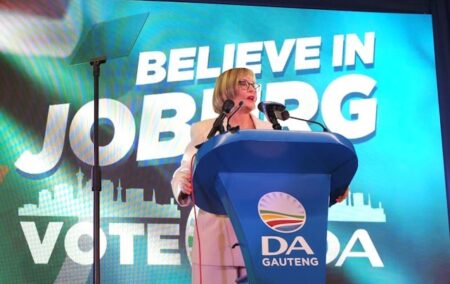
The launch of Helen Zille’s campaign for Mayor of Johannesburg ranks as one of the most inspired moves in South African politics, at least in recent times.
It shows the DA is putting up one of its heaviest hitters to take on one of the most daunting political tasks in the country. Win or lose, it shows the party wants to deal with dire problems.
The way Johannesburg votes could be the way the country votes, a few elections away.
Zille has immense name recognition, is quick on her feet, and was the force behind the turnaround of Cape Town. She also has a determination of steel and enjoys a fight. But it is a bit of a stretch to expect that she will be elected as mayor and be able to push through her turnaround plans.
Some watchers of the Electoral Commission say the upcoming local elections will be held in early November next year. A year-long campaign presents an increased risk of slips and many other candidates emerging.
Zille’s key message is simple. It is that the DA governs better than any other party. That is entirely credible and is what President Cyril Ramaphosa told ANC local councillors last week.
Sticking to her campaign launch message − “The only job of the local government is to deliver quality basic services. Water. Sewage. Refuse removal. Roads. Traffic lights. Electricity” − is narrow but solid.
That just might help her to side-step the predictable land mines of Gaza and accusations of racism that the comrade parties, ActionSA and others, will lay for her. They can’t point to anything they do well, and this is their last resort.
It is unclear in which directions the ANC cookie will crumble at the upcoming elections. In last year’s national election, the 14 percent of the vote that went to newcomers uMkhonto we Sizwe (MK) was due to former President Jacob Zuma effectively capturing the mantle of Zulu nationalism. A swing of this magnitude towards the DA is out of the realm of possibility. Even a five percent swing to the DA would be good.
Supporters are motivated
The DA tends to do better in local government elections than it does in national elections, largely because its supporters are motivated to turn out for these. Pollster Gareth van Onselen points out that the ANC’s local government slump is increasing, but the DA’s ability to take advantage of the differential turnout in local government is decreasing. Back in 2011, the DA managed to increase its vote over the most recent national election result by more than seven percentage points, but in 2021 the party only increased its share by less than one percentage point.
Analyst Richard Wilkinson says that if the DA performs at its absolute best at the local elections, it will emerge as Johannesburg’s largest party. But it will still not have an outright majority. Under this scenario, Wilkinson says the DA would take 37 percent of the vote, the ANC 23 percent, and the Economic Freedom Fighters (EFF) and MK 13 percent each. Sothe ANC would be king-maker and could either join a “doomsday” coalition with its fellow comrade parties or go for one with the DA.
If Zille becomes mayor, the question then becomes whether it will be possible to implement a turnaround plan with the ANC as a coalition partner. The DA is unlikely to drop its insistence that it will not form a coalition with the other comrade parties.
Dealing with the ANC in coalition in the city will be very tough. The city administration is ANC-controlled, although the DA has headed a coalition at various times. Municipal government is a chance for cadre deployment and patronage.
In the 13 years from the financial year ending in 2011 to that ending in 2024, there has been an 84 percent increase in staff employed by the City. That leaves little for maintenance and capital investment.
Would the ANC agree to slashing the number of its cadres employed by the City? What sort of payouts would be required to cut the payroll?
Clean-out
Would a DA coalition with the ANC allow a clean-out of many of the corrupt and incompetent?
Even if staff numbers are cut, it would take years to generate revenue for a turnaround. As it is, the City’s working capital − current assets less current liabilities (that is, what it needs to address day-to-day expenses) – is heavily in the red.
The amounts needed to fix the backlog in infrastructure could be as high as R300bn, according to some estimates. That’s nearly four times the City’s total annual budget. The City does not recover revenue on about 46 percent of the water it buys from Rand Water. City Power, which resells power that it buys from Eskom, has a mammoth deficit.
A few quick wins, such as ensuring better management of Johannesburg Water, City Power, and prompt filling of potholes, could change sentiment. Public/private partnerships could be used to deal with many of the most difficult issues.
With that, businesses might be encouraged to return, which would boost city revenues, and a virtuous circle might begin.
There is a long list of cities that have turned around, but it usually takes years.
In certain respects, Detroit’s five-decade decline sounds eerily like that of Johannesburg. Much of the reason for Detroit’s deterioration was, according to City Journal, heavily due to domination by a “Democratic Party race-and-patronage machine that thwarted reform at every turn”.
That’s pretty much the machine that we have in Johannesburg.
For years, people who were nervous about Detroit’s future, mainly white middle-class people, fled the city. That left the Democrats running the city with a more solid group of supporters who did not push for reform. That’s called the “Curley effect”, after a corrupt early 20th century Boston mayor, James Curley, who used economic policies to push people who did not vote for him to leave town.
Declared bankruptcy
In 2013 after years of high crime, a rising number of abandoned houses, a high murder rate, financial mismanagement, and a massive number of broken streetlights, the city declared bankruptcy. Just months afterwards a Democrat, Mike Duggan, who happened to be a white guy, was elected mayor on the strength of many black voters writing his name onto the ballot, something allowed in some US elections.
Clearly, people once satisfied with the patronage machine and an absence of reform were suddenly furious at the mess. When a real crisis hit, race and the patronage machine meant nothing to voters who might once have considered these a priority.
After a dozen years of Duggan as mayor, Detroit has turned around and is buzzing with activity.
If Johannesburg’s decline is not reversed after the next election, middle-class flight will accelerate and with that a terminal decay could set in. If the patronage machine endures, business can try and step in, but even they might be thwarted.
This election is make or break for our city.
[Image: J C Katzenellenbogen]
The views of the writer are not necessarily the views of the Daily Friend or the IRR.
If you like what you have just read, support the Daily Friend