

It is corrupt. It is criminal. It is tyrannical. And no other private organisation in the world gets special laws to feed its greed.
When I wrote, back in 2010, that FIFA, Russia and Qatar deserve each other, I did not expect that one day, I would be able to make the same argument about FIFA and the United States.
Yet America’s recent turn towards high-level corruption, disregard for human rights, despotic rule, and anti-market policies have made it a perfect partner for the world’s most evil private multinational, FIFA.
Until this week, FIFA’s 35-page Stadium Code of Conduct – which prohibits the iconic vuvuzelas South Africa made famous in 2010 – permitted fans to bring empty reusable plastic water bottles into the stadium.
Given that it’s summer in the US, Mexico and Canada, where the tournament is being held from 11 June to 19 July 2026, hydration must be high on the list of priorities for fans.
Then the rules changed. Now, “for the avoidance of doubt, reusable water bottles may not be brought into the Stadium”. If you want to hydrate, you must now buy bottled water from FIFA’s accredited water “partner”, at whatever excessive price they choose to set.
This bit of petty tyranny is a timely reminder that FIFA, the world football governing body, is the single most objectionable monopoly in the world, bar none.
Sportwashing
I do not use these words lightly, and I am aware of the competition. There are oil cartels that fix the price of the fuel in your tank. There are telco monopolies that help authoritarian regimes murder dissidents in the name of sovereignty. There are tech companies that provide the tools of mass surveillance to war-mongering superpowers, and would like nothing more than to establish crypto-fascist oligarchies free from the constraints of the rule of law and democracy, and free of the nuisance of the poor.
But none of them combines, in one tidy Swiss package, the full quartet: a documented criminal enterprise, a parasite on the public purse, a serial violator of private property and contract, and a moral coward in the face of the abuse of children.
FIFA manages all four at once, and it does so while draped in the bunting of the beautiful game. It sportswashes not only the governments of World Cup host countries, but most of all, it sportswashes itself.
Criminal enterprise
Consider, first, the criminality. These are not allegations. These are the stuff of formal indictments, guilty pleas and jury verdicts.
On 27 May 2015, the US Department of Justice unsealed a 47-count, 164-page indictment charging FIFA officials and sports-marketing executives with racketeering, wire fraud and money laundering.
Swiss police, acting on the American request, arrested seven of them in the predawn dark of the Baur au Lac, the five-star Zürich hotel where FIFA’s grandees had gathered.
The DOJ alleged bribes and kickbacks of more than $150 million, paid over nearly a quarter of a century to capture the media and marketing rights to tournaments.
A superseding indictment that December added sixteen more defendants and pushed the count to 92.
By the time the dust settled, more than 40 individuals and entities had been charged, the bribes tallied in excess of $200 million, and 27 defendants had pleaded guilty.
This isn’t a case of a few bad apples. It demonstrates the original meaning of the idiom, “one bad apple can spoil the barrel”.
World Cup of corruption
The IRS investigator who helped crack it called it the “World Cup of corruption”. Sepp Blatter, FIFA’s president for seventeen years and the spiritual heir of King Leopold I described back in 2010, was forced to resign.
His secretary-general, Jérôme Valcke – the same man who told us that 80% of African countries “would not have football” if FIFA was not allowed to make its extraordinary profits – was banned from the sport.
Two confederation presidents, José Maria Marin of Brazil and Juan Ángel Napout of Paraguay, were convicted at trial of racketeering conspiracy. (U.S. Department of Justice)
This is the governing body of the most popular sport on earth, run for a generation as what American prosecutors, in the dry language of the statute, called a “corrupt enterprise”. Not a few bad apples. The enterprise itself.
And at the rotten heart of it sat the two decisions that my 2010 column predicted would shame FIFA forever: the awarding of the 2018 World Cup to Vladimir Putin’s Russia and the 2022 tournament to the desert autocracy of Qatar.
The bribery allegations swirling around those votes were, the DOJ noted, central to the whole scandal.
Human cost
I wrote at the time that Russia, Qatar and FIFA deserved each other – that an organisation which conducts itself like an unaccountable sovereign state would naturally feel most at home among the unfree.
I take no pleasure in having been right. The human cost of that prediction was paid not by FIFA but by the men and women who built Qatar’s stadiums.
In 2021, The Guardian reported that more than 6,500 migrant workers from India, Pakistan, Nepal, Bangladesh and Sri Lanka had died in Qatar in the decade after it won the right to host. Qatar disputes the figure, insisting that only a handful of deaths (a mere 400 to 500) were directly linked to World Cup construction sites.
Quibble, if you must, about how many of the dead were laying the foundations of a stadium and how many merely happened to die of natural causes in the country FIFA’s corrupt vote had filled with imported labour. FIFA handed its showpiece to a state that runs on indentured workers it can neither pay on time nor permit to leave.
It commissioned a report which concluded that FIFA ought to compensate the victims. FIFA said, “It should be noted that the study did not specifically constitute a legal assessment of the obligation to remedy.”
It expressed its regret in press releases.
Flattery and bribes
This is the body now in business with Washington, and the alliance fits.
FIFA could not have known, when the right to host the 2026 World Cup was awarded to the US, Mexico and Canada, that its corrupt, authoritarian ethos would find such fertile soil in North America.
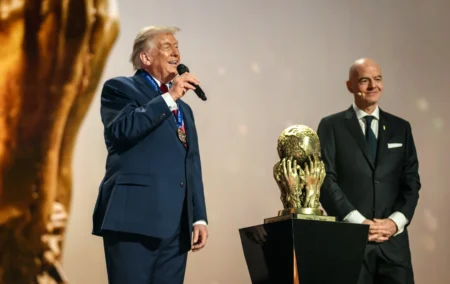
It certainly did, however, when in late 2025 its president, Gianni Infantino, broke a long-standing FIFA principle to stay out of politics, and invent an absurd “Peace Prize” for Donald Trump, to make up for the Nobel Peace Prize he did not win.
Like most other powers who want something from Trump, Infantino knows that he can easily be manipulated with obsequious flattery or a shiny bribe.
America, newly comfortable with strongman governance and contempt for due process, and Infatino’s FIFA are birds of a feather. They will flock along famously.
The real swindle
Even if one disregards FIFA’s record of criminality and corruption, one ought to object to the real swindle, which is perfectly legal, albeit perfectly immoral and a violation of the rule of law. We South Africans funded a masterclass in it.
The pattern never varies: the host government is sold a fantasy of economic windfall, global marketing, and positive sentiment.
It then borrows and taxes to build stadiums, roads, airports and the necessary security apparatus.
FIFA arrives, claims strict monopoly rights to the broadcasting, sponsorship, marketing, accommodation and ticketing revenue, scoops every penny it can possibly extract from the fans and the citizens into its tax-free Swiss bank accounts, and departs, leaving the locals to service the debt and mow the grass in the white elephants.
And it, and its supplier cartel, are rapacious in the extreme. They take massive commissions on any business even remotely related to World Cup tourism, and compensate nobody when their optimistic bookings don’t materialise.
In 2010 we were promised that the World Cup would shower riches on South Africa. As I pointed out in my seminal column on the 2010 World Cup, Boycott FIFA, the economists Stefan Szymanski and Simon Kuper warned that visitors spend far less than hosts lay out, and that “the next World Cup will not be an airplane dropping dollars on South Africa”.
They were right. A post-mortem by the Mail & Guardian, five years later, concluded with the words of the late (and much lamented) economist Mike Schussler, who said: “Physically we won’t make our money back. But it was a good marketing exercise, it put us at the centre of the world stage and was good for tourism. … There is a marketing reason to do this. Although now we are stuffing it up … It now seems we paid to lose money.”
Private profit, public costs
Beijing’s Olympic “Bird’s Nest” was branded a financial albatross within years; Cape Town’s Green Point stadium – the one FIFA insisted we build instead of upgrading Athlone stadium, to exchange a dispiriting view of poverty for far more marketable sea-and-mountain views – is our own.
Brazil repeated the experiment in 2014, spending billions on stadiums while its public services buckled and its citizens took to the streets.
Now North America takes its turn. A string of Canadian, American and Mexican municipalities are pouring hundreds of millions into stadium retrofits, security and transit, while FIFA, as ever, demands sweeping exemptions from tax on its revenues.
The upside is privatised to Zürich; the downside is socialised to the taxpayer.
Economists across the political spectrum have found, again and again, that the promised windfalls from these mega-events are systematically overstated while the costs land on ordinary people.
FIFA has perfected the corporate dream: it establishes a legally impregnable monopoly, gouges the punters, and repatriates the profits while it hands you the bill.
Subverting the rule of law
If that were the whole charge sheet, FIFA would merely be a rapacious rent-seeker, and the world is full of those. What lifts it into a category of its own is the third count: its routine override of the most basic rights of property and contract, achieved not by negotiation but by law.
A normal event organiser works within ordinary law. It signs voluntary contracts. If it wants your shop closed for a day, it asks, and pays. If a sponsor wants exclusivity, it buys it from the property owner. Trademark and contract law, which we already have, are entirely adequate to that task.
Not for FIFA. FIFA demands, and gets, special legislation that grants it rights no citizen of the host country enjoys.
In 2010 our own Parliament obliged, creating “designated areas” and “special measures” in which your pub, your shop or your advertising hoarding could be commandeered, in which you could be barred from selling a boerie roll outside a stadium where you had always sold one, and in which you became subject to special search-and-seizure powers.
Dutch fans were arrested on criminal charges for the offence of wearing orange dresses bearing a brewer’s name. A Mail & Guardian journalist had her accreditation torn from her neck for the crime of filming with a camera that could shoot video.
These are not the rules of a sports federation. They are the decrees of an occupying power. They undermine the rule of law, which holds as its highest principle that everyone is equal before the law.
“Ambush marketing”
FIFA’s so-called fight against “ambush marketing” turns ordinary commercial speech – an advert that mentions football, a promotion that references the tournament, a particular combination of words – into a punishable offence, sometimes a criminal one.
It overrides existing stadium naming rights and existing beverage and catering contracts in favour of its own sponsors.
It restricts what fans may say, what banners they may carry, what politics they may express – this from an organisation that lobbies governments for a living.
It criminalises the resale of a ticket you lawfully bought and lawfully own.
And so, in 2026, we arrive at the reusable water bottle. Stripped of all the lofty talk of the beautiful game and the unity of nations, here is FIFA in its purest distilled form: a private body, granted the protection of “Clean Zone” ordinances that sweep away street vendors and silence protest, and using that quasi-sovereign muscle to forbid a thirsty fan from carrying his own empty bottle into a stadium in the American summer, so that he must instead buy water from FIFA’s anointed partner at FIFA’s chosen price.
The monopoly extends, now, to the contents of your own backpack and the most basic human needs. I’m surprised it hasn’t started charging people to take a leak, too. Profit going in, profit going out.
Boycott FIFA
What I wrote sixteen years ago, I will write again, because nothing has changed except the postcode.
The principle on which a free society rests is equality before the law. There is every reason to object when special laws are written to tilt the field towards a single foreign cartel; when those laws infringe your right to choose what you buy, eat, wear or sell; when public money is conscripted to underwrite private profit; and when the body demanding all this is, by the verdict of a US federal jury, a criminal enterprise.
The remedy in 2010 was the same as the remedy in 2026. Love the football. Welcome the visitors. Cheer Bafana Bafana until you are hoarse. But owe FIFA nothing, and grant it less.
Boycott FIFA.
[Image: FIFA Peace Prize.webp]
[Caption: US president Donald Trump was delighted to receive the FIFA Peace Prize, created just for him, from FIFA’s chief flatterer, Gianni Infantino, on 5 December 2025. Official White House photo by Daniel Torok.]
The views of the writer are not necessarily the views of the Daily Friend or the IRR.
If you like what you have just read, support the Daily Friend