

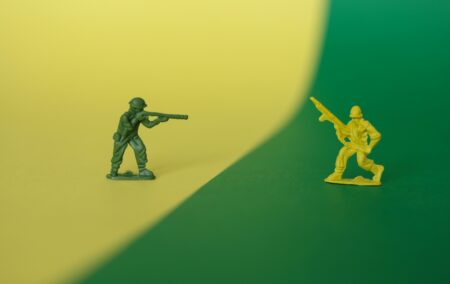
There is growing talk of a civil war in many Western countries.
David Betz, the Professor of War in the Modern World at King’s College, London, has warned that the “retribalisation” of these societies might result in civil war. “Civil war is likely to dominate the military and strategic affairs of the West in the coming years,” he writes.
Security and intelligence chiefs, some politicians, and commentators are also worried about civil disturbances and war.
One of the most powerful causes of civil wars is the perception of ‘downgrading” of a former majority,” Betz argues.
Much of the white working class and some in the middle class across the West feel that their culture and countries are under threat. In the US, much of the Mid-West has been under deep strain for years, as evidenced by high suicide rates and an epidemic of addiction to the painkiller, OxyContin. The working class in much of Europe harbours similar sentiments.
At the same time, immigrants feel degraded by the rise of the right. And the social and political activist class, many of them “over credentialed” but without decent paying jobs, feel a deep outrage at the lurch to the right.
The big division is over immigration, but there are also battle lines over Gaza, climate change, President Donald Trump and the European right, which is fast gaining support in the UK, France and Germany, adding to tensions.
All these rival factions share deep frustration at the political process, which is generally failing to deliver satisfactory outcomes for anyone. The resulting anger and outrage are likely to be easily manipulated and provide tinder for possibly violent confrontations, as populists on all sides feed their supporters with rhetoric and calls to action. This makes for dangerous times.
And we at the tip of Africa are unlikely to be immune to any chaos in the West. Similar conditions are present right here: strong anti-immigrant sentiment, economic crisis, and an incapable and distrusted government. My colleague Terence Corrigan pointed out earlier this week that we are certainly not immune to a descent into pathological politics.
In Europe much of the blame for the polarisation of societies has been attributed to badly mismanaged “multiculturalism.”
Distinct identities
Multiculturalism is the idea that different cultures and ethnic groups can live in a single society while being allowed to retain distinct identities. Some on the left scream that it is racist to question this claim, but there is the widespread fear that “multiculturalism” has allowed some immigrant groups to refuse integration into the host society, paving the way for conflict.
David Starkey, a conservative British historian blames successive UK governments’ mishandling of “multiculturalism” for what he calls “frozen civil war.”
The concern, not only on the right, is that many Muslim immigrants are no longer seeking to become part of wider society.
The warning has also come from moderates. Former German Chancellor Angela Merkel has said that multiculturalism has failed. And British Prime Minister Sir Keir Starmer recently said that the UK risks becoming “an island of strangers.”
The sentiment is echoed by former German intelligence head, Hans-Georg Maaßen, who believes that failure to integrate risks “civil war-like conditions.” Across Europe, disgruntled voters echo this, often claiming that their societies and resources are being overwhelmed. In the UK, the right has been fed by working class resentment of official neglect, and the perception that illegal migrants are given undue benefits.
Here in Johannesburg, Operation Dudula has in recent weeks been demanding SA identity documents from people queuing at clinics for medical treatment. There is a deep rage about immigration right here.
The battle of ideas and now increasingly street confrontations have caused a breakdown in civility and reasoned debate about these issues. Opposing camps regard each other as evil, and cannot see any common ground.
Deep mistrust
And then there is the deep distrust of official elites using underhand means to get what they want. In the US, the right complained about the Biden administration’s alleged suppression of free speech. In Germany, there are calls for the government to ban Alternative for Germany (AfD), the right-wing anti-immigration party.
There are already frequent clashes with the police across Europe, and anti-migration marchers are increasingly facing off with pro-Palestinian demonstrators on the streets of capitals. Betz fears that “anti-status-quo groups” might soon adopt “strategies of attack based on systems disruption of vulnerable critical infrastructure.”
With the tensions over the killing of Charlie Kirk and the “Unite the Kingdom” march, which brought an estimated 150,000 largely anti-immigration protesters to the streets of London last month, Betz’s warnings are attracting increasing attention.
For Betz, “the conditions which scholars consider to be indicative of incipient civil war are present widely in Western states.” He believes the chance of civil war occurring in one of ten high-risk European countries in the next five years is 87 percent.
Predicting such probabilities gives problems, as most countries suffer from precursors to a varying extent. Nevertheless, the message that such wars are increasingly likely in the current climate is credible.
Most wars are civil wars. They tend to last about six years, and are very bloody. Betz is not clear on what form this sort of war might take in the West, but expects large no-go areas for the police in major cities, attacks on buildings of cultural importance, the displacement of people, a large number of casualties, and possible foreign intervention.
The war talk is a warning from Betz that governments and their security establishments had best be prepared for what is generally not anticipated. There is a risk of attacks from lone-wolf gunmen with political motives, and of mass protests turning violent. There are multiple possible sparks in such a tense environment.
Stirring with disinformation
On the sidelines, waiting and stirring with disinformation, are the Russians and the Chinese. A West being pulled apart is just what they want to see.
What Betz does not mention are the West’s strong institutions, though they are increasingly mistrusted. One of the questions in averting civil wars will be the extent to which elections, the media, the judicial system, and the professional security establishments are trusted. There is a lot to test them.
If civil war is an increasingly likely Western scenario, it could also be one for South Africa. We too are a badly managed multicultural society facing extreme economic distress and with crumbling infrastructure. Distrust of the state is high. There are already extreme levels of violence and a general sense of economic decline and division.
A big question for us and the West is whether moderate politics and centrist, largely liberal parties which uphold individual rights and a market economy can win the day. With these global headwinds, they will struggle against the extremes in the West, and in SA, the comrade populists.
[Image: Sahand Babali on Unsplash]
The views of the writer are not necessarily the views of the Daily Friend or the IRR.
If you like what you have just read, support the Daily Friend