

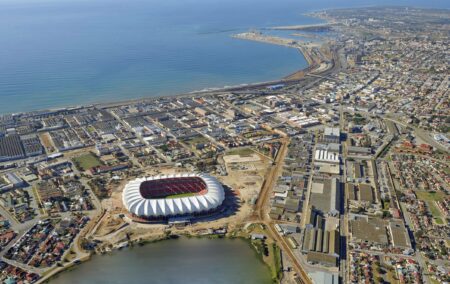
With local elections on the horizon in 2026 and the story mostly being about Johannesburg, I thought it would be good to highlight another metro in Nelson Mandela Bay that, if governed well, could become an incredible growth story for South Africa.
It is a relatively cheap (compared to Cape Town and Durban) city with a beautiful beachfront and a laid-back lifestyle on offer, but it has fallen foul of decay and disrepair because it has been governed so poorly for so long.
For one thing, it should be a main tourism spot with an upgraded airport that can serve as a gateway to different travel experiences ranging from the Addo Elephant Park to world-class surfing in Jeffrey’s Bay to affluent vacations and boating in St Francis, and even access to the historic town of Makhanda.
Even as I write this, I can imagine a reader may feel some cynicism, and that is understandable and even to be expected, because of the all the disrepair and municipal incompetence in the Eastern Cape (though Kouga which covers Jeffrey’s Bay and St Francis is a notable exception). However, this is really an article about potential.
At least from my vantage point, the main difference between the Eastern and Western Cape is indeed the governance of the two provinces and in a more granular sense the metros and small towns within each.
Both have a metro connected to a historic town with excellent schools and a historic university. Both have incredible coastlines with incredible beach towns and even historic inland towns. The tourism potential of Nelson Mandela Bay and the satellite towns around it is astronomical, if the metro is won outright by a competent party that can over time clean up the finances, the infrastructure and aesthetic of the metro itself, and also deal with crime effectively (which admittedly is a South Africa-wide problem).
Hidden gems like Tsitsikamma would be world-famous in a country and indeed a metro that was competently run and was dealing effectively with crime.
Perfectly poised
The other part of it is the potential for creating tens of thousands of low-skill, low-wage jobs within the metro. As Ann Bernstein of the Centre for Development and Enterprise argued in 2016 (which is still applicable today), Nelson Mandela Bay is perfectly poised for an export processing zone (EPZ):
“The kind of firms such an EPZ would target would be engaged in export-directed activities (mostly manufacturing — clothing, footwear and toys). They would, therefore, need to enjoy duty-free imports, and benefit from rapid customs and export clearance.
Their most important requirement would be for a more flexible set of rules governing employment, since it is our labour-market regime that helps price South African firms out of these markets. Subject only to national minimum standards governing health and safety, working conditions and plant safety, firms locating in the EPZ need to be free to negotiate employment conditions and wages with workers.
This would make it possible for them to engage in activities that absorb many unskilled workers by ensuring that the costs of employment were appropriate for the markets in which these firms competed.
In return for these exemptions, EPZ firms would be subject to two conditions to prevent unfair competition with other firms in the country. First, they would have to export everything they produced.
Second, there would have to be new investments. Firms would not be allowed to relocate factories from elsewhere to the EPZ.”
Flexible wage regime
Put another way, we know many South Africans are hungry for any kind of job, as evidenced by the fact that the Expanded Public Works Programme pays a wage of R15.83 per hour. This is well below the R28.79 per hour of most workers, and it cannot accommodate all the South Africans who want to work within the programme. The only people who would object to a flexible wage regime are the very people who are not in want of work and would not even want to work in the EPZ.
The metro could also buttress the auto industry by forgoing taxes on any car that could be produced and sold for under R125,000 (as a working number) provided that the automakers who do make these cars, like Malaysian automaker Perodua, produce them in Gqeberha. This would avoid their clashing with the established automakers but would also make cheaper new cars available to many more South Africans and the emerging middle class on the rest of the continent.
Another potential area for growth would be in Business Process Outsourcing, where South Africa could outcompete hubs like the Philippines, and in Nelson Mandela Bay specifically the lower cost of doing business and the lower cost of living for potential employees is attractive.
On the point of quality of life, the other night I was looking through a property website and found entry-level properties ranging from R300,000 in Richmond Hill to R500,000 in seaside suburb Humewood. The potential for young people to be on the property ladder in the metro who are white-collar or well-paid blue-collar workers or entrepreneurs is enormous considering the cost challenges in the Western Cape.
There is even a sweet spot for first time homebuyers who earn between R10,000 and R20,000 a month to get help through the Finance Linked Individual Subsidy. For example, a first-time homebuyer earning R15,000 a month qualifies for an R85,000 downpayment, which banks would look on very favourably, especially with affordable property.
Nelson Mandela Bay would have the potential to attract young South Africans who are remote workers too, who could get affordable property and a relaxed seaside lifestyle with access to nature, world-class surfing and stunning weekend getaways nearby.
The potential for Nelson Mandela Bay to become an economic powerhouse is astronomical. We can only hope the pollsters are right, that the ANC is dying and that a possible new dawn of governmental competence and technocracy can be born.
[Image: By Ngrund – Panoramio, CC BY 2.0, https://commons.wikimedia.org/w/index.php?curid=8707950]
The views of the writer are not necessarily the views of the Daily Friend or the IRR.
If you like what you have just read, support the Daily Friend