

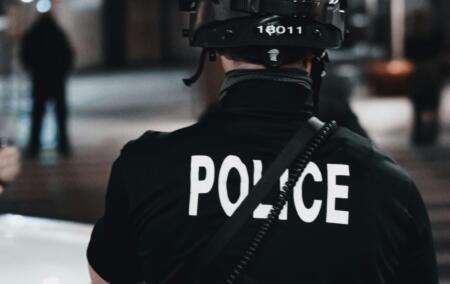
The recent controversy around the killing of Renee Good in the United States by Immigration and Customs Enforcement (ICE) employees – a complex situation in itself – has once more revealed the unfortunate simplicity with which conservatives and the broader right, many South Africans among them, approach the question of obeying the police.
Few things should terrify us as much as the police being an institution where everything is clothed with what is effectively absolute situational authority. The ways in which this reified institution can be abused are rarely appreciated, particularly by the right.
It should therefore not be surprising that simply being “pro-police” as a kneejerk response does not serve either the conservative agenda of protecting communities, nor does it serve freedom.
Renee Good and universal principles
The particular details surrounding the shooting of Renee Good are relevant to the hopefully independent inquiry that will follow, but there are various general principles that we need to both establish, and avoid establishing, for dealings with the police.
The right currently finds it easy to defend the ICE employees involved in the shooting because they happen to be enforcing something that the right supports: raiding places where illegal immigrants are supposedly present. The discourse would be very different if these were employees of the Bureau of Alcohol, Tobacco, Firearms, and Explosives (ATF) during the Obama administration attempting to confiscate guns.
This is an understandable response among those (arguably a majority) who are content with politics being a constant game of unrestrained exercises of power.
Unlike in the international realm, where the notion of constitutionalism (the legal limitation of state power) has never vested – inaptly so-called “international law” notwithstanding – the idea that the state and its enforcers are in fact subject to law is today firmly established in virtually all domestic contexts. It does not matter so much what the law in a specific jurisdiction provides, but rather that, simply, the police are meant at least in theory to be an institution limited by factors outside of raw power.
Another difference from the international realm is that, when the “international police” – whether you believe this is the long arm of the United States, or some multilateral force – propose to enforce what passes for “international law”, the target of their enforcement is naturally expected to defend itself. Domestically, on the other hand, defending oneself against police action – even if one is ultimately an innocent victim – is widely believed to be ipso facto invalid.
This is to say that my previous ruminations on the Wild West of international politics and its “lesser evils” are not 1:1 applicable in a domestic policing context.
To determine whether the Renee Good situation offers us a general lesson of “always obey the police”, we need to determine whether this is a universal principle. If it is not true that the people of South Africa and Iran “always” have to obey the police, for instance, then it is also not true in the United States, and if this is the case, then the general lesson might instead be that one must “obey the police” only when certain conditions are met (as opposed to “always”).
Why should THIS be obeyed in the West?
As a start, let us remain in the American context.
In August 2023, Annika Olson, an American woman in Florida, was arrested for “refusing to comply and resisting an officer without violence”. The police claim that Olson obstructed them in their duties and created a safety hazard in the road as a result.
One might ask why she failed to obey, and what the reason was for the officer giving her instructions, and these are fair questions, but it does not change the facts of the matter (divorced from the forms we give it): Olson’s “crime”, for which she presumably now has a criminal record, was to refuse to do what armed men in costumes commanded her to do.
As it turns out, Olson witnessed the Lee County Sheriff’s Office seizing the goods of a vendor on the side of the road.
The vendor, Norma Garcia, was also arrested under a county ordinance, for “illegally selling merchandise” – the loot being flowers. Apparently, the police had already been “investigating” Garcia for this serious crime against the administrative state, having even “warned” her before.
Outraged by this, Olson attempted to hand Garcia US$20 against the police’s instructions, and was arrested as a result.
Let’s stay with the dog-eat-dog criminal underground that is the black market in flowers.
A year after the Florida incident, in April 2024, a 13-year-old boy was arrested outside a Walmart in Summerville, South Carolina. The boy’s crime, of course, was again “refusing to comply” with instructions from people dressed slightly differently from the general public. He even “cursed” the police, and “resisted” and punched one of them when they (presumably physically) tried to detain him.
The boy’s crime, alongside an associate, was “selling [roses] near the [Walmart] entrance [without] a business licence”.
With a hop and a skip over the pond, we find ourselves in Brussels, Belgium, also in April 2024, where my philosophical opponents in the national conservatism movement booked a private venue in the city for one of their yearly conferences.
Imagine their surprise when Brussels’ finest arrived to shut down the event. Their crime, naturally, was that the event somehow threatened “public security” and, in the view of the local mayor, “the far right is not welcome” in his city. The police blocked paid delegates from entering without a “permit”.
Popping slightly north, on 1 September 2025, a comedian, Graham Linehan, was arrested by five armed British police at Heathrow Airport for “inciting violence” on X (Twitter). He had to be hospitalised shortly thereafter.
The first post on X that supposedly caused the thin blue line to come for Linehan concerned his saying (remember, he is a comedian) that biological males in designated biological female-only spaces should be strongly encouraged to leave, failing which they should be punched in the organ that identifies them as biologically male. The second post involved him commenting on a photo of an urban protest and remarking that “you can smell” the photo. The final post, supposedly, had him saying he “hates” misogynists and homophobes.
Before turning to South Africa, it is important to remark that each of these arrests can be traced back to partisan diktat.
Many people will object to referring to police as “armed men in costumes”.
This objection can only come back to the idealistic notion that the police protect ordinary people from violence. They run towards the danger, putting their own lives on the line for the rest of us.
Now ask: is that what the police were doing in the cases of Annika Olson, the 13-year-old boy, the conservative conference, and Graham Linehan?
Is this – running towards danger to protect us – even what the police do primarily anymore?
If this fantasy of what the police did were true, I would have a similar, lofty admiration for them.
But we do not live in that fantasy. The police are “law enforcers”, not “order enforcers” or “safety enforcers”.
We live in a reality where the police are automatons who are legally expected to employ the violence of the state against anyone deemed by a small band of politicians to be acting “illegally”. Whatever “the law” (read: the politicians) says, the police will uncritically use violence to ensure compliance with it.
It is only because some county boards in Florida and South Carolina got together, decided that selling flowers by the roadside or without a “business licence” went against their preferences, and wrote a county ordinance that codified that preference, that armed police created a violent confrontation with otherwise peaceful people.
It is only because some law or bylaw in Belgium gives local governments authority to regulate private events in the name of “public security” that a peaceful conference could be broken up for ideological reasons.
And it is only because a bunch of politicians in the United Kingdom have decided to criminalise words considered hurtful that armed thugs could violently attack a comedian for things he posted online.
This is the thin blue line in the West.
South Africa’s shocking examples
Let us now turn to South Africa, where the situation is significantly worse.
On 20 April 2021, it was reported that armed men posing as police kidnapped a traditional leader in iZingolweni.
On 30 April 2021, it was reported that a robbery had taken place the previous week in Benoni, and that a Tshwane Metro Police Department employee was implicated.
On 1 May 2021, it was reported that a couple had been hijacked and kidnapped in the east of Pretoria by men posing as police with blue lights on their vehicle. The victims were forced to transfer a large amount of money to the kidnappers.
In a report from 3 May 2021, Pretoria FM alleged that in the east of Pretoria, Tshwane Metro Police Department officers had for months by that time been targeting motorists for bribes at night. It is unclear whether this has been stopped.
When motorists were pulled over or stopped at roadblocks, they would be tested with faulty or fake breathalyser equipment that created the impression that they were under the influence of alcohol. This then gave the police a pretext to threaten arrest, which eventually culminated in bribes.
In the comments on this report, a woman alleged that she and her husband were stopped at a roadblock when she was in a very late stage of pregnancy. The police threatened to lock up her husband, who was sober, and hit her cell phone out of her hand with a torchlight. Their two-year-old daughter was in the car with them. The woman had to get psychological counselling thereafter and remained understandably frightened whenever she approached a roadblock.
Various others reported similar events.
In a 5 May 2021 Rekord report (for which I have lost the link), it was alleged that a woman who had gone to the police station to report an attempted hijacking was herself instead assaulted, arrested, and jailed, for apparently being publicly inebriated. When the officers at first refused to assist her in the crime report, she attempted to record them (a veritable capital offence), whereupon her phone was grabbed and damaged. They then said she was drunk, without having performed a breathalyser test, and arrested her.
These are not rare or exceptional stories. They are all from a spot-check of less than one month in 2021. There are dozens of stories like this every week.
In a now infamous case from July 2022, our heroes in blue physically accosted Ian Cameron (ironically now Chairperson of the Portfolio Committee on Police) when he attempted to speak to then police minister Bheki Cele at a community meeting.
Why, one wonders, were the police involved at all? Many opinionistas need constant reminding that the police minister is not a senior police officer, but a civilian whose profession happens to be “politician”. He has no authority over the police, and yet, in a confrontation between a taxpaying citizen and a fat-cat imbecile, the police’s kneejerk reaction was to remove Cameron, not Cele, from the venue, for the latter’s misconduct.
In April 2024, members of the Special Task Force (the supposed crème de la crème of South Africa’s police) were filmed brutally kicking and assaulting unarmed people outside a home on the East Rand. One of their victims was filmed having surrendered, knelt down, and put his hands in the air, only to be kicked below the belt by South Africa’s finest.
We have been reading and hearing about, and experiencing, either abusive or corrupt police conduct, or criminal conduct by people posing as police – whom we nonetheless need to cooperate with, given nothing other than their police-like appearance – for years. Even if none of these reports have yet been verified in court, it would be odd indeed if there were a vast conspiracy afoot by ordinary South Africans to randomly lie about and slander the police.
The most recent notable story was by Daily Maverick, reporting on the testimony of Dumisani Khumalo, Head of Crime Intelligence at the South African Police Service (SAPS), in front of a parliamentary committee. Dumisani alleges that “nearly all [SAPS] officers in Gauteng are working for a criminal cartel”.
No more need be said on this score, but I wish to conclude this portion with the story of Dania Human.
In a shocking post initially shared on Facebook – since covered by the press – Human (not “Jordaan”) explains that she and her fiancé, Barend, were attacked by a convoy of vehicles with armed assailants inside. They evaded the convoy, which pursued them and tried to force them off the road, all the way to the White River police station.
The couple ran inside, begging the police for help, only for the group of armed attackers to follow them inside the building. There, the attackers threatened to kill the couple, pursuing them into restricted areas of the station while the police themselves stood aside. Barend recorded much of this, despite police demands to hand over his phone.
Dania and Barend desperately reached out to their friends, lawyers, and security company for assistance – while supposedly in a “safe space”.
Finally, a friend arrived alongside the real cavalry – the private security firm Divergent Ops – who witnessed, alongside SAPS, the attackers beating Barend up and smashing his property.
Eventually, the attackers left, with the police cordially seeing them off. Naturally, the police did not entertain Dania and Barend opening a case.
Our boys in blue. The thin blue line. The men and women who run towards the danger. Our heroes.
The victims in this horrendous event were in the advantageous position of having access to private security firms, attorneys, and a support network that came to their aid.
What about the thousands of South Africans who likely experience this same kind of whimsical behaviour by the police on a daily basis, without any recourse? For them, little has changed since the supposed end of arbitrary rule in 1994.
What, in a situation like this, is someone supposed to do?
Hundreds of Facebook commentators have said: lodge a complaint with the Independent Police Investigative Directorate (IPID), with the provincial and national police commissioners, go to court, and so on.
But IPID is a state institution closely associated with the police, and the police commissioners are part of the SAPS, and the courts depend entirely on enforcement of their orders by the very same police.
At the end of the day, any and all of these supposed “remedies” come down to asking the police (who seem to largely be working for a criminal cartel) to investigate and punish themselves.
Circling back to Renee Good
It is simply not true that people should always just do whatever so-called “police” tell them to. Sometimes, and sometimes often, it is the right thing to do to not merely disobey, but actively resist and undermine the police and those who pose as the police.
At no point should there ever have been a reason for the ICE employees to fear for their lives.
They should not have been congregating around Good – clearly an activist seeking confrontation – and the shooter certainly had no business, as an immigration enforcement officer, not a traffic enforcer – walking around a car in the middle of the road.
Good was moving her vehicle around for several seconds before the shooting. Why did the ICE employees not place themselves well out of the way?
The macho-cop “I must always get my way” mentality is horrifically dangerous, not only to the victims of police brutality, but to the police themselves who place themselves in an antagonistic relationship with the public.
Sometimes, yes, the police should just let people who have not deprived anyone else of their liberty or property drive off. Yes, even if that means the people “failed to comply” with the police (oh, the horror!).
Renee Good could then have been arrested in an orderly fashion at her home, later, rather than being carried away in a body-bag. It is only because ICE sought to get their way in the moment – as they and other cops are unfortunately trained to do – that someone is dead, and an ICE employee was injured.
Adversarial interactions
How did we arrive in a situation where in any interaction between a taxpayer and a police officer, it is the comfort and disposition of the police officer that must take priority? The moment a cop feels uncomfortable, the situation morphs from a mere adversarial interaction into a situation of lethal danger to the taxpayer.
It has come to a point where lawyers and watchdogs – in the United States, South Africa, and elsewhere – advise taxpayers to not confront the police, not make any sudden movements, not raise their voices, and so on.
Police officers are theoretically trained to keep their composure and – given the amount of firepower they possess – to err heavily on the side of not overreacting. The taxpayer has none of this training. They can be crude, make wild bodily motions, manoeuvre their car in a way that seems threatening, and do many other things besides that the police need to expect and not be debilitatingly scared of.
We all interact with each other every day without fearing for our lives – why do the police approach every interaction as a dangerous-by-default one? If they are apprehending murderers or rapists, it is of course a different story, but the police’s essential behaviour in this regard remains the same when they pull over people who ostensibly broke traffic laws, when they enforce immigration law, and even when they inspect business licences.
This, of course, simply cannot be right.
An interaction with the police – including and especially an adversarial interaction when they are enforcing essentially arbitrary political preferences on non-consenters – should never hold the possibility of being a death sentence. Naturally, as in any other interaction with anyone else, the exception to this rule is when one threatens or undertakes tangible harm.
“Bad apples”
It is no longer sufficient to say that cops who overreact or engage in corruption are “bad apples” who represent a minority, and that the vast majority of cops are hard-working peace officers who simply wish to protect and serve the people.
This is an undoubtable fact – but it is a useless fact. The “bad apples” – and, in practice, those who merely pose as police – are clothed with the exact same absolute situational authority, to expect unquestioned obedience, that good cops are clothed with.
Telling yourself most police are good, as your pregnant wife is manhandled by uniformed thugs – whether posers or real cops – does nothing to help her or the many other untold victims of similar conduct.
We are supposed to be in a situation where there is unparalleled trust in the police. The police are supposed to be ‘of the people and for the people’. Instead, at best, the police are for themselves – whether in the sense of corruption, or prioritising their own safety over that of the public – and at worst, for a small political elite and their supposed “laws”.
We must not, we dare not, uncritically “back our boys in blue”. Much else needs to happen first.
What to do?
The philosophy of liberty often provides common-sense answers to some of society’s most pressing issues. This is not one of them. The precise solution to this problem – of what to do when the police become the enemy of the people – is difficult to discern.
“Do not confront or be confrontational with the police” is not a solution. The security officers of Divergent Ops were right to confront the police and help Dania Human. The people of Iran are right to confront the men who should be protecting them, not killing them on behalf of the regime.
The exact contours of a solution – this is where conservatives and the right need to start paying attention – unclear as they are, must always at least to some degree come back to generating alternative sources of real power outside of the state, in our own communities and private institutions, fully (fire)armed.
This must include a positive agenda for the decentralisation of state power.
Every neighbourhood, municipality, and province must – and I submit, does – have the power to establish its own safety structures within its available resources. The doctrine of the lesser magistrate, further, allows any civil authority (whether a lower tier of state, an authoritative institution like the church, family, and so forth) to interpose when higher tiers of authority conduct themselves in an abusive, corrupt, and tyrannical fashion.
Ultimately, where the police act outside of their only real mandate (to protect life, liberty, and property, as opposed to pursuing their own interests or enforcing some political diktat), little recourse exists other than private defence.
Being subordinate to the law does not mean rights-bearing taxpayers must allow themselves to be battered by thugs in costumes. In situations where the police are conducting themselves unlawfully, there should be an allowance – in the civic mind of society – for them to be opposed with superior force. The common law recognises this. But more importantly, the law tells us: necessity knows no law.
There are easier avenues. But these, too, conservatives and the right tend to shun. When activists began sharing ICE employees’ personal information online, a firestorm of reaction erupted. Yes, the right happens to support ICE in this ad hoc context, but the real question is this:
Should the British police officers who arrested Graham Linehan, or routinely knock on doors to harass people for social media posts, be socially shunned by their communities?
Yes, of course. But that requires society knowing who they are and where they do their shopping.
These are not private citizens, but public appendages of the coercive state.
This is an incredibly difficult situation with no good, and certainly no pleasing, answers. Defending yourself against undue police violence has the potential to significantly exacerbate the situation, but allowing yourself or your loved ones to be beaten or killed until you can go through the “process” later also cannot be the answer. Social ostracism must be an available avenue, but this remedy is similarly dismissed.
What, then, is the conservative and right-wing proposal? To always obey?
Even when federal authorities in the United States under a Democratic administration try to disarm the populace? Even when SAPS in South Africa helps to implement the Expropriation Act and put owners off their property? Even when the SS in Germany or Stalin’s secret police dragged people kicking and screaming to concentration camps and gulags? What about the recent stolen election in Uganda, where the police stand guard as the head of the military calls for opposition leaders to be killed?
What is the limiting principle?
For liberals, the limiting principle is that the police must be obeyed when they are protecting life, liberty, and property. Then, and only then. Under all other circumstances, they are merely armed thugs cosplaying with badged costumes. This theory, while neat and correct, does not make practical application any easier.
Whatever the case, this age-old question needs to be answered eventually.
[Image: LOGAN WEAVER | @LGNWVR on Unsplash]
The views of the writer are not necessarily the views of the Daily Friend or the IRR.
If you like what you have just read, support the Daily Friend