

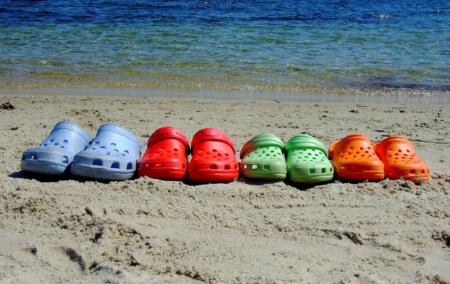
The remarkable story of Crocs is one of paradoxes. It’s about ugly shoes becoming fashion statements, a source of division amongst podiatrists, and how the free market becomes simple because of its complexity.
Since its launch as a slip-resistant boat shoe in 2002, around 800 million pairs of the plastic clogs have been sold in 19 types and 30 colours. Comfortable and convenient, my first pair was a Classic Beige. The fact that it was quite ghastly to look at was an additional attraction. An early slogan was: “Ugly can be beautiful,’ a delightful contradiction, which made the shoe irresistible to many. The shoes were iconoclastic, ridiculous and a slap in the face of the fashion industry. They were considered the choice of restaurant workers, medical professionals, and people who spend the whole day on their feet. Named after the strength and durability of its animal counterpart, Crocs has survived many ups and downs, but is now a stronger brand than ever.
I love my Crocs. My affinity had an existential crisis recently when I fell shortly after a hip replacement. I was on my way out to take the dog for a walk when the hound ran under my feet. I lost my balance and, like someone slipping on a banana peel in a cartoon, I took a hard landing. It was an unfortunate arrangement of events and objects, comprising a Jack Russell, a loose mat and a tile floor. When I sent a photo of the crime scene to a physio, she was aghast. “You wore Crocs? How many times do I have to tell you people; these shoes are death traps!” There was zero sympathy for me, and the dog got off scot-free.
Hang on, not only are these shoes not slip-resistant, but they are also dangerous? That is a bit of a stretch, isn’t it? Depends on who you ask, apparently. In some parts of the US, Crocs are banned or prohibited in hospitals due to safety concerns. In South Africa, the rubber foam shoes are popular amongst health workers. I wore my Crocs while consulting with my orthopaedic surgeon and during my hospital stay, comparing Jibbitz collections with the nurse assisting me. It is not unusual to see an octogenarian shuffling along the shiny floors with their walker, wearing Crocs, with the physio accompanying them in their own complementary shade of pink.
Part of Crocs’ brand identity was an original recommendation from a podiatrist expounding the virtue of shoes with a roomier toe box and ventilation holes. It was a main marketing hook. It certainly feels like freedom when you wear them. Furthermore, the clogs offer high levels of cushioning and shock absorption. But some podiatrists caution against the lack of arch and heel support. The wide, loose fit may allow feet to move or slide around inside, increasing the risk of tripping and falling, particularly for the elderly or those with mobility challenges, they say. Wait, what?
Shoes are big business, and with a sharp focus on longevity and fitness, even sneakers and takkies are becoming status symbols, where qualities like toe space, shoe depth and golden ratios become part of an elaborate trade in perception and profit margins. Currently, minimalist shoes and ‘barefoot shoes’ are being sold alongside elaborate constructions, each healthier for your feet, pocket or ego in some way. They all co-exist on our shelves, with Crocs carving out their own special place on the health, safety, and couture spectrum.
Crocs’s design has remained the same throughout the years, while adapting to global economic crashes, pandemics, and shifting market needs. By adding special ranges from time to time, the brand consistently broadens its appeal while holding itself accountable to core principles. The shoe has stepped from its humble working-class origins to the exalted echelons of high fashion. Crocs recently joined Saint Laurent, Prada, Bottega Veneta, Lowe and Miu Miu as part of the top ten most coveted luxury products in the Lyst Index. Hollywood icons wear these shoes, sometimes combined with mullets, in what some have described as a gentrification of the working classes’ style-guide to show that you are ‘real’. Again, an absurdity that keeps Crocs relevant, over and over again.
Love Crocs or hate them, they are masters of adaptability and survival, showing us, how free market forces do not necessarily result in the best solutions or optimal centralised designs, but rather emergent manifestations of countless interactions, price signaling, and earning incentives. In the space of 20 years, a product might be popular in one part of the world but fail in another. The rich might adopt the tastes of the poor, or the other way around. Somehow, people get what they want. Suppliers see opportunities not only to sell customers what they want, but suggest to them that they should want. It’s simple, really – leave this intractably complicated system to operate as unhindered as possible. This is the magic of markets – let it run freely, or in my case, jog cautiously or walk.
I am very grateful that I didn’t sustain serious damage after my fall, a challenge to my dignity being the most bruising. I retain my allegiance to Crocs, and (not but) I have switched to more structured shoes when walking for longer distances. I also like walking barefoot and have added backwards walking to my repertoire; it is good for the knees and hips, according to my physio. Bonkie, my faithful canine companion, cares not whether I walk forwards or backwards, wear shoes or not. She just loves it that we are walking more often.
[Vivienne Vermaak is an award-winning journalist and public speaker. info@vivienne.co.za]
[Image: https://www.flickr.com/photos/zuccsim/1355912205]
The views of the writer are not necessarily the views of the Daily Friend or the IRR.
If you like what you have just read, support the Daily Friend