

One of the most persistent analytical mistakes in South African politics is the failure to distinguish between noise and public opinion.
The two are repeatedly conflated, even though they behave very differently. In writing my book about the 2024 election campaign, I saw up close in the data that while media of all forms are a key component of understanding moving political trends, the relevance of such is far less in the volume than in the patterns of behaviour over time and adjusted to control for the relative importance of each party’s realistic media footprint.
If social media were a pure, unweighted indicator of public opinion, the EFF would be a greater player than the sub-10% party it has become. And the IFP wouldn’t even exist. It is therefore important to appreciate that media noise and currents have a place in analysing trends and currents in public opinion, yet the risk is ever present that noise gets mistaken for true public opinion.
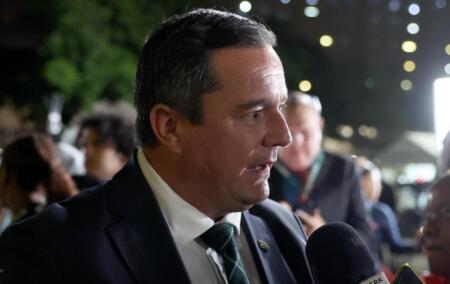
Noise is immediate, emotional, and performative. Public opinion is slow, cumulative, and revealed over time through voting behaviour and durable attitudes. Mistaking one for the other produces confident commentary that often collapses when confronted with evidence. The reaction to John Steenhuisen’s announcement this week that he will not seek re-election as leader of the DA at the party’s federal congress in April illustrates this problem with clarity.
Within hours of the announcement, building on weeks of speculation and proclamations, a verdict had formed across parts of the media and on social platforms. Steenhuisen was cast as a vote loser, a PR liability, and a drag on the DA’s brand in the buildup to crucial local government elections.
Some claimed that parties like the Freedom Front Plus (FF+) are effectively recruiting members by the hundreds on the back of Steenhuisen’s political toxicity. His decision not to stand again for his party’s leadership was immediately read less as a leadership transition at a time of political pressure and a weighing up of timing, ego, and risk, than as a confession of utter failure from a party in total crisis. The confidence of these claims was striking, not least because they rested almost entirely on noise rather than on evidence.
Yet when one steps away from the commentary cycle and the addictiveness of influencer algorithms and cheap shots, and one looks at the indicators that actually matter in democratic politics, a very different picture, more likely in tune with reality, emerges.
One should start with votes cast rather than opinions about opinions. Over the past year, despite claims of calamity and peril, the DA has, as per the excellent analysis by Dawie Boonzaaier of Rapport, gained support in more by-elections than it has lost. By-elections are of course not perfect predictors of national outcomes, but taken cumulatively they offer a reliable signal of whether a party is bleeding, stagnating or consolidating. They reflect real voter behaviour under competitive conditions. On that measure, the DA does not resemble the caricature of a party in chaos.
Steenhuisen himself pointed to a further inconvenience, at least to his detractors, in his announcement. He took over leadership of a party polling at around 16% in 2019, yet steps aside from the leadership in 2026 with the party polling at 30%. In a fragmented, volatile political system marked by deep distrust of political institutions, nearly doubling a party’s support is hardly evidence of failure. It is evidence of a party with confidence in its base, consolidation in its position, and consideration from previously unconvinced voters.
Internal DA polling as recently as this week shows a tight national contest with the ANC for the position of largest party. Internal numbers should always be treated with appropriate caveats, yet what gives them weight in this case is that they are reinforced rather than contradicted by independent data. The latest polling by the Social Research Foundation (SRF) places the DA on 32% and the ANC on 37% nationally. As the SRF in 2024 came within 1,5% of accurately projecting the final election outcome, these numbers can be taken seriously. The narrow gap between the ANC and the DA in the latter’s own numbers is not remotely consistent with claims of a DA under Steenhuisen in distress.
More revealing still is what lies beneath the topline figures in other parts of the SRF data. On virtually every substantive measure of governing credibility, the DA now leads. 37% of registered voters rate the DA as the best party at service delivery, compared to the ANC’s 16%. On clean government, the DA leads with 35%, while “none of the above” comes second on 15%, a stark indictment of the governing party’s credibility, others not even in contention. On working best in coalitions, a defining skill in the post-majoritarian era initiated by the 2024 elections, the DA stands at 31% to the ANC’s 16%.
The same pattern that exposes the noise-based and shrill critiques of the DA during Steenhuisen’s tenure appears consistently. On good policies, the DA leads the ANC 30% to 18%. On providing good leadership, 31% to 15%. On accountability, 28% to 18%. These are not cosmetic advantages driven by superficial messaging cycles. Instead, they speak to a level of competence, trust, and perceived governing capacity and attributes that shift public opinion slowly but decisively.
Even Steenhuisen’s personal standing complicates the noisy caricature his critics have loudly proclaimed. His net approval rating has improved to -1, now better than that of President Cyril Ramaphosa, who sits on -4. In absolute terms, these numbers reflect widespread political distrust, and ought in and of themselves not be considered reason for celebration, yet in the relative terms of comparative and competitive politics, they indicate improvement rather than decline.
It is important to point out that the DA isn’t without its polling problems. On the issue of which party voters most strongly associate with racism, the DA also gains the rather less than flattering top spot, earning 34% to the EFF’s 24% and the ANC’s 13%. Those who might dismiss the SRF’s numbers merely as pro-DA run into the reality of this deeply worrying finding as well as the SRF’s credibility gained from 2024’s election projection. It is therefore wise to take seriously these SRF numbers showing a DA facing a stubborn hurdle of racial perception, yet significant acknowledgement of the party’s other electoral strengths near the end of the Steenhuisen era.
So why does the dominant narrative of a DA doomed by the leadership of John Steenhuisen diverge so sharply from the evidence of a party in a seemingly decent state in terms of its pursuit of public support?
Part of the answer lies in how political noise is produced. Media ecosystems reward immediacy, certainty, and absolute moral clarity. Social media amplifies intensity while muddying representativeness unless appropriately screened and contextualised as I tried to do in writing about the 2024 campaign. Elite commentary frequently reflects the preoccupations of journalists, activists, and party insiders rather than those of ordinary voters. As perfectly illustrated by the breathless coverage of the flouncing resignation of Dion George, tone, symbolism, and internal drama are overweighted while the true markers of public opinion on politics, such as delivery, effort, competence, and comparative performance are underweighted.
There is also a deeper structural issue. The DA occupies an awkward position in South African politics. It is neither the dominant party nor a radical insurgent. Its gains are incremental, procedural, and often institutional: coalition management, service delivery records, policy credibility. These do not generate outrage or exhilaration, and so they struggle to compete with more myopic narratives of crisis or collapse.
But voters do not experience politics as a stream of hot takes. They experience it through whether services work, whether coalitions hold, whether leaders appear more or less competent over time, and, particularly in the post-2024 context of the GNU, whether parties are in government for the right reasons. These judgements accumulate quietly, and they are reflected in polling trends and by-election results long before they are acknowledged in commentary.
None of this is to suggest that the DA is guaranteed victory, or that Steenhuisen’s leadership was beyond criticism. Nor that Steenhuisen’s leadership might not have become a concern for the party. From engagements with representatives on the ground, it is clear that Steenhuisen’s handling of the current Foot-And-Mouth outbreak has grown as a cause for political concern with prominent interest groups taking issue with Steenhuisen’s ministerial handling of the crisis.
Especially in areas of significant Afrikaner votes, like Pretoria, DA officials have increasingly flagged the issue as one that comes up on the doorstep. It is likely that this matter would have crescendoed into a greater attack on the DA from particularly the FF+. It is further entirely arguable that a series of judgement errors by Steenhuisen forced him into abandoning a leadership contest he was on course to win. The point of this analysis is simply to note that the story of DA existential distress does not survive contact with the available evidence, indicating a likely over reliance on noise rather than true public opinion by some observers. Mistaking noise for public opinion leads not only to poor analysis but to persistent misreading of the electorate itself.
Noise is loud and always urgent. True public opinion, the sort that shifts electoral loyalties, is patient. And when one looks past the noise, the DA John Steenhuisen leaves behind appears less like a party in terminal trouble than one that has patiently, steadily, and often against expectation, positioned itself as a serious contender of national leadership as South Africans are once again on the cusp of asking to decide who ought to govern in South Africa.
[Image: https://www.flickr.com/photos/governmentza/54310974992/in/photolist-2isR6uL-2isR6to-2amQocK-2qKgWGy-2qKoC5s-2qKoC5C-2rDsNan-2qSLjsV-2rDsNah-2rDsvNo-2rDmKSv-2rDreax-2rDsq41-2qSQSoj-2qSS4xo-2qSS4xi-2rDsNbE-2rDreaH-2rDmKU9-2qSRMia-2rDmKUe-2rDmKTN-2qSSHCU-2rDsvR4-2qSS4yF]
If you like what you have just read, support the Daily Friend