

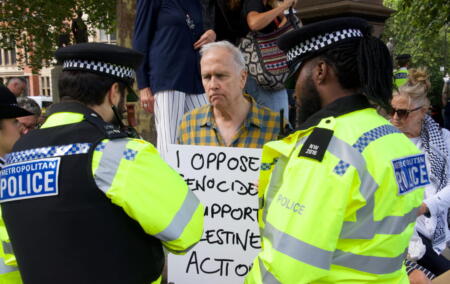
Toward the end of last year, something unusual started happening in London. At pro-Gaza marches, already a weekly fixture in the professional protester’s calendar, the Metropolitan police began arresting people, and not just any people, but specifically white, elderly, middle-class men and women.
Those arrested were confused, incandescent: “it’s not like we called someone a gay on the interwebs or anything”, they panicked, before describing, through a lattice, just how important slaughtering Jews was to defeating climate change. But the police’s behaviour was puzzling. At the time they were only sending armed response vehicles to things like catcalling. If an incident warranted urgent intervention with specialist firearms units, negotiators, helicopters and entire boroughs ordered to shelter-in-place, then it would probably have had to involve someone suspecting they may have been misgendered.
Invariably the protesters were not charged, but the experience of being dragged to the local nick and warned enraged them: “What’s wrong with celebrating the bravery of men willing to fly paragliders into a party then machine-gun innocent ravers in the back?”
The answers to questions like these actually began at the site of the Nova festival massacre itself, then squeezed themselves through a few impossible kinks and eventually arrived at the decision made in the UK parliament to proscribe the protester group *Palestine Action as a terrorist organization. It had invaded the UK’s largest airbase and vandalized two Airbus Voyagers, exhausting any remaining patience or embarrassing any enthusiasm, so the Home Secretary acted, and the boomers were collared at the next available opportunity.
But the real story goes deeper than that. October 7th had raised the temperature in London, a place that loves to boast to anyone who will listen about how multicultural it is – excepting, of course, for those people who wear yarmulkas. Whilst Jewish suburbs stepped up security, the attitude of elite Londoners – the lanyard or human rights law classes – was akin to a shrug – pivoting swiftly to fury the moment the Israelis decided to rescue hostages kidnapped during the terror attack.
Raging pensioners
By then, if you’d already been an expert on Covid, George Floyd and Ukraine, you were suddenly an expert on the Middle East – and Middle Eastern expertise spread through the country, scooping up – especially – expert boomers, so at the time of their arrest these raging pensioners were visibly unwell, possibly one or two spastic fits away from being victims of mass fungal poisoning, their eyes rolling around their heads, their bodies filled with a creepy energy inconsistent with people in the evening of their time.
In the immediate aftermath of the Roedean (posh tarts, but that’s just me) scandal, something similar arrived in Johannesburg. Predictably loss-making media sided with the stuck-up madams, publishing articles entitled “private conversations should stay private” – despite the school having been caught bang-to-rights courtesy of some brilliant reporting by The Common Sense. But adrift from any sense whatsoever was the same logic possessed by the middle-class English circulating through northern suburbs households: “Roedean was wrong to apologise” and “we stand on principles” and “we have values” and “my husband has grown very close to a handsome young man from the Lebanon and we all have principles and values”.
So antisemitism or anti-Jew hatred – whatever you wish to call it – got a little shot in the arm right at the time exiled Iranian scholars were still calculating just how many protesters had been butchered by the Ayatollah’s thugs at the start of the year – 7,000? 36,500? Up to 100,000? There wasn’t much talk about that in Johannesburg, to say nothing of the score in Sudan, which according to some analysts sits north of 500,000 in the last year alone. Al Jazeera, which isn’t so much media as it is the point where lots of money meets scheming, has described the events in Sudan – essentially Muslim man against Muslim man with the casualties being mostly black Africans – as a “true” genocide, betraying the scruffiness of their editorial policy.
The collective default
Central to Roedean’s position and the supportive responses sits the pending decision of genocide (or not) at the International Court of Justice (ICJ). Whenever a pressure vessel erupts, as was the case of Roedean and King David, this is the collective default. Here there are two schools of thought.
The first is that the case is home and dry, that the judges, with the exception of one Ugandan dissenter whose character has already been impugned in SA and UK media, will rule that Israel has committed genocide and the subsequent celebrations could warrant consideration of yet another public holiday – in South Africa. The other requires a sober reception as it aligns to the mechanics responsible for how things actually get done – in contrast to how they appear.
This thought considers what Israel is almost guaranteed to have at its disposal: the substantive weight of American jurisprudence, from Ivy League emeritus professors to the sharpest, sneakiest minds across the country’s most prestigious and storied white shoe firms – conditions, perhaps, offered to Benjamin Netanyahu as parties sought to locate a ceasefire.
The English claim to justice supremacy is wracked with unique circumstances – “de-colonialism” – and fraught with contradictions – “international law”. Explosions of tension notably that were revealed in the pro-Gaza marches are symptomatic of soul-searching. The country no longer knows what it is, or where it’s going – and this should be a private battle, akin to the rehabilitation of a porn addict. This explains why watching the expert boomers being hauled into pig wagons didn’t reveal as much sympathy as it did…awkwardness.
There’s nothing desirable about this condition, particularly when “values” or “principles” are so easily traded in today’s political environment. Much more effective is to get really mad about things that matter. Water is one idea.
*Palestine Action successfully appealed the UK government’s proscription. The UK government is now appealing the appeal.
[Image: By indigonolan – https://www.flickr.com/photos/200818277@N02/54771963090/, CC BY 4.0, https://commons.wikimedia.org/w/index.php?curid=175005417]
The views of the writer are not necessarily the views of the Daily Friend or the IRR.
If you like what you have just read, support the Daily Friend