

Allow me to butt into the conversation on whether racism is bad by offering a reason why it is always bad.
Garth Zietsman recently wrote a column entitled Why is racism bad? in which he gives some circumstances in which racism is self-evidently bad (for an undefined value of “bad”) or “stupid”, but that one should consider that there is always some element of truth to stereotypes; that if racist assumptions can help to avoid harmful interactions, then one could argue that racism in such a case is “good”; and that research ought to be conducted into the genetic determinants of behavioural traits such as violence.
Michael Morris, in a detailed response entitled Why is racism bad?, challenges Zietsman’s assumptions and value judgements, questions the validity of racial stereotypes, and points out that there is a vast wealth of scientific research available that proves, beyond reasonable doubt, that race has no clear biological definition and that if there are genetic markers that indicate a proclivity for harmful behaviour, then those markers cannot be found in race.
He gives some illuminating examples of why one might consider the white race to be prone to violence and oppression – the Nazis were notoriously white, and so were several South African farmers who were convicted of brutal murders of black people.
He concludes by rejecting the premise that not all racism is bad, and that the statistical validity of racial stereotypes ought to be studied, even if only to better address racial disadvantages.
It is dispiriting that we’re even having this discussion in 2026. I once thought it possible to put racism behind us; I never thought a day would come when it might not be self-evidently bad.
Since that was clearly a naïve hope, let me suggest that stereotypes are not only sometimes wrong, but are useless, whether deployed as a means of making private judgements, as an instrument of political analysis, and as a tool of public policy.
Prejudice
We often throw around words without really thinking what they mean. “Prejudice” is a term that describes the act of reaching conclusions based upon racial or other stereotypes.
That word contains within it the entire argument for why racism is always stupid, always bad, and never justifiable.
By pre-judging someone, we are making a value judgement about someone without having considered relevant information.
“Prejudice”, including racial prejudice, describes the irrational act of judging someone based on superficial appearance or characteristics that they cannot control, and that cannot predict their actions with any degree of confidence. It describes judging someone before having considered relevant factors such as their character, actions, qualifications, track record, or personal reputation.
That makes racial prejudice, in all cases, unjustifiable, and not merely because it could harm the person or dignity of the victim of racism. It is unjustifiable because it is not a rational means of discriminating between people.
Not only are racial stereotypes not statistically valid – having usually been formed without the benefit of statistical analysis – but since they tend to be exaggerated caricatures, they are almost always invalid.
Even when stereotypes are based on statistical data, however, they still do not form a legitimate, reliable and just basis for public policy, and cannot be recommended as a sound basis for private choices, either.
Whether a group forms a majority or a minority is likewise entirely irrelevant, and does not make a group-based analysis any more or less valid.
Individualism versus collectivism
The key fallacy underlying prejudice, whether racist or otherwise, is that of collectivism.
In classical liberal thought, as developed by thinkers such as John Locke, Immanuel Kant, Adam Smith, John Stuart Mill, Friedrich Hayek, Ludwig von Mises, Alexis de Tocqueville, Karl Popper, Isaiah Berlin and Milton Friedman (to limit the list to 10), the individual person is the primary bearer of rights, agency, and responsibility.
The rights asserted by a liberal constitution – property rights, the right to life, the right to free speech, the right to freedom of religion, the right to free association – are rights that attach to individuals.
Unless by conspiracy or collusion, no person is ever responsible for the actions of another, nor can any person take credit for the words or deeds of another. Nobody can obtain new and different rights from another merely by being classified into a category – such as a race, a common birthplace, sex or gender, ability or disability, belief or non-belief, etc. – to which they did not choose to belong.
Maggie Thatcher once said, controversially, that “there is no such thing [as society]; there are individual men and women and there are families and no government can do anything except through people…”.
What she meant is that “society” is not an entity, a mind, with agency and moral rights of its own. It does not exist outside the individual people that comprise it. It merely describes the pattern of relations among individuals.
In much the same way, “the market” is not a thing. It has no mind of its own. It is the word we use for the spontaneous order of resource allocation, work and prices that emerges from an unfathomably complex network of individual productive acts, consumption choices and transactions between individuals.
Classical liberals therefore treat each person as an end, not as a member of a group of which they did not choose to be a member, nor as a means to a larger objective.
Collectivism, by contrast, relocates moral standing to a group – a nation, class, race, community, “the people” – and then treats individuals as members of a group, with implicit group interests that trump individual wants and needs.
Hayek warned that once social goals are treated as morally superior to individual ends, coercion becomes easy to justify because it can be justified as service to something greater than any one person.
Individualism versus isolated atomism
A common misunderstanding is that individualism means atomised isolation. Classical liberalism, by contrast, is rich in voluntary sociality: families, churches, unions, clubs, mutual aid, companies, co-operatives, charities. These are forms of collective action that respect individual consent, the right to free association, and pluralism. The dividing line is not between the individual and the community, but between voluntary coordination and coerced subordination.
This is also where classical liberals distinguish civil society from the state: the former is the domain of voluntary cooperation; the latter is the institution with a monopoly on coercion. It is a necessary evil in pursuit of limited objectives, such as collective protection of life, liberty and property, but like all evils, it must be restrained.
Collectivist economics
If you design a political-economic system with collectivism as its foundation, what you ultimately get is a socialist society in which production is planned by a central state to ensure that everyone enjoys roughly equal outcomes.
If you design a political-economic system with individualism as its axiomatic principle, what you get is a liberal democracy with free market capitalism and minimal government intervention beyond the protection of the fundamental rights of life, liberty and property.
Since no central planner can fathom, or even discover, the subjective needs and wishes of individuals, any society based on collectivism inevitably fails. And since no central planner can elicit production and manage distribution except by order, any society based on collectivism inevitably becomes autocratic and coercive.
As Churchill said in the House of Commons on 22 October 1945: “The inherent vice of capitalism is the unequal sharing of blessings. The inherent virtue of socialism is the equal sharing of miseries.”
(What we currently live under is a mixture of the two, which limits the benefits of free market capitalism while introducing the disadvantages of socialist interventionism.)
The aforegoing hints at the reason why collectivism fails: people are not the same, and any system that treats them as if they were is bound to allocate resources and work without taking into account individual aptitudes, needs and desires.
Because people are not the same, we must also conclude that if we categorise people into groups, based on arbitrary identity markers – and especially identity markers over which people have no control – we cannot expect the people in those groups to have similar aptitudes, needs and desires, either.
Afrikaners
Michael Morris gave excellent examples of exceptions to the stereotypical rule. It isn’t hard to construct more of them.
Take “Afrikaners”, as a group.
First, notice that it suffers from the same difficulty of definition as any racial analysis would: are “coloured” people who speak Afrikaans as a first language “Afrikaners”? Some are undoubtedly descended from proper Afrikaners who trekked into the interior of South Africa during the 19th century. Others are of pure Khoi or San extraction. Either way, they were formally excluded from Afrikanerdom during apartheid. None were ever members of the Broederbond, or the National Party, or the N.G. Kerk.
But consider the notion of “Afrikaner” you have in your head.
This group will include Koos Bekker and Johann Rupert. It will also include Max du Preez and Pierre de Vos. It will include the poor white Afrikaners of the Coronation Park squatter camp in Krugersdorp. It will include both wealthy and struggling farmers all over the country. It will include expats who never accepted the new constitutional dispensation, as well as the expats who did, but couldn’t tolerate the crime and misgoverance. It will include Koos Kombuis and Anton Goosen, but it will also include Bok van Blerk and Steve Hofmeyr. It will include people who vote for the ANC, and people who vote for the FF+. It will include good, upstanding citizens, and it will include rapists, paedophiles, thieves, and murderers. It will include Markus Jooste, who committed the largest corporate fraud in South Africa’s history, Zachariah Johannes Olivier, who stands accused of murdering two black women for the crime of scavenging for food, and Christo Barnard, who dragged a black worker behind a bakkie as punishment for being late for work. It will include Breyten Breytenbach and P.W. Botha, Beyers Naudé and John Vorster, Bram Fischer and Eugène Terre’Blanche, Adriaan Basson and Willem Petzer, Nataniël and Eben Etzebeth.
Stereotypes
By what logic could you construct a stereotype from this mélange and claim that Afrikaners are a coherent group with a single culture, a consistent value system, and broadly similar abilities, desires, needs and ambitions?
Other than speaking a common language, being born in the same country, and perhaps the colour of their skin, what list of defining characteristics can you offer that would describe any given Afrikaner? What list of characteristics would be indicative of their subjective value-judgements? What government policies would be appropriate vis-à-vis the group?
Afrikaners are rich and poor. Religious and non-religious. Straight and gay. Right-wing and left-wing. Urban and rural. Educated and thick as a plank. Trans and cis. Enlightened and verkrampt. Sober and drunk. Hardworking and lazy. Civilised and barbaric. Outdoorsy and sedentary. Peaceful and violent. Patriotic and packed-for-Perth. Proud of their heritage and ashamed of it. Nationalist and individualist. Conservative and liberal.
Making any assumptions at all about an “Afrikaner”, without any other knowledge about their character, abilities, words or actions, judges them before you actually know anything about them. How can such prejudice possibly be rational?
Treating Afrikaners as a coherent group is fallacious. It simply makes no sense.
Not useful
The same is true for any other group, whether it’s national, ethnic, racial, or based on any other characteristic that implies nothing about their moral character, the virtue of their actions, or the intelligence of their words.
Collectivist thought is simply not useful, and racism is perhaps the crudest of collectivist ideas.
Yes, racism is insulting. Yes, it unnecessarily undermines dignity. Yes, it is unfair. It is all those things, and those are good reasons to object to it. But above all, racism is stupid, because it is collectivist.
Even the fig leaf of “statistics”, behind which many a racist hides, is not useful. If I told you that the average white household owns 20 times the wealth of the average black household in South Africa, what useful conclusions could you draw from that about any given individual?
You can’t conclude that a given black individual is poor, because I might be thinking of Patrice Motsepe. You can’t conclude that a given white person is rich, because I might be thinking of the beggar at the traffic light. You can’t conclude that a given person’s wealth was unjustly acquired, or another person was unjustly deprived, because that depends, 100%, on that individual and their own prior actions and circumstances.
For this reason, basing any policies (or for that matter private decisions) only upon race, inevitably leads to undesirable and unjust outcomes.
If you have a problem with someone’s poverty, then address their poverty. If you have a problem with someone’s wealth, then address it with full knowledge of how that wealth was acquired. If their wealth was obtained unjustly, then act against that individual, and not against other individuals who look similar.
Acting indirectly, based upon the incidental national, racial, ethnic, language, geographic or hair colour categories into which statistics would bin them, leads to bad outcomes, because the members of such categories are not all the same.
Racism is bad because it inevitably leads to injustice and bad decisions.
Racism is bad because it is hateful, arrogant, and morally reprehensible.
But most of all, racism is bad because it denies true individual agency, and replaces it with a false collectivist identity. That is not the road to liberty; that is the highway to authoritarian coercion – and it is a highway that far too many people are on, right now.
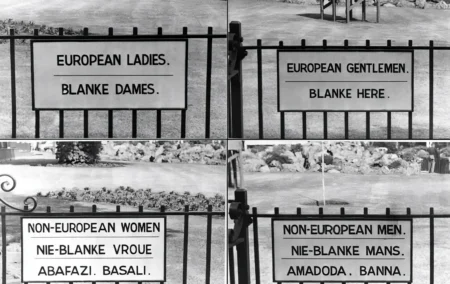
[Image: Signs indicating segregated access points to a public park in Johannesburg, 1957. Photos in public domain.]
The views of the writer are not necessarily the views of the Daily Friend or the IRR.
If you like what you have just read, support the Daily Friend