

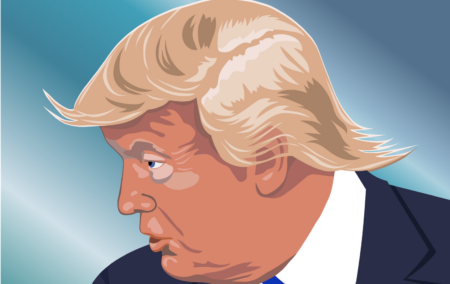
Reeling after the US Supreme Court’s devastating 6-3 decision to strike down his sweeping tariffs, President Donald Trump announced a new 10% levy on global imports.
The court ruled that Trump exceeded his authority when he imposed tariffs using a law reserved for national emergencies, saying he needed congressional approval to impose taxes on imports.
The court’s Republican-appointed Chief Justice John Roberts and Justices Neil Gorsuch and Amy Coney Barrett, and three Democratic appointees, Justices Sonia Sotomayor, Elena Kagan, and Ketanji Brown Jackson, voted to strike down the tariffs.
Only three of the nine justices – Clarence Thomas, Brett Kavanaugh and Samuel Alito – voted not to strike down the tariffs.
The court’s ruling applies to Trump’s so-called “Liberation Day” tariffs, but not individual tariffs he imposed on specific countries or products.
The BBC notes Trump has long argued that tariffs boost American manufacturing, though many in the business community, as well as Trump’s political adversaries, say the costs are carried by consumers.
According to the BBC, however, Trump’s tariffs have already brought in “a fair bit of extra revenue” since they came in last April, with customs duties surging from under $10bn in March to a peak of more than $34bn in October, dropping slightly to just over $30bn by January this year.
However, attention turns now to what is being forecast as a “refunds battle”, with many firms that paid those duties now wanting a refund.
During his White House briefing, Trump suggested that he was not preparing to issue refunds, suggesting that any potential payments would be probably be tied up in litigation for years.
According to Amy Howe at ScotusBlog, the court rule on whether or how the federal government should provide refunds to the importers who have paid the tariffs, estimated in 2025 at more than $200 billion.
Howe writes that, in his dissenting opinion, Justice Brett Kavanaugh suggested that the federal government “may be required to refund billions of dollars to importers who paid the International Emergency Economic Powers Act (IEEPA) tariffs, even though some importers may have already passed on costs to consumers or others.” Moreover, he added, “[b]ecause IEEPA tariffs have helped facilitate trade deals worth trillions of dollars—including with foreign nations from China to the United Kingdom to Japan, the Court’s decision could generate uncertainty regarding various trade agreements. That process, too, could be difficult,” Kavanaugh warned.
Evidently smarting at the fact that two of the justices he nominated in his first term, Amy Coney Barrett and Neil Gorsuch, ruled against his tariff powers, Trump commented: “I don’t want to say whether I regret. I think their decision was terrible. I think it is an embarrassment to their families, you want to know the truth, the two of them.”
He said he was “absolutely ashamed” of the three conservatives who struck down his tariffs “for not having the courage to do what’s right for our country” and called the three liberals on the court a “disgrace”.
In true Trump style, the President said petulantly that he “[h]onestly … couldn’t care less” if the Supreme Court judges who ruled against him did not attend his State of the Union address next week, where he is expected to lay out his plans for the year to come.
He says the three justices who voted in favour of his tariffs are “happily invited” and the rest are “barely invited”.
Trump’s former Vice-President from his first term, Mike Pence, applauded the Supreme Court’s ruling as proof that “the Constitution grants Congress – not the president – the power to tax”.
Pence, the founder of Advancing American Freedom, an organisation that has lobbied against Trump’s tariffs, commented: “American families and American businesses pay American tariffs – not foreign countries. With this decision, American families and businesses can breathe a sigh of relief.”
In striking contrast, Trump’s present Vice-President, J D Vance, called the ruling “lawlessness from the court, plain and simple”.
He wrote on social media: “Today, the Supreme Court decided that Congress, despite giving the president the ability to ‘regulate imports’, didn’t actually mean it. [The ruling’s] only effect will be to make it harder for the president to protect American industries and supply chain resiliency.”
In other reaction, California Governor Gavin Newsom praised the Supreme Court’s decision, writing in a post on X: “Even Donald Trump’s Supreme Court agrees: His tax on the American people is illegal. A huge win for families and small businesses across the country who have been suffering under this man’s ego.”
Newsom added in a follow-up post: “Issue an immediate refund to all Americans for your illegal tax. Now.”