

Everyone seems to be convinced that in principle, age-gating access to social media and other platforms is a good idea. They’re wrong.
I’ve written a fair bit about the dangers – to adults – of the global race to require identification or age verification online, and ban children from various social media sites.
All of this is premised on the idea that, in principle, allowing children younger than, say, 16, to use social media is a bad idea.
Surveys find support or strong support for banning under-16s from social media in about three quarters of respondents, regardless of their political alignments. Several countries have implemented, or are implementing such bans. They are politically popular all over the world.
Yet, like most government interventions that restrict freedom, they really ought to be examined a lot more closely.
Anecdotal evidence of harm
That social media, and the internet in general, can harm children is supported largely by dramatic, but rare, anecdotal evidence of bullying, sextortion, or suicide.
How harm occurs more generally, how prevalent this harm is, whether the benefits of age restrictions outweigh the disadvantages, and whether age restrictions will actually reduce these harms, are all much more doubtful.
More nebulous forms of harm, like anxiety, depression, poor sleep, cognitive impairment and general well-being, are all far more difficult to link conclusively to social media use, or to what researchers have taken to calling “social media use disorder” (by analogy with “gambling disorder” and “alcohol use disorder”) or “problematic social media use” (PSMU).
A negative association between well-being and PSMU and a positive link between psychological distress and PSMU have been postulated by various studies.
This is not true for non-problematic social media use, however.
One study showed that total time spent on social media is not a predictor of PSMU.
There is conflicting evidence on the prevalence of PSMU, ranging from 1.6% to 47% among adolescents and young adults. Such a range points to inconsistent definitions of what constitutes PSMU, inconsistent methodologies, large differences between countries, high levels of uncertainty, and probably all of the above.
An interesting observation is that on average, PSMU prevalence appears to be more than twice as high in lower-income and more collectivist countries than in high-income individualistic countries.
A recent review of PSMU prevalence cautions, however, that “no solid conclusions can be made on the prevalence of PSMU for a variety of reasons,” including the fact that the methods for diagnosing it have not been widely validated.
Another systematic review, from 2020, found a “negative but small” association between PSMU and well-being, and that “the broader and pervasive use of [social media] does not clearly appear to associate with severe damage of people’s well‐being”.
We don’t really know
So, scientifically speaking, we don’t know how common PSMU is, how it is caused, how it affects children, or which children it affects badly.
That there is a correlation between social media use and various psychological difficulties, like anxiety and low self-esteem, seems clear, but there is little evidence of whether there is any causation, or even in which direction the causation points.
It is eminently possible that kids who suffer from anxiety and low self-esteem are more drawn to spending time online, in much the same way that such children of my generation would withdraw to libraries, their comic book collection, or the TV room.
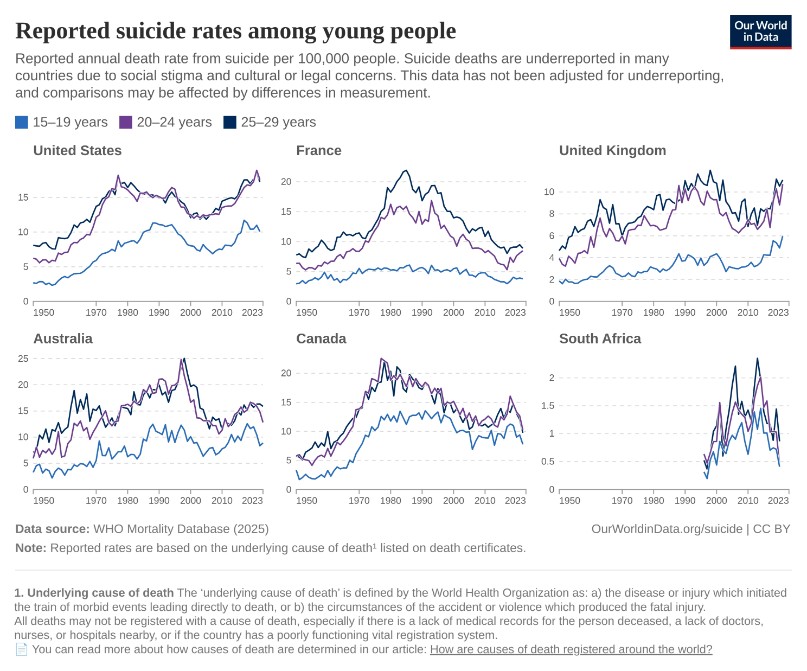
Considering the chart above, it isn’t obvious that, for example, suicide rates are changing in step with social media adoption, and cannot be explained by other factors, or that troubled teenagers wouldn’t have suffered the same fate in the absence of social media.
It isn’t at all clear that the apparent rise in mental health diagnoses isn’t entirely an artifact of wider awareness, greater understanding, and better screening.
In my day, autism spectrum disorder wasn’t something that would have even crossed a parent’s mind when faced with a child that was lonely, anxious, socially withdrawn, prone to fits of temper, or performing below their abilities at school. Difficult kids were more likely to be taken for a talk with a priest or pastor than with a psychologist or psychiatrist.
Therefore, it isn’t at all clear that today’s generation struggle more with mental health problems than previous generations did, and that if so, social media must be to blame.
Benefits of social media
One also has to consider the benefits of social media use. Our hyper-protective generation has severely restricted children’s ability to socialise outside the house. Other than planned playdates, or chaperoned outings to the park or beach, neighbourhood children can no longer socialise together after school in the way we used to do. Instead, they connect online, whether via social media, or via extended video chats.
When I grew up, there was always a newspaper or two and a clutch of magazines lying around the house, which we would read when bored. We would often watch news or educational television programmes, just because they were what was on TV.
Now, people rarely buy print newspapers and rarely watch broadcast television, so that sort of casual access to information just isn’t there anymore.
Instead, we get most of our news via mobile apps or social media. Mobile phones have dramatically changed how everyone, including teenagers, interacts with the world.
Teenagers aren’t going to magically hang out on Wikipedia and Google News if they’re banned from TikTok, I can tell you that for a certainty. They’re going to play games instead. If you lock teenagers out of information sources, they will grow up sheltered and ignorant.
Instead of gradually introducing them to the internet over time, kids under a government social media ban will suddenly be exposed to an overwhelming and dangerous world when they do hit 16. It’s not like they have a fully developed prefrontal cortex by then.
It isn’t clear to me that an age-restriction will be at all protective of teenagers’ mental health.
If you ban social media, you’re going to have to define what social media is, exactly. Facebook, sure. But no self-respecting teen is on Facebook anyway. Okay, TikTok, SnapChat and Instagram, then. But what about online games with chat facilities? Or message boards? Or instant messaging apps? Or music-sharing platforms?
Children aren’t going to willingly give up their ability to share their experiences with their friends or access information they find interesting and entertaining. They’ll just go to less savoury sites – chatrooms, message boards – that are not required to enforce age restrictions.
If you cast the net even wider, they’ll just spend more times in online games or on WhatsApp. Or they’ll use VPNs or proxy servers, or use AI to generate adult-looking selfies, or find any of a myriad ways to circumvent technical enforcement of age restrictions.
How to raise a child
I’m no parenting expert, but I have recently helped to raise a boy to the age of 16.
He got his first phone around the age of 10. Having a phone was a necessity for him to keep up with schoolwork during the pandemic, which struck exactly six years ago now.
All this time, he has had parental control software on his phone that limited the apps he could use, prevented him from installing apps without permission, and limited the time he could spend using his phone.
These restrictions, and the apps he had access to, were gradually eased over the years. And when his schoolwork started to suffer, they were tightened again. He had to earn the right to use his phone.
We also had periodic chats about the sort of content and people he was likely to come across online. These chats would include (awkardly, I admit) adult material he might find (or worse, look for), like gore and porn.
He was taught online safety, like never giving out personal information on public forums or to people he didn’t know. We taught him never to post compromising photos of himself or others that could be used to blackmail him, or might resurface at a job interview ten years from now. We taught him to always be alert for camera phones that could take pictures that would later embarrass him.
We taught him about scams and misinformation.
We discussed toxic influencers like Andrew Tate, because that was a thing among his school friends a few years ago, and online movements like wokeness, incels, looks-maxxing and MAGA.
We taught him not to overvalue “fake internet points”, not to take other people’s opinions of him too seriously, and how to handle online bullying.
We discussed how girls get treated online (which is abominably), and what was and wasn’t okay on his part.
When he got his first girlfriend, he was already an expert at spotting creepy types, both online and in person. So were his other friends. The way they spoke made me confident they wouldn’t end up exploited or victimised.
He learnt to shun toxic chatrooms in games, and to this day is more conservative about mature content than we actually expect of him. He chooses not to watch content that we wouldn’t mind him watching when he feels that it is too violent, or too racy.
Our monitoring of his phone use has never turned up anything that we felt he couldn’t handle. He has always felt free to come to us with questions about questionable stuff he sees online.
Now that he is 16, he is well-adjusted, even if he probably uses his phone a bit too much (but who doesn’t, or didn’t spend too much time watching TV or reading comics in our day?). He happily spends time with his friends, or outdoors, without being dependent on his phone, and despite a few hiccups which needed parental management is doing well at school.
In loco parentis
I don’t need a government to tell me that we did wrong by letting him use social media when he was 12. We didn’t. Instead, we parented, like parents should. We not only protected him, but taught him to protect himself.
The government has no right to stand in loco parentis, unless parents are actively abusing their children.
Enfin, I’m not at all convinced that social media is as harmful for teenagers as it is portrayed to be.
I’m not convinced that enforced age restrictions will have any benefits at all, let alone more advantages than disadvantages.
I’m not convinced that banning teenagers from legitimate social media won’t drive them to underground platforms where neither governments nor parents have any oversight.
I’m not convinced that the sort of teenagers that might need protection from social media aren’t exactly the sort of teenagers that will find ways to circumvent technical restrictions.
I’m not convinced that overly restrictive laws won’t turn children into rebels who resent their conservative straitjackets, and will go wild as soon as they turn 16, thereby endangering themselves and others.
Overprotective
I think being overprotective of children is dangerously counter-productive, in almost all contexts. If you keep children innocent of risks they never learn to weigh dangers and make good decisions for themselves. They should be taught how to handle situations that make them uncomfortable, and feel free to ask their parents, friends or teachers if they are unsure.
And I certainly don’t think governments ought to step in and become overprotective on behalf of parents.
So while everyone seems to be cheering efforts to keep under-16s off social media, or expresses concern only about the implications for adults, I’m going to go to bat for the teenagers.
I welcome ways to make social media algorithms safer for younger users, but I oppose government-mandated age restrictions and unceremoniously kicking teenagers off social media.
They don’t need no thought control.
[Image: Mobile phones changed how teenagers interact with the world. Image source: World Economic Forum]
The views of the writer are not necessarily the views of the Daily Friend or the IRR.
If you like what you have just read, support the Daily Friend