

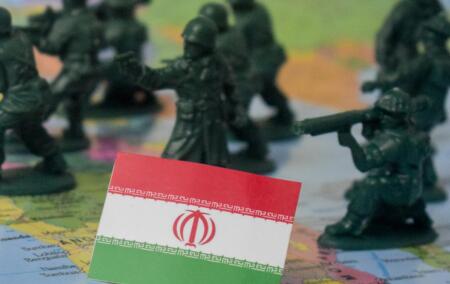
The current international landscape in the Middle East is a clear testament that Hamas’s 7 October surprise attacks against Israel fundamentally altered the political and security outlook of the entire region.
The Israeli military campaign against Iran’s proxies, Hamas, Hezbollah, and the Houthis, was never going to eradicate the existential threat facing the State of Israel and its people since its establishment in 1948.
Israel has long maintained that Iran harbours intentions to annihilate it. This belief is not based solely on the chanting of “Death to America” or “Death to Israel,” but is also reflected in Iran’s position on the Israel–Palestine question, which has historically shaped Middle Eastern politics. Iran positioned itself as a support base for those seeking to attack Israel and its people, advancing its strategic objectives by sponsoring and backing militant activities against Israel.
Since the 1979 Iranian Revolution and the emergence of the late Ayatollah Ruhollah Khomeini, the Islamic Republic of Iran has sought to position itself as a dominant regional security and military power. This ambition has fuelled enduring rivalry and deep-seated tensions with Israel. Iran’s nuclear aspirations have further intensified friction, not only with Israel but also with Western powers concerned about regional proliferation and strategic stability.
The prospect of Iran expanding its nuclear and missile capabilities would significantly alter the political and security balance of power in the Middle East. Within this context of entrenched rivalry, Israel views the possibility of a militarily strengthened Iran as an existential threat, fearing that such capabilities could ultimately be directed against its sovereignty and national security.
The US, as Israel’s greatest ally, has always placed Iran’s nuclear project at the heart of its foreign policy because it seeks to go against its strategic regional interests. It is for that reason that almost every US administration has always held talks and negotiations with Iran in an attempt to talk it down on its pursuit of its nuclear ambitions.
Hell-bent
On the other hand, Iran is hell-bent on building its nuclear facilities, which it obviously wants to use to attack its presumed enemies in the region and outside.
Would the death of Ali Khamenei bring freedom to the Iranian people?
There were mixed feelings around the world after the elimination of Ayatollah Ali Khamenei. As could be expected, we saw the pictures of those mourning him from Tehran, but those coming from outside, such as in the US, Britain and others, were celebrating the news of the end of the tyrant.
This brings new hope into the lives of those exiled Iranians who are hoping that they will one day go back home to reunite with their people and build the country that they so much love.
It is now up to the people of Iran to take advantage of the prevailing political conditions to advance their interests; to free themselves from the 47-year authoritarian rule. The US and Israel were creating a necessary, conducive mood for the oppressed people of Iran to rise up against dictatorship and institutionalised corruption, which had turned a once beautiful country into a personal fiefdom.
Iran, like South Africa, has uncontrollably skyrocketing levels of unemployment, water and electricity shortages, and growing levels of inequality which is exacerbated by heightened levels of corruption.
Costing the country dearly
It is also true that isolation and international sanctions have not only affected the country’s economic growth, but have really downgraded the country when it comes to modernisation, in terms of updating innovative science and technology. This is really costing the country dearly.
There is also the fact that the current regime is corrupt and not accountable to anyone, hence the lives of ordinary people are deteriorating. We continue to see social unrest, showing that people are disillusioned with their leadership.
Is the ongoing war influenced by the electoral calculations of Trump and Netanyahu?
There will be a battle to control Congress towards the end of this year. But it is very common in the history of America that the sitting president loses seats to another party. Domestically, we have seen that Donald Trump is waging a more aggressive campaign trail, even in the swing-states where he does not have major support.
He has successfully made the campaign and the message about himself. The results will prove whether Trump is as popular as the polls are suggesting, or otherwise. This war cannot be ignored, as it will play a crucial role in determining who controls Congress.
Benjamin Netanyahu’s Likud would surely want to extend its national mandate and continue its campaign to thwart the security threat to Israel. Many Israelis were not happy with Netanyahu’s judicial reforms, which were proposed in 2023, months before 7 October happened.
He is likely to be held accountable again for the bloody invasion of Hamas on 7 October 2023. Naftali Bennett, with his political party, “Bennett 2026,” will likely become the next Prime Minister of Israel, given his popularity.
[Image: Saifee Art on Unsplash]
The views of the writer are not necessarily the views of the Daily Friend or the IRR.
If you like what you have just read, support the Daily Friend