

As US President Donald Trump vowed that Iran “will be hit very hard”, warning that US forces would attack “areas and groups of people that were not considered for targeting up until this moment in time”, Iran’s President Masoud Pezeshkian apologised to neighbouring countries that had been attacked by Iran, saying countries not on the offensive against Tehran would not be targeted.
In a further development last evening, Iran’s Foreign Minister, Abbas Araghchi, said his country’s “openness to de-escalation” had been “almost immediately killed” by Trump.
In a statement following Trump’s comments – reflected fully below – Aragchi said the US president had misinterpreted Iran’s “capabilities, determination and intent”.
The BBC’s Lyse Doucet writes: “[Pezeshkian’s] announcement of a decision he said was made by the interim Leadership Council appears to be a response to the enormous anger among Arab leaders who, in recent years, had developed a new relationship with their former arch-enemy; many had urged the US not to go to war against Iran.”
Writing in The Guardian, Diplomatic Editor Patrick Wintour says Pezeshkian’s statement that Iran will no longer attack Gulf and neighbouring states if they are not attacking Iran “appears on the surface a significant change in tactics, reflecting the overpowering diplomatic pressure Iran was under to change course, or risk uniting the whole of the Arab world against Iran. It would be an admission that Iran’s current military strategy is heading for diplomatic disaster.”
Yet, he continues, the “precise implications of his announcement remains open to interpretation”. This is in light of an Iranian armed forces spokesperson “seeming to qualify its meaning heavily by saying: ‘Strikes against the US and Israeli assets will continue. So far, we have targeted every base that was the origin of aggression against Iran and we remain committed to this matter. Countries that have not provided space and facilities to the United States and the Zionist regime have not been our target so far and will not be targeted in the future.’”
Wintour concludes: “Whether this reflects an internal disagreement, a reinterpretation of the decision taken by Pezeshkian and other members of Iran’s temporary executive council or simply a more hardline way of explaining the political leadership’s decision, time will tell. It is a test of where power lies in Iran in wartime.”
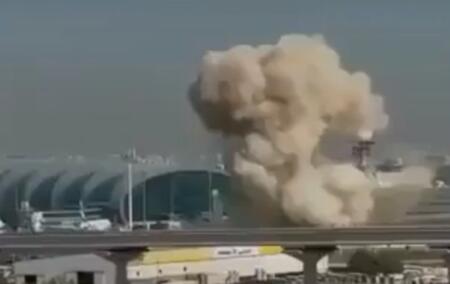
As the BBC’s Joe Inwood reports, “at roughly the same time [of Pezeshkian’s statement], footage emerged of what appeared to be a drone strike on Dubai International Airport”.
Inwood notes: “At the start of the war, aware of the risk that the US and Israel could wipe out their top commanders, Iran is said to have adopted what’s known as a ‘decentralised mosaic defence’.”
He writes of the Dubai drone attack: “We cannot be certain exactly what has happened at this point, or if the president’s promises were sincere, but it may be that what we are witnessing is the danger of the mosaic strategy and the difficulties it will pose to attempts at deescalation.”
Last evening, it was reported that a resident of Dubai had been killed after shrapnel from an “aerial interception” fell on to a vehicle. The Dubai Media Office said the incident occurred in the Al Barsha area of the city.
Wintour argues that “[i]f Pezeshkian’s promise is translated into reality then Iran hopes the path [is open] to reunite the region and the focus can shift back to what it regards as the injustice of the US attacks in the midst of diplomacy. The pressure to relent has been coming from all the Gulf states, but notably countries that have tried to be close to Iran, including Oman, Turkey and Qatar. Some of the phone conversations have been said to be seething.”
Pezeshkian reportedly responded to Trump’s demand for Iran’s unconditional surrender by saying this was a “dream that they should take to their grave”.
Yesterday, Trump said in a post on Truth Social that Iran had “surrendered to its Middle East neighbours, and promised that it will not shoot at them any more (sic)”.
He wrote: “Iran, which is being beat to HELL, has apologized and surrendered to its Middle East neighbors, and promised that it will not shoot at them anymore. This promise was only made because of the relentless U.S. and Israeli attack. They were looking to take over and rule the Middle East. It is the first time that Iran has ever lost, in thousands of years, to surrounding Middle Eastern Countries. They have said, “Thank you President Trump.” I have said, “You’re welcome!” Iran is no longer the “Bully of the Middle East,” they are, instead, “THE LOSER OF THE MIDDLE EAST,” and will be for many decades until they surrender or, more likely, completely collapse! Today Iran will be hit very hard! Under serious consideration for complete destruction and certain death, because of Iran’s bad behavior, are areas and groups of people that were not considered for targeting up until this moment in time. Thank you for your attention to this matter!”
Araghchi warned later that if Trump sought escalation, “it is precisely what our powerful armed forces have long been prepared for”.
Drones and missiles continued to be fired by Iran, and US and Israeli forces continued to hit targets in Iran (and, in the case of the Israel Defense Forces, Lebanon).
In a message to Lebanese president Joseph Aoun, Israel defence minister Israel Katz said that if “the choice becomes protecting our civilians and the safety of our soldiers [from attack by Hezbollah based in Lebanon] or Lebanon, we will choose to defend our civilians and our soldiers, and the government of Lebanon and Lebanon will pay a very heavy price”.
[Image: Screengrab from footage of what appeared to be a drone attack on Dubai International Airport]