

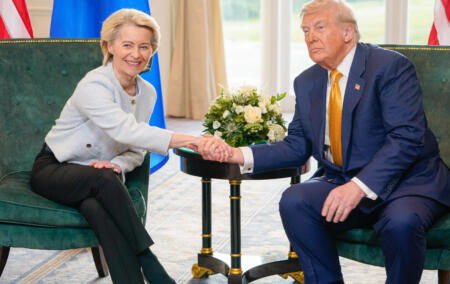
The US must mitigate risks arising from Europe’s weaknesses; European leaders must embrace realism.
The past eighty years have been remarkably peaceful by Europe’s historical standards. This reflects the EU binding most of the region together economically while NATO deterred Russian aggression.
Supranational organisations such as the EU and NATO advanced US interests during the Cold War. More recently, however, the trend between the US and the EU has been accelerating in the opposite direction. Yet Europeans can confidently assume that the US, through NATO, will continue to backstop their security.
If the US exited NATO, Russia’s nuclear superiority and its centralised decision-making would give it escalation dominance over Europe. This would deeply destabilise the region and the world economy.
To appreciate the “nuclear deterrence gap” between Europe and Russia, consider how ludicrous it would be for a European nation to threaten a nuclear attack against Russia. Now consider if, after the US were to exit NATO, Russian President Putin again threatened to use nuclear weapons to pressure the EU to reduce its support for Ukraine.
If the US exits NATO, Putin or his successor could pursue territorial gains through combining threats, military incursions, and interference in the political workings of European countries. As this strategy would yield territorial gains while risking a world war, the US is better off staying in NATO.
European leaders rely on the US to guarantee their security while economically seeking to play China off against the US. This ignores core European weaknesses spanning energy access, technology development, and competitiveness. It also ignores how China’s gains have come mostly at Europe’s expense. When these factors are considered alongside Europe’s core values, it should be obvious that Europeans should align with the US while accepting that China is a predator that preys primarily on them.
Europe’s failed policies reflect realistic threat assessments being sidelined by an idealism that fixates on ‘what should be’. The resulting policymaking shortcomings are amplified by EU bureaucrats subordinating national interests to their political crusades such as climate change and gender issues.
Ever more reliant
The US being locked into NATO would have comforted leaders from Germany and other European nations when they chose to become ever more reliant on Russia for cheap energy to fuel their economies. Never mind that US presidents ranging from Ronald Reagan to Barack Obama and Donald Trump had warned of the dangers of Europe becoming excessively reliant on Russian energy.
Pipelines connecting Europe and Russia make solid economic sense if measures are taken to deter Russia’s predatory proclivities. Europe’s reliance on Russia for its energy requirements needed to be balanced with access to alternative energy sources and robust investments in defence capabilities. Instead of enacting these safeguards, European leaders comforted themselves that the US had little choice but to extend its security umbrella across Europe.
Rules-based
The rules-based international order began breaking down when China’s economic growth became increasingly reliant on thwarting the enforcement mechanisms of the WTO’s free trade precepts. Meanwhile, reliance on Russia’s resource endowments empowered Moscow to violate the sanctity of Ukraine’s borders. In both cases, Europe has been the West’s oversized weak link.
All countries and regions have weaknesses, but Europe and its largest economies have willfully provoked perilous security and economic vulnerabilities. Worse still, Europe doesn’t have a plan. Nor do its leaders objectively acknowledge the region’s challenges sufficiently to begin to form one.
The big picture is that China’s leaders oppose core Western values, like representative forms of government, and they are well-positioned to undermine the foundations of the Western-led international order. China’s primary advantages are its centralised decision-making capacity and its manufacturing competitiveness.
Yet domestically China’s economic model is overly prescriptive and internationally it is excessively predatory. As China’s consumers lack sufficient purchasing power to fuel healthy GDP growth, Beijing relies on other countries downgrading their industrial potential in favour of cheap Chinese imports. Many of these goods are significantly subsidised by China’s government in violation of the WTO’s key anti-dumping provisions.
Free trade should be favoured over tariffs—so long as the world’s most dominant manufacturing exporter isn’t profoundly subverting the basic principles of free trade. China is doing exactly that with its involution policies. The US’s high tariffs on Chinese EVs are an appropriate response. If other Western and Western-aligned countries adopted similar or complimentary policies, China would have to pivot away from its beggar-thy-neighbour policies.
Justifiably coy
US President Donald Trump is justifiably coy about his Iran war objectives. He would have been correct to reason, as implied by his Secretary of State, that as Iran was rapidly manufacturing missiles and drones, it would soon be impossible to deter that country’s malicious leadership without a full-scale war that risked devastating the region’s energy production capacity. Israel could not afford to ignore this.
It isn’t credible to suggest that a regime which massacres unarmed protesters and attacks all of its neighbours was negotiating in good faith. They were negotiating to buy time to build their stockpiles of missiles and drones and they were within months of being too formidable to be challenged.
Just as the US State Department during the Cold War considered all of its important policies through Soviet-focused lenses, Trump’s views on the Middle East and Europe are filtered through Sino-focused lenses. But if Trump were open about this, today’s geopolitics would wobble dangerously and unnecessarily. Diplomacy does not prioritise openness.
Trump was justified in initiating a war against an evil regime that has long provoked conflicts in the Middle East while restraining its prosperity. Many outcomes are now possible and they are all superior to Iran being able to menace the region indefinitely with ever greater firepower. The costs of reopening the Strait of Hormuz are much lower today than they would be if Iran had had a few more months to expand its weapons stockpiles.
Venezuelan strategy
Trump’s ideal outcome for his war against Iran is a redux of his Venezuelan strategy. For instance, if the US can control access to Kharg Island, it can control Iran’s oil exports and the distribution of the proceeds.
Such control is consistent with the US keeping the sea lanes in and around the Persian Gulf open. The region’s other energy exporters would greatly prefer this outcome over threats from Iran. Such influence over the flow of vital hydrocarbons might also counterbalance China’s rare earths dominance.
Largely independent
Trump’s vision is to make the US and the Western hemisphere largely immune to coercion pressures from other parts of the world. As of March 20, energy price variations were consistent with this. West Texas Intermediate traded at just under $100, Brent was close to $110, whereas Asian/Middle East benchmarks like Dubai exceeded $150. Meanwhile, European and Asian LNG contracts continued trading at more than five times US prices.
The worst-case scenario for the global economy would include the Strait of Hormuz remaining closed for many months or longer. This would mostly benefit Russia, and perhaps the US, while being quite costly for most Asian, European, and African nations.
Criticisms
Europeans are easily roiled by Trump’s verbal jabs at them. While many of these are unhelpful, others sting because they are accurate.
Trump seeks leverage through negotiating trade deals and he has gambled that most significant US trading partners will struggle to find alternative export destinations to the world’s largest consumer market. Energy supply disruptions now threaten to crimp consumer spending in other regions.
Trump’s top priority is to persuade other countries to realistically respond to the threats posed by China and its alignment partners. Trump’s critics presume that if he were just more traditional, leaders in Europe and elsewhere would be more cooperative.
Unfortunately, European leaders are like ours in that they can’t look past Trump’s annoying negotiating style to appreciate that their overindulged idealism ensures dismal outcomes.
[Image: https://upload.wikimedia.org/wikipedia/commons/6/68/Meeting_between_Ursula_von_der_Leyen%2C_President_of_the_EC%2C_and_Donald_Trump%2C_President_of_the_United_States_-2025%283%29.jpg]
The views of the writer are not necessarily the views of the Daily Friend or the IRR.
If you like what you have just read, support the Daily Friend