

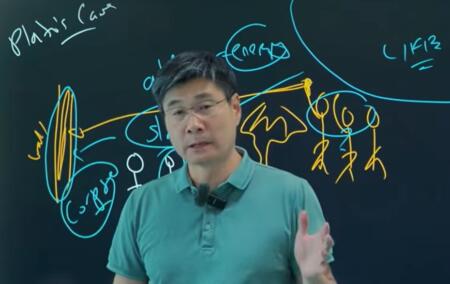
Jiang has rapidly become one of the internet’s most talked-about commentators on geopolitics and history. His lectures are often compelling. They are also, I argue, a lesson in how easily intelligent people can mistake explanation for proof.
I have almost lost count of the number of people who have asked me about Jiang over the past few weeks. Family members, friends, former colleagues and, rather unexpectedly, even an Uber driver, have all posed essentially the same question. Usually it is accompanied by a kind of excitement. “Have you seen this guy? He predicted everything.”
Curiosity eventually got the better of me. I sat down and watched a substantial number of his lectures. Geopolitics. Iran. Trump. World War III. Secret societies. Education. Power. Social class. I wanted to understand why someone I had never previously encountered had become such an intellectual touchstone for so many otherwise thoughtful and intelligent people.
Jiang Xueqin, better known online as Professor Jiang, is a Chinese-Canadian high-school educator who has built a large audience through his Predictive History channel. He is not, as far as I can see, a professor in the ordinary university sense of the word. (He holds a Bachelor of Arts in English literature from Yale). He is an educator and teacher whose lectures have found a massive audience because they offer something people badly want: an explanation of the present that appears to make sense of everything. His channel combines history, game theory, geopolitics, philosophy, religion, and prediction.
It did not take long to understand the attraction. Jiang is clearly an intelligent man. He is articulate, widely read, and unusually good at drawing together ideas from history, philosophy, economics, religion, and international relations. He explains genuinely complicated subjects in an accessible way and speaks with remarkable confidence. Most importantly, he makes a bewilderingly complicated world feel coherent.
After an hour listening to him, one comes away with the impression that the hidden logic of world affairs has finally been revealed. That is precisely what makes me uneasy.
Let me be clear from the outset. This is not an article arguing that Professor Jiang is unintelligent or that everything he says is wrong. Neither claim would survive even a cursory examination of his work. Nor am I suggesting that one requires formal qualifications to comment intelligently on history or geopolitics. Some excellent thinkers have worked outside their original disciplines, and plenty of formally credentialed academics have had very little worth saying.
Style of reasoning
My concern lies elsewhere. After watching lecture after lecture, I concluded that Professor Jiang encourages a style of reasoning that is fundamentally at odds with serious historical scholarship. He repeatedly mistakes synthesis for demonstration, treats compelling patterns as evidence, and leaves his audience with a sense of understanding about subjects whose complexity has actually been understated.
His appeal begins with the fact that he often starts in exactly the right place. US power is changing. Great-power competition has returned. The Middle East matters. Religion shapes politics. Elite networks exist. Wealthy people know one another. Institutions protect themselves. None of these observations is controversial or especially original. They are simply sensible starting points that any reasonably informed reader would accept, and that any reasonably informed analyst/historian would use.
The lectures, however, rarely stop there. Almost imperceptibly, the obvious begins to acquire explanatory power it cannot bear on its own. One reasonable observation is joined to another. Then comes a historical analogy. Then a connection. Then a broader framework. Before long, the audience is no longer listening to a series of plausible propositions. They are being invited into a comprehensive account of how the world really works. Possibility becomes probability, probability becomes expectation, and expectation becomes certainty. A collection of strategic considerations transforms into an apparently comprehensive account of where history is heading.
His lectures on Iran illustrate the pattern well. Jiang correctly points out that Iran is not Iraq, that geography matters, that military victory does not necessarily translate into political success, and that great powers have repeatedly underestimated weaker opponents. These are perfectly sensible observations, and, again, nothing groundbreaking in the least. Indeed, part of the reason many people now take him seriously is that his warnings about Iran have seemed, to some, to be vindicated by events. Many now argue that the United States has ‘lost’ against Iran, or at least that America has failed to achieve anything resembling a clean strategic victory.
That objection should be taken seriously, not brushed aside. If Professor Jiang’s claim was simply that Iran would be difficult to subdue, that US power has limits, that air power alone could not produce political submission, or that a war with Iran could become a strategic trap, then he is saying little that would surprise a competent student of strategy.
Startling revelations
Those are not startling revelations — they are broadly consistent with what many serious analysts have argued for years. And that is also not quite the same as proving the larger system of thought that surrounds the prediction. “America may lose a war with Iran”, is one claim. “Professor Jiang’s broader predictive framework has revealed the hidden logic of world affairs”, is another. The first may turn out to be right, depending what one means by ‘lose’. The second requires a much higher standard of evidence.
This distinction matters because Jiang’s admirers often seem to treat correct or partly correct predictions as proof of a much broader credibility. But predictions are slippery things.
A broad prediction can look far more impressive after the fact than it was at the time. If someone says that US power is weakening, that Trump may return, that Iran will be hard to defeat, and that the Middle East could draw the United States into a costly conflict, some of those claims may well prove accurate. But none of them is unavailable to serious analysts. None requires belief in secret structures, predictive history, or some privileged access to the machinery of the world.
This is Jiang’s central intellectual weakness. He repeatedly mistakes synthesis for demonstration. Bringing ideas together is not the same thing as proving that they explain a particular historical event. Recognising patterns is not the same thing as establishing causation. Historical analogies illuminate possibilities; they do not demonstrate that history is about to repeat itself.
His greatest gift is making inference feel like evidence.
The problem becomes more serious when one turns to his lectures on secret societies and hidden centres of power. Here again, he begins with a legitimate premise. Elite networks do exist. Powerful people meet each other at universities, clubs, conferences, think tanks, foundations, religious institutions and political organisations. Influence often travels through informal channels as much as through formal institutions. No serious historian would deny any of this.
But there is a vast difference between influence and control. There is an equally important distinction between saying that elite networks matter and saying that secret societies are the true centres of power in the world. The first claim is ordinary historical analysis.
Lizard people
The second moves us towards conspiratorial thinking, even if it is presented in calm, academic language. Once again, the difficulty lies in the transition. Jiang does not need to shout about lizard people or hidden puppet masters to make the move. He can do it quietly, by presenting one connection after another until the audience begins to feel that the accumulation itself proves direction.
Powerful people knowing one another does not prove coordinated control. Shared membership of elite institutions does not prove a single will. Historical continuity does not prove secret design. There are always networks, interests, factions, rivalries, accidents and unintended consequences. Serious historical reasoning requires us to ask how influence operates, through which mechanisms, with what evidence, against what opposition, and with what limits. Without those questions, the existence of networks becomes a substitute for proof.
That is why I find the ‘secret societies’ material so revealing. It shows, in concentrated form, the same intellectual habit that appears elsewhere in Jiang’s work. He begins with something real, then builds beyond what the evidence can safely carry. The result is not the crude conspiracy theories one normally encounters online. It is more sophisticated than that, which is precisely why it is persuasive. It is conspiracy-adjacent thinking dressed in the language of history, philosophy, and strategy.
Part of the answer to his popularity lies in the nature of history itself. These are subjects everyone encounters. Elections dominate the news, wars fill our screens, and foreign policy is discussed endlessly on podcasts and social media. We therefore feel familiar with history and politics in a way we do not with geology, neurosurgery or quantum physics.
That familiarity creates an illusion, and so we imagine that because we recognise the names and have followed events for years, genuine expertise cannot be very far away. It becomes even easier if we are accomplished in our own profession. Expertise in one field can make us underestimate the complexity of another.
The thing is, history and international relations are every bit as demanding as any other serious discipline. Behind every confident claim lies an enormous literature, countless methodological disputes and decades of scholarly disagreement. I would never dream of watching a dozen YouTube videos on structural geology and then attempting to explain tectonic processes to a geologist. Yet we do something remarkably similar with history and politics all the time. We watch a few videos, read a few articles, and suddenly feel equipped to pronounce on wars, diplomacy and grand strategy. Why does one seem absurd while the other has become almost normal?
‘In the know’
Professor Jiang is exceptionally good at making that distance appear much shorter than it really is. His audience leaves with the feeling that they have crossed from being interested observers to informed interpreters of world affairs, perhaps even people now ‘in the know’ about information and analysis that others have somehow missed.
Some of the appeal may also lie in the impression that he speaks from outside the Western intellectual mainstream, offering a perspective on US power and Western decline that feels both informed and external. That is an appealing feeling. Human beings have always enjoyed believing they can see behind the curtain while everyone else is merely watching the show.
One of the things that struck me while watching Professor Jiang was how quickly my intellectual alarm bells began ringing. Not because he was saying obviously false things. He usually was not. They began ringing because I started noticing what he was not saying. I found myself asking which historians would disagree, what evidence pointed in another direction, where the uncertainties lay, and what assumptions had quietly entered the argument without being defended. Those are not questions someone new to a subject is likely to ask, because they simply do not yet know enough to realise they should.
This is what troubles me most. Someone approaching a subject for the first time cannot know what has been left out. They cannot see the debates that have been omitted, the historians who disagree, the evidence pointing in another direction, or the assumptions that underpin the argument. They leave believing they have acquired a comprehensive understanding when they have usually encountered one confident interpretation among several plausible alternatives. The less one knows about a subject, the harder it is to recognise what has not been said.
That is one of the peculiar consequences of studying history seriously. The more history I have studied, the less willing I have become to offer simple explanations for large historical events. That is not because I know less than I did before. It is because I have become much more aware of how many competing explanations usually exist, how incomplete the evidence often is, and how difficult it can be to establish causation with any confidence.
Different questions
Whenever Professor Jiang reaches what appears to be a satisfying conclusion, I find myself asking different questions. What evidence would prove this wrong? Which historians disagree? What alternative explanation fits the available evidence equally well? What has been omitted? Those questions rarely produce exciting YouTube videos, but they are the questions historians ask almost instinctively. They are also the questions that make one considerably less certain than Professor Jiang generally appears to be.
This is where the question of credibility becomes unavoidable. I do not object to Professor Jiang speaking outside a narrow field of professional expertise. That would be a cheap argument, and not a very good one. The problem is not that he lacks the correct academic title. The problem is that his lectures often do not display the habits that make scholarship trustworthy: careful qualification, sustained engagement with opposing interpretations, clear evidentiary standards, and a willingness to say what cannot be known.
In the end, my concern is not really ‘Professor’ Jiang alone. There have always been charismatic public intellectuals who could weave ideas from different disciplines into compelling narratives. Some have been right more often than others. Some have been spectacularly wrong. What is new is the environment in which such figures now operate. Social media rewards confidence, fluency and certainty.
It has far less patience for the historian who replies, ‘It is more complicated than that.’ It also has a habit of turning popularity into a proxy for credibility. A lecture with millions of views feels more trustworthy than one with thousands, even though viewership tells us remarkably little about whether the underlying argument is sound.
That is one of the defining intellectual problems of our age. We increasingly mistake confidence for expertise, synthesis for scholarship and tidy explanations for the messy reality that serious scholarship usually uncovers. We assume that because an argument hangs together neatly it must therefore be correct.
Jiang makes me nervous, not because I think he is stupid. He plainly is not. Not because I think he has never made a good prediction. He plainly has. Nor because I object to people thinking boldly or drawing connections across disciplines.
Increasingly dangerous
He makes me nervous because he exemplifies a style of reasoning that is becoming increasingly common and increasingly dangerous. It begins with sensible observations, gathers them into an elegant narrative, and presents that narrative with a degree of confidence the underlying evidence often cannot sustain.
If his lectures encouraged people to read more history, engage with competing interpretations and appreciate the complexity of the past, I would welcome them. Too often, though, they encourage something rather different. They encourage the comforting belief that complexity has already been mastered, that the hidden logic has been uncovered, and that those who remain unconvinced simply have not yet seen behind the curtain.
History has taught and continues to teach me almost the opposite lesson. The more I have learned, the more cautious I have become. Not because history has fewer answers than I once thought, but because it has many more questions. In an age increasingly attracted to certainty, that may be the most valuable lesson the discipline still has to offer.
[Image: Screengrab from https://www.youtube.com/watch?v=rsi7cDRUrmE]
The views of the writer are not necessarily the views of the Daily Friend or the IRR.
If you like what you have just read, support the Daily Friend