

Work is an important part of life. It will account for a big slice of your time on earth. It is our means of survival and a stepping stone to our aspirations. It is an important source of social respect and status – both in terms of not being a burden or free-loader and for achieving relative status.
The job tasks can have an influence on the solution of not only your own life problems, but those of your community and even of the wider world.
The tasks could also be intrinsically enjoyable. They could call forth all your creative insights and puzzle-solving capacity. Your work environment might even be more pleasant than home – temperature-controlled, with better lighting and ventilation, comfortable furniture, less noise, decent food in a cafeteria, interesting colleagues, and so on.
Yet for most people work is not fun.
Work can be intrinsically nasty in the sense of being dirty and smelly. It could be freezing, wet or uncomfortably hot. It could be dangerous. Work is often boring. The economics of poverty turned up some surprising insights. One is the importance people attach to entertainment. People who routinely do not get enough to eat will sacrifice food for it. So boring work is not a trivial issue.
You might have to travel for hours to get to work and wake up at an ungodly hour to have the time.
A shorter commute is one of the few things where a change could result in a permanent rise in happiness. The hours at work can be lengthy and seem interminable. In Victorian times people could work for 10 hours per day, six days per week. Your job could pay badly but you accepted it because it was better than nothing.
Some of the people you work with could be horrible company. They could be incompetent and end up creating more work than you signed up for.
Personal control is a huge factor in life satisfaction, more important than material rewards. Those who do not control their lives at work have poorer health outcomes independently of other lifestyle factors.
Work can seem senseless too. Karl Marx drew attention to the lack of meaning in work. He called it alienation. Like lack of control, it can be soul-destroying.
My point is, a great many people pass their workday in a state of “quiet desperation”. The use of the word desperation is not hyperbole. Working people do often feel they are hanging on for dear life.
It may surprise you what sorts of jobs do or do not drain the soul.
“Soul of the harlot”
A girlfriend of mine once used the phrase “the soul of the harlot” to make a point about the personal cost of prostitution. She had the common view that a woman in the oldest profession must be suffering tremendously and have zero self-esteem. The physical process of sex is not intrinsically nasty or harmful. Quite the opposite. Nastiness mostly enters when there is a lack of choice and control.
Sometimes aesthetic considerations play a role. However, psychological research on prostitutes says they do not suffer unduly from those circumstances and tend to be psychologically healthy.
One study using the Minnesota Multiphasic Personality Inventory – a well-validated questionnaire designed to assess mental illness – found that a large group of prostitutes had better self-esteem, fewer mental illnesses and stronger psychological defences than unselected women.
Other studies look at their reaction to their work. While some do report bullying or find hooking depressing and turn to drugs, most find it perfectly acceptable and believe they are providing a positive social service. Many find it thoroughly enjoyable and a few go as far as to regard it as a worthwhile spiritual journey. Female porn stars give similar responses. They talk about having a lot of control, low work hours and an average remuneration higher than most middle-class jobs.
More anecdotally I know of prostitutes who have fulfilling and well-paying day jobs outside of prostitution. They do not have to have sex for money, they want to. I also knew of prostitutes persuaded to do a more respectable job, in this case admin in the insurance industry. They lasted only a few months before deciding that the insurance job was absolutely terrible, at least compared to prostitution.
Military work is another case in point. I know soldiers who find risking their lives in physically uncomfortable environments, for modest pay, very fulfilling work. On the other hand, I know people who find the prospect of filling in another form or making phone calls extremely stressful.
Marx blamed alienation on capitalism and the division of labour but many, like Bryan Caplan of George Mason University, point out that capitalism has multiplied the range of jobs and creative opportunities massively.
I certainly think that if jobs were more congenial people working at them would be more productive. For example, reducing time at work does not reduce the amount accomplished, implying that it increases hourly productivity.
What can we do to make work more congenial?
Less alienating
Automating away mindlessly repetitive tasks via machines or computers would help. Freeing up time and minds for more creative and interesting work would be far more engaging and less alienating.
AI could be a big step in that direction and would double as a creative assistant.
More work from home would reduce commutes and exposure to toxic colleagues. More effective education would open up better jobs for a lot of people. Far-sighted employers should consider the impact of such measures on the long-term prospects of their business.
Hey, thinking about it might be fun for them too.
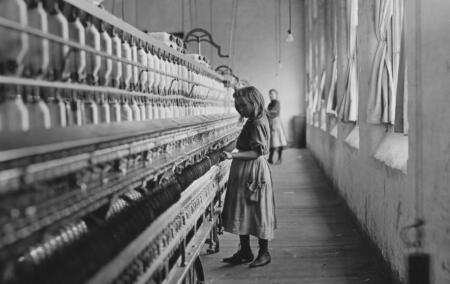
[Image: Sadie Pfeifer, a Cotton Mill Spinner, Lancaster, South Carolina, 1908, by Lewis Wickes Hine, 1874–1940 https://www.artic.edu/artworks/11344/sadie-pfeifer-a-cotton-mill-spinner-lancaster-south-carolina]
The views of the writer are not necessarily the views of the Daily Friend or the IRR.
If you like what you have just read, support the Daily Friend