

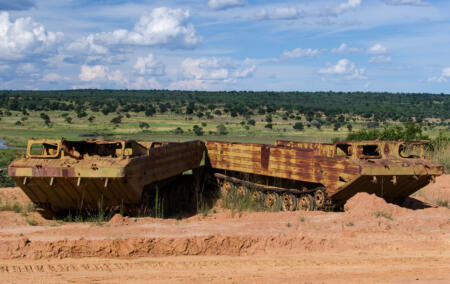
In case you missed it – and I almost did – last Monday was Southern Africa Liberation Day. This is an annual commemoration observed by the Southern African Development Community since 2019.
It echoes a similarly named event on the African Union’s calendar, Liberation Day, which takes place on 25 May. In a brief explainer on the SADC website, the day exists “in honour of the men and women who sacrificed their lives for political liberation and freedom of the Region.”
But whereas the pan-African day reflects the founding of the Organisation of African Unity – an institution intended to expedite the as yet incomplete process of decolonisation, and its hopes to represent the continent as a powerful global voice in the future – the Southern African version harks back to something rather different. The date, 23 March, would be familiar to those with an interest in regional history, as the anniversary of end of the Battle of Cuito Cuanavale in 1988.
The battle remains front and centre of the day. It was the site of the inaugural commemoration and remained so in last week’s message by President Cyril Ramaphosa, as SADC chairman. “We also recall,” he said, “with profound appreciation, the solidarity and support of our international partners – most notably the people and government of Cuba – who deployed their military forces to stand alongside regional liberation movements and independent states. Together, they confronted the South African Defence Force of the apartheid regime in the historic Battle of Cuito Cuanavale in Angola. This decisive confrontation marked a turning point in the struggle for liberation in Southern Africa, contributing significantly to the independence of Namibia in 1990, and paving the way for the first democratic elections in South Africa in 1994.”
There are few moments in the political history of the region, and in South Africa in particular, that have spawned the scale of mythology as has the Battle of Cuito Cuanavale. It was indeed a significant military episode, a series of engagements over seven months rather than an apocalyptic pitched confrontation and has been termed the largest battle on the continent since the Second World War.
Its military outcome is disputed. Some years ago, I had the pleasure of meeting Prof Vladimir Shubin, an eminent Soviet (and later Russian) historian, one of that country’s foremost experts on its involvement in Southern Africa over this period. He told me that after the transition he had worked for a while as a visiting professor in South Africa and in that capacity had thought of organising a conference on the battle, bringing in participants and analysts from various perspectives. It would have been a fascinating event, since the battle was at that time less than a decade in the past. He found very little interest, people being satisfied with their own dogmas, and unwilling to see them disputed.
My own sense, for what its worth, is that each side had a very different view of what “winning” entailed, and the conflict was becoming too costly for the external participants, South Africa, Cuba and the Soviet Union. By 1988, each was quite amendable to shifting gears. This was settlement by mutual exhaustion. No doubt, I would find no shortage of criticism for this interpretation.
For the region’s liberation movements – a species of parties that includes the African National Congress (ANC) in South Africa, the People’s Movement for the Liberation of Angola (MPLA) in Angola, the South West Africa People’s Organization (SWAPO) in Namibia, the Liberation Front of Mozambique (FRELIMO) in Mozambique, the Zimbabwe African National Union – Patriotic Front (ZANU-PF) in Zimbabwe, and Chama Cha Mapinduzi (CCM) in Tanzania – it has the status of a millenarian moment. In their eyes, it was the event that saw them assert their authority over the last holdout of colonialism. Not through negotiation, certainly not through compromise, but through military dominance. This is a heroic, macho, spirit-stirring view of the world and of history. And it also legitimises and solidifies the claims that these organisations have to “hegemony” over the societies that they had credited themselves with birthing. They are, in their own conception, “the people”, and had paid for that in their own blood.As an MPLA slogan has it, “O MPLA é o povo, e o povo é o MPLA” (The MPLA is the people, and the people are the MPLA).
This helps explain why the battle has such cachet in the ANC’s telling of history, despite the inconvenient fact that its forces were not present. There have been dubious claims of “ANC special forces”, and numerous reflections on the events from ANC grandees told so as to elide the ANC’s military absence from the battle. Indeed, the deployment previously of uMkhonto weSizwe operatives against UNITA, the Angolan opposition movement, had become a source of resentment among those who wanted to return to South Africa to confront the apartheid government. There was something incongruous about fighting another country’s war when their aim was to liberate their homeland.
Southern African Liberation Day is in many respects built on a shaky premise: that the entire region was at one in confronting the apartheid state, this unity being expressed through the barrels of the weapons of the Angolan army and its allies at Cuito Cuanavale.
The countries of the region had a less than simple relationship with South Africa in this period. More conservative states such as Botswana and Swaziland were closely integrated into South Africa’s economic orbit and were reluctant to attract the displeasure of South Africa’s government and security forces; nor were they enthusiastic about communist influence in the region. Botswana, long the region’s only real democracy, had historically been close to the geopolitical West. Malawi, a founding member of SADC antecedent body, the South African Development Coordinating Conference (SADCC), maintained full and open relations with South Africa. Mauritius (now a SADC member, though not part of SADCC at the time) carried on a profitable trade and investment relationship with South Africa, an important factor in its early economic success. Zambia trod a careful line on the matter, vocally critical of South Africa, harbouring the ANC, though also at times deeply suspicious of the MPLA, and even initially sympathetic towards UNITA.
Not even the “revolutionary” governments were typically all-in on confronting South Africa militarily, and even then, not necessarily in cooperation with the ANC. Zimbabwe, for example, allowed the ANC to maintain diplomatic representation on its territory, but not to use it as a base for military operations. This matter was even discussed between representatives of the two governments and their security services (a younger Emmerson Mnangagwa, then minister for state security, helped represent his country at these engagements). Moreover, relations between ZANU and the ANC were often frosty. Ideologically, the ANC was closer to the rival Zimbabwe African People’s Union (ZAPU), and ZANU to the ANC’s rival, the Pan Africanist Congress. Stephen Ellis has pointed out that when ZANU emerged as the winner of the 1980 election, the South African Communist Party regarded the result as “as a conspiracy with international capital”. From the Zimbabwean side, the discovery that uMkhonto weSizwe operatives (who had previously been captured by the Rhodesian authorities, and released following the ZANU takeover) had remained in the south of the country in territory aligned to ZAPU, was viewed dimly – MK being regarded as an ally of ZANU’s greatest opponent at the time. They were expelled from Zimbabwe.
Perhaps President Ramaphosa would also be aware that part of the agreement that followed the Battle of Cuito Cuanavale involved removing ANC military bases from Angola. Inconveniently, solidarity had its limits. This pushed the ANC’s military presence so far from South Africa’s borders that any military aspirations it might have had were comprehensively neutralised. If anything, the ANC was an immediate loser from the battle and its aftermath.
This narrative also fails to consider the context within which the Battle of Cuito Cuanavale was fought. It was a part of the civil war that tormented Angola for decades, and whose origins were not necessarily bound up with South African policy or geopolitical posturing. South Africa had acted in support of UNITA (which remains, in electoral outcomes, the second largest in the country); from what is known about the casualties, UNITA’s exceeded those of the South African military by a factor more than 90. UNITA had (and has) a genuine constituency, and entirely legitimate grievances.
If this is a day that genuflects before the liberation movements, and which expects others to do the same, it’s worth asking what the eponymous “liberation” would entail. Liberation should not be confused with “liberty”. The sort of society that liberation movements propounded was free in the sense that they – as the true expression of “the people”, and the highest expression of correct political consciousness – had assumed control. The extent of individual liberties, economic freedoms, the rule of law and so on – what we might term the liberal ideals – would depend on the decisions and guidance of the movement in charge, and on their utility to its plans.
Democracy, then, is viewed in its original etymological sense, “power of the people”, rather than in the sense of free political competition. Quite the contrary. Henning Melber, a Namibian-German academic, has commented: “If you are not with the liberator (as represented by the movement now party and state), you are considered to be an enemy. Given the blurred boundaries between the party, government and state under a factual one-party system subordinating the state… any opposition or dissent is considered to be hostile and branded as an enemy to the people and the national interest.” Melber has a background in SWAPO, which makes his critiques of it and its fraternal parties even more hard-hitting.
There has been a tragic train of evidence for Melber’s observations in the conduct of politics in the region.
If Cuito Cuanavale represented the defeat of apartheid South Africa, following this narrative, it also represented the victory of one of Africa’s most venal and corrupt regimes. The MPLA had shown an appallingly authoritarian side from its early incumbency, and not just towards other parties: in 1977, during the so-called 27 May purge, some 30,000 people were killed by army units and their Cuban allies as the dominant faction of the party cracked down on internal dissidents. (By comparison, the death toll in the Soweto Uprising and its follow-ons in South Africa the previous year was estimated at something below 600; indeed, the cumulative total political fatalities inside South Africa into the 1990s may not have equalled those of the 27 May.) The civil war continued into 2000s, leaving a legacy of dislocation and suffering from which Angola has never properly recovered.
South Africa held its first all-race elections in 1994. Although our national mythology is prone to seeing this as an event unique unto itself, it is equally accurately seen as part of the “wave” of transitions to multi-party democracy that characterised the 1990s. This was the prevailing means of resolving intractable political problems besting autocracies at the time, the “only game in town”. Across the Southern African region, official one-party rule became unfashionable: Angola, Mozambique, Malawi, Zambia, Namibia and Tanzania all held elections, with varying degrees of probity and success. The ritual of an election remains an important legitimator, domestically and probably more so internationally.
Yet here again, the cold hand of liberation movement politics is ever-present. In a prescient comment on South Africa in early 1990s, the American scholar Marina Ottaway cautioned that liberation movements had a very poor record of sustaining democracy. As it turned out, South Africa has for all its troubles been able to do so, the counter-constitutional orientation of many of its power holders notwithstanding. Namibia, likewise, though there have been some questions about the integrity of its elections. In both countries, frustration at corruption and poor governance has engendered widespread public cynicism. It’s no surprise that survey evidence shows declining satisfaction with democracy and even support for it on the part of their citizens.
Angola, Mozambique, Tanzania and Zimbabwe reflect a grimmer reality. While Zimbabwe had maintained a nominal multi-party system since 1980, the character of ZANU had been apparent since the early days of its rule. Between 1983 and 1987, as many as 30,000 people (numbers are disputed and may never be accurately tallied) were killed as forces loyal to it went through opposition strongholds in Matabeleland, the so-called Gukurahundi. Later, when faced with a real electoral threat and the prospect of losing power, ZANU returned to outright violence and added election rigging against its political opponents; ironically, this was probably less overtly brutal overall than what it had done in the 1980s, but destroyed the country’s economy, hollowed out whatever had existed of its institutions and became the poster child for Africa’s enduring pathologies.
And given the support extended by many of its fraternal governments – invariably those headed by liberation movements – belied the claim, made by people like Thabo Mbeki, that the continent was serious about a turn towards good governance in pursuit of development. I think this cost Africa a rare historical opportunity.
It is also darkly fitting to note that as President Ramaphosa was delivering his statement, one of Zimbabwe’s most prominent activists for constitutional governance, Tendai Biti of the Constitutional Defenders’ Forum, was sitting in a jail cell. His supposed crime was calling a meeting without notifying the authorities. The context was a highly controversial Bill that would have presidents elected by Parliament rather than through a public vote, and allow President Mnangagwa to continue serving in the office after his second term expires in 2028. (Presidential term-limit extensions have become a favourite tool of African autocrats.)
In Angola, Mozambique and Tanzania, the attitudes inherited from an authoritarian single-party history continue to be reflected in governance and electoral conduct. Corruption and malfeasance are commonplace. This is a particularly obscene phenomenon in Angola, where the MPLA did an abrupt turn from Marxism to freebooting rentier capitalism, siphoning off billions into the hands of a small clique of comrades, amid devasting deprivation. The mismanagement of resources of Angola, incidentally, underlay a now global campaign for transparency and accountability for companies in the extractive sectors. It’s not an honour.
Democratic politics, meanwhile, remains constrained and sometimes dangerous for those challenging incumbent governments. As recently as last year, Mozambique and Tanzania conducted elections that were fraught to the point of fraudulence. Protests following were met, predictably, with state repression and hundreds if not thousands of deaths. The scenes from Tanzania were particularly jarring, since even in the heyday of Julius Nyerere’s repressive one-party rule, it gave the impression of placid stability. No longer. It comes across as doubly jarring in that the declared winner, Samia Suluhu Hassan (implausibly elected with close to 98% of the vote), had come to prominence with the affectionate and reverential moniker “Mama”, touting the persona of someone who cared about the lot of ordinary Tanzanians. In the event, she was sworn in to the Presidency on a military parade ground.
“Through their unwavering commitment and resilience, many freedom fighters and ordinary citizens made immense sacrifices in the fight against colonial rule and apartheid, laying the foundation for the peace, dignity, and sovereignty we uphold today,” said President Ramaphosa. I’m not sure that either peace, dignity or sovereignty really is the lot of most of the region’s people. Still less so am I convinced that these are principles a good number of their governments are particularly interested in upholding.
In Tanzania, the sight of a civilian executive taking the oath of office in a military facility while the security forces fired on protestors is rich in symbolism. In Zimbabwe, the detention of a constitutionalist advocate by a government headed by a former security chief who first took power through a coup is equally so. It also emblematic of a dysfunctional, superannuated politics that makes a fetish out of a military campaign. Cuito Cuanavale is in that sense less a memory or a milestone than an ideal, and one poorly suited to the demands of democracies or the developmental aspirations they pursue.
And it seems to me that this hardly the sort of liberation Southern Africa needs to commemorate in 2026.
[Image: https://www.flickr.com/photos/theonlymikey/8682380083/]
If you like what you have just read, support the Daily Friend