

Tomorrow, a whole 32 days after the effective closure of the Strait of Hormuz, South African fuel prices will finally respond. Finally!
The last time South Africa’s fuel prices were adjusted, on Wednesday 4 March, everyone already knew the Strait of Hormuz was closed.
It was effectively closed on 28 February, when Israel, supported by the US, attacked Iran, for reasons.
It was officially closed on 2 March, when Iran’s Islamic Revolutionary Guard Corps (IRGC) formally warned ships that they would face “severe consequences” if they passed through the Strait without permission.
Everyone knew what would happen next. Fuel prices around the world immediately responded to a fifth of all supply being taken off the market.
Yet the minister of mineral and petroleum resources, Gwede Mantashe, was constrained by a regulatory formula that he is required to apply to adjust fuel prices every first Wednesday of the month.
He could only weakly gesture towards “geopolitical uncertainty caused by the tension between the US and Iran, which could result in disruption of crude oil supply in the Strait of Hormuz”, as he increased petrol prices by a meagre 20 cents and diesel prices by 62 to 65 cents per litre.
The result of this wholly inadequate increase was what the solons call under-recovery, what the industry calls a crisis, what ordinary people call a bonus, and what economists call a fatal conceit.
Market turmoil
Since the previous fuel price determination, the price of oil has shot up by more than 40%, and the value of the rand slumped by nearly 8% against the dollar. And for a whole long month, there was absolutely nothing that South Africa’s government or the fuel industry could do about it. The president and finance minister literally lay awake at night, quite impotent.
The turmoil in the fuel market led industry players to “call for immediate fuel price hikes as pumps run dry”, days before tomorrow’s expected increases of over R10 per litre in the diesel price and nearly R6 for petrol. (Actual increases will only be announced today, after publication of this column.)
The increase calculation is based on a barrage of input costs, including the price of fuel from refineries at home and abroad, transportation and storage costs, financing costs, wholesale and retail margins, and a long list of levies and taxes.
It’s all rather complicated, but the formula is fixed. There is no room for discretion.
Critically, the formula uses the average over the prior month of these input costs, to determine the fuel price for the next month. The increase cannot even reflect the actual present costs. It is already weeks outdated on the date on which it takes effect.
The more sharply input costs rise, the less of the increase can be reflected in the official fuel price.
That means that as input costs rise, “under-recovery” is built into the price of fuel every month. (Conversely, when input costs fall, the fuel price lags that decline by up to a month, leading to “over-recovery”.)
If this system sounds broken, that’s because it is.
What a bonus!
People who don’t understand the economic implications are quick to counter that lagging fuel price increases are fortunate for us, because at least we have been spared the impact of the war until now.
That is true. Superficially, and in the short term, controlled prices that are set too low benefit consumers.
As we know from the theory of price controls, however, prices that are set too low lead to over-consumption, under-production, and eventually, to shortages. (Conversely, if they are set too high, supply will exceed demand and you end up with a glut.)
That is why people have been panic-buying fuel in recent days, in anticipation of large price increases. This drained fuel reserves and left some petrol stations empty.
Such shortages are the inevitable consequence of controlled prices that are set too low, and, as we’ve seen, South Africa’s fuel prices are always set too low in an environment of rising input costs.
In the long term, therefore, these artificially low prices cause more harm than good. What’s the use of a lower nominal price if you cannot buy any petrol at all?
Fuel prices should have started rising as soon as news of the Iran war and its consequences broke. This would have motivated consumers to economise on fuel, and reduced the scope for panic-buying. Fuel shortages would have been much less severe, if they occurred at all.
Price mechanism
The root of the problem is that controlled prices undermine the role of the price mechanism in a well-functioning economy.
Recall that the purpose of an economy is to organise production in such a way that demand is supplied in the most efficient manner possible. At the core of this effort to match supply with demand lies the price mechanism. Break the price mechanism, and you break the economy.
Prices are the economy’s central nervous system. Cut those nerves, and the economy becomes insensate and paralysed.
In his legendary essays, The Use of Knowledge in Society and The Pretence of Knowledge, Friedrich Hayek explained that no central authority could ever possess the dispersed, complex, local, tacit knowledge that was expressed in the voluntary interactions of millions of market participants. (A compilation of these and other essays is available for free here.)
Planners cannot know all the constraints on supply, and they cannot know the subjective value individual people place on demand. They do not know whether a given individual can economise, can switch to alternatives, or is prepared to suffer higher prices. They do not know the impact of particular events on complex supply chains operated by dozens or hundreds of individual firms.
Prices, however, aggregate this knowledge automatically and transmit it virtually instantly.
The destruction of price signals
An administered tariff, adjusted only monthly, severs this communication channel in several critical ways.
Most importantly, it creates temporal rigidity in the price signal.
A market price reflects the impact of global events like the closure of the Strait of Hormuz, in real time. It actually begins to reflect that impact even before it happens, simply because market participants anticipate the event. That’s what market-watchers mean when they say a particular future scenario is “already priced in”.
Market traders might get it wrong, which is why they talk about “price discovery”, “overshoot” and “corrections”, but the collective knowledge of the market is both faster and better at predicting and responding to world events than any single bureaucratic agency could ever be. (As we saw, South Africa’s fuel price is based upon last month’s averages, and not an anticipation of future events, or even present conditions.)
When a supply shock occurs, prices should reflect it almost immediately, signalling scarcity to consumers and opportunity to alternative suppliers.
Under South Africa’s petrol price regime, however, this signal is suppressed for 28 or 35 days (the time between successive first Wednesdays of the month). Consumers see no reason to economise; suppliers see no price incentive to rush additional supply to market.
Milton Friedman would frame this as a government-imposed information blackout. The price mechanism, the most efficient discovery process ever devised, is replaced by a bureaucratic thumb suck based on limited and outdated information.
The lag alone makes South Africa’s fuel price system structurally blind to reality.
How shortages are generated
When prices cannot adjust to market realities, and everyone knows that even the present is not “priced in”,shortages develop in a very predictable manner.
On the demand side, quantity demanded exceeds quantity supplied as global supply tightens while the administered price remains artificially below the market-clearing rate. Oblivious consumers will continue to buy as freely as they did before, while those in the know will be tempted to establish stockpiles in anticipation of future price increases.
This is the textbook price-ceiling outcome that Milton and Rose Friedman described so vividly in Free to Choose.
On the supply side, importers, distributors, and retailers find their margins compressed or inverted. Facing costs that have risen with world markets but revenues capped by the administered price, they will not wish to increase supply, which is what a rising price would signal under ordinary circumstances.
The rational response is to do the opposite: hang on to stock, delay deliveries, or even divert supply to unregulated channels. They are just as motivated as consumers are to hoard stocks, since they can anticipate selling at a higher price, which fairly rewards the higher costs they already paid, at some time in the future.
Without accurate price signals, market participants – both buyers and sellers – cannot rationally allocate resources, and the necessary investment in additional capacity is suppressed or delayed.
Then you get the queues. What the price system would have resolved through adjustment is now resolved through queuing, rationing, or informal (and often corrupt) allocation. All of these consequences are economically wasteful and socially regressive, falling hardest on those who cannot afford to stockpile, will not pay or cannot afford bribes, or cannot afford the time cost of queuing.
Perverse incentives
We’ve seen that the destruction of price signals has behavioural consequences.
When consumers anticipate the monthly price adjustment, especially if they suspect (or are told outright) that the next revision will be upward, they have a strong incentive to fill every available tank or container before the revision date.
Like a run on a bank can cause the very collapse that is feared, this manufactured demand spike creates the very shortage it anticipates. It is a self-fulfilling prophecy that a free-floating price system, by continuously clearing the market, would not produce.
When the administered price is set below true scarcity levels, consumers use fuel instead of conserving it. Limiting journeys, putting off leisure travel, reducing speeds, working from home, or buying more fuel-efficient vehicles – the normal responses to high fuel prices – are all postponed.
Without correct prices, consumers misallocate their own budgets just as government planners and industry companies misallocate capital.
Compounding the problem is that sophisticated buyers, like fleet operators and large industrial companies, will have staff dedicated to timing purchases around the monthly adjustment. This represents pure deadweight rent-seeking: resources devoted not to production, but to exploiting the arbitrage created by administrative lag.
Distributors and retailers, facing the same price-adjustment uncertainty, will strategically over-order before anticipated price rises and under-order before anticipated falls. This bullwhip effect, amplified at every level of the supply chain, produces the exact volatility in supply that the administered price was presumably designed to reduce.
Deeper critique
Where Hayek would push the critique further than Friedman, Ludwig von Mises would push it even further than Hayek.
Hayek was concerned that central planners might not be benevolent, and could in any case never comprehend all the dispersed knowledge reflected in the price mechanism.
Mises went further, by assuming away the problem of evil intent (such as self-dealing, political patronage or corruption) as well as the problem of dispersed knowledge.
Assuming an ideal central planner, perfectly well-intended and staggeringly well-informed, Mises argued that they would still be casting about blindly. Not only couldn’t they determine a correct price that efficiently balanced supply with demand, but even with highsight, the absence of market prices would give them no way to measure whether their choices were correct.
The problem, therefore, is not merely one of lag. It is one of epistemological impossibility. The ministry setting the monthly price cannot know local supply conditions across thousands of retail points. They cannot know the marginal cost structures of competing importers. They cannot know consumer urgency and willingness to pay across all individual use cases. They cannot anticipate future supply shocks that market prices would at least partially anticipate.
In practice, they cannot even account for recent supply shocks that have already happened, as we saw with the 4 March fuel price increase of a mere 20c, after the Iran war had well and truly begun and the Strait of Hormuz was already closed.
The market price, by contrast, synthesises all of this knowledge continuously and without central direction. The monthly administered price substitutes the limited knowledge embodied in a formula for the unlimited aggregated knowledge of the market.
The result of administered prices is not merely suboptimal; it is, in Hayek’s phrase, a pretence of knowledge.
The cure for volatility
The cure for fuel price volatility is not to administer prices, but to address whatever underlying market challenges genuinely exist.
There might be state-owned or protected private monopolies that need to be broken up (like PetroSA). There might be externalities or tax distortions that affect supply and demand. There might be capacity constraints due to inefficient regulation. There might be political considerations, such as protecting jobs at petrol stations, or environmental considerations, such as reducing fuel-related emissions.
Intervening in the market should always be a reluctant undertaking, entered into as a last resort. When considering interventions, however, it is critical that they are designed in such a way that they preserve, rather than destroy, the price signal.
A percentage tax, for instance, adjusts relative prices continuously while leaving the market free to clear. It will change the level of consumption at which the market clears, but it will not cause gluts or shortages.
Administered prices, however well-intended, trade the discomfort of price volatility for the far more serious costs of misallocation, shortages, and perverse incentives.
Set the fuel price free
While we await today’s final verdict on exactly how gargantuan tomorrow’s fuel price increases will be, the world has already moved on.
Half of South Africa’s own refineries are out of action due to neglect, under-investment, inhospitable business conditions and government mismanagement. To make up for that, the country buys a lot of finished petroleum products – petrol and diesel – from foreign refineries.
About 24% of those imports, of both diesel and petrol, come from India.
India just announced that it will protect its own fuel supplies by imposing an export tax on diesel and kerosene (jet fuel). That export tax, amounting to nearly R4 per litre of diesel, will be in effect for the duration of April, before May’s fuel price increase can finally account for it.
And we haven’t even considered the possibility that the oil price could rise further, or even double, over the next month, depending on how the Iran war plays out.
As Hayek wrote inThe Fatal Conceit: The Errors of Socialism: “The curious task of economics is to demonstrate to men how little they really know about what they imagine they can design.”
Administered fuel prices can never catch up with reality. South Africa should set the fuel price free.
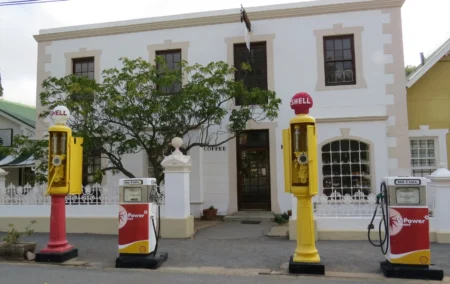
[Image: Antique fuel pumps at Matjiesfontein, reading “no fuel”. South Africa’s system of administered fuel prices is outdated, and must end. Sara Essop, 18 May 2014, used under CC BY-SA 3.0 licence.]

The views of the writer are not necessarily the views of the Daily Friend or the IRR.
If you like what you have just read, support the Daily Friend