
The miraculous transition from a limited form of parliamentary sovereignty to constitutional democracy for all came more than three decades ago in South Africa. The miracle was achieved after decades of struggle (some of it armed), years of painstaking negotiations, a National Accord, and, eventually, after compromises all round by those negotiating what was promised to be “a better life for all” in SA.
With high hopes, most of the people over 18 years of age in SA at the time queued to vote in the first open elections in a country in which all citizens are “equally entitled to the rights, privileges and benefits of citizenship”. A “rainbow nation” blessed with a government under the rule of law in which a multi-party system of democratic government to ensure accountability, responsiveness and openness was promised, by the founders of the new and supreme Constitution, to become the order of the day.
The above words are not wild and unfounded imaginings. They are a summary of the first two sections of the Constitution, our supreme law, which professes itself to be dedicated to respect for human dignity, the achievement of equality and the advancement of human rights and freedoms.
The Bill of Rights is Chapter Two of the Constitution. It requires that:
The state must respect, protect, promote and fulfil the rights in the Bill of Rights.
Sections 9 to 35 contain an exhaustive list of those rights, some of them subject to progressive realisation within the state’s available resources, some of them immediately available and claimable by all citizens. Available resources inevitably become more and more limited when rampant looting of state coffers is allowed with impunity for many years.
Lest it be thought that the notion of “a better life” is borrowed from the slogans of political parties, bear in mind that section 198(a) of the Constitution provides that:
National security must reflect the resolve of South Africans, as individuals and as a nation, to live as equals, to live in peace and harmony, to be free from fear and want, and to seek a better life.
Our national security services consist of a single defence force, a single police service and any intelligence services established in terms of the Constitution. All these services are currently in disarray in SA. The minister of police and its national commissioner (along with other top cops) are on precautionary suspensions, the head of crime intelligence has been arrested by IDAC, and morale in the defence services is low as budgets shrink.
That elusive “better life” has not yet materialised, except for a handful of politically well-connected South Africans. Gender-based violence, gangsterism, organised crime and corruption have conspired to make it so. The president in his February 2026 SONA has described organised crime and corruption as the greatest threats to our democratic order. He is right.
The Gini co-efficient of SA is higher now than it was at the dawn of democracy in 1994. It is a statistical measure of economic inequality, representing how income or wealth is distributed within a population on a scale from 0 to 1 (or 0% to 100%). A zero indicates perfect equality (everyone has the same), while 1 indicates perfect inequality (one person has everything).
South Africa’s Gini coefficient has remained among the highest in the world since 1994, generally fluctuating between 0.60 and 0.70. Inequality has persisted or increased post-apartheid, rising from 1995 to a peak around 2005, and sustained by high unemployment, education gaps, and an unequal tax/grant system. Recent data (2020s) places it around 0.63–0.67%.
In plain language, this means that too few have too much and too many have too little in SA today. According to Stats SA:
As of late 2025, approximately 37.9% of South Africans, or 23 million people, live below the lower-bound poverty line (LBPL) of R1,300 per person per month. While poverty has declined from 46.7% in 2015, high inequality, a 31.4% unemployment rate, and high costs of living mean a large portion of the population remains vulnerable.
This vulnerability is reflected in the unnecessary death by starvation of infants in rural areas, the stunting of thousands of our children due to their growing up hungry. Stunting is a lifelong health challenge which cannot be corrected either physically or mentally. To our national shame, roughly 30 children die daily in SA from starvation and extreme malnutrition. South African households that earn less than R1300 per person per month are not able to feed their young appropriately. At least one in four of SA’s children are stunted due to malnutrition. All this occurs while SA consigns to landfills about a third of the food it produces.
The unacceptably high unemployment rate of 31.4 % is a critical factor, if hunger is to be addressed. According to StatsSA, youth unemployment in South Africa is a severe structural crisis, with the unemployment rate for those aged 15–34 reaching 46.1% in early 2025. Over 4.6 million young people are jobless, with roughly 43% neither employed nor in education or training (called NEETs by those who study the phenomenon). Key drivers include a skills mismatch, poor schooling, lack of experience, and sluggish economic growth.
SA’s sluggish economic growth is a symptom of the lack of investor confidence in the future of the economy in the country. Cautious investors, both local and foreign, are apprehensive regarding the poor state of the rule of law in SA (evidenced by the suspension of several senior personnel in SAPS, low conviction rates achieved by the NPA and general dysfunction in the capacity of the state to counter corruption). Government policies around expropriation without compensation and Black Economic Empowerment give otherwise interested investors the jitters. The spat with Elon Musk has exacerbated investor apprehensions. The rise in violent crime and the recent sharp increase in kidnappings also tend to scare off investors. Calling in the defence force to deal with increased gangster-generated violence also does not inspire confidence in the ability of the police to do their work, nor has it proved to be a successful strategy against rampant gangsterism in the past.
According to the Chancellor of the University of the Free State, Bonang Mohale:
“The great problem for South Africa is rampant greed. [It] is essentially a problem for the once glorious African National Congress that has morphed into an organised crime syndicate, primarily because for a solid 30 years of our democracy, they held the absolute majority power in everything that matters”.
If he is right, the deadly sin of greed will remain unaddressed while SA lacks the capacity to end the corruption with impunity that infects the land. Failure as a state beckons. The learned professor regards SA as a failed state already.
The question for all interested in the future in SA to consider, as local government elections are shortly to be held, is whether the voters of SA are prepared to continue to tolerate the conditions sketched above. Can the middle classes continue to huddle in security estates, insulated bubbles serviced by private doctors, solar panels and private security services? Will the poor continue to meekly accept their lot in life in SA?
Too many registered voters elect not to vote: a wasteful attitude that expresses no confidence in the ability of politicians to bring about the necessary course correction in the country. Those who do vote too often do so out of party loyalty rather than from a clear-eyed analysis of the state of the country in 2026 and the qualities of the candidates contesting for votes. All political parties contesting elections in SA should address the issues of the day set out above in a manner that inspires thoughts and hopes of “a better life for all”. It is what SA set out to do more than thirty years ago. We have the blueprint in our Constitution. Building the political will to implement that blueprint is the task facing the electorate. Voting wisely is indicated.
Service delivery in SA occurs largely at local government level; but it is at that level that local government has failed to deliver on the promises of the Constitution. All voters, especially those in waterless and sewerage-soaked towns, should answer this question and vote with the answer in mind: “For how long will the ever-swelling ranks of our NEETS be prepared to continue to tolerate their lot in life in SA?”
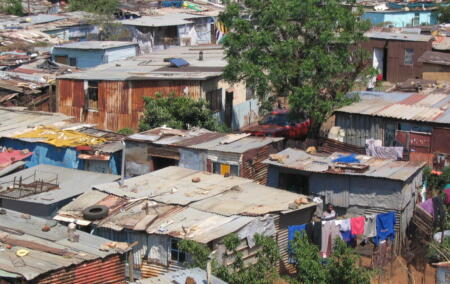
[Image: https://commons.wikimedia.org/wiki/File:Soweto_township.jpg]

The views of the writer are not necessarily the views of the Daily Friend or the IRR.
If you like what you have just read, support the Daily Friend