
On Monday earlier this week, US Secretary of State Marco Rubio sent greetings to South Africa on Freedom Day. There was nothing unusual in that, but the message was short and not sweet.
“Over the decades since South Africa’s democratic transition, this occasion provides an opportunity to reflect on the country’s history and future. As we look ahead, we remain open to constructive engagement where our interests align,” the message read.
By contrast, His Majesty King Charles III sent an effusive message noting the “warm friendship and strong and close partnership” between SA and the UK.
What Rubio was saying is that relations are poor and there are no current moves likely to bring about an improvement—but that talks remain possible.
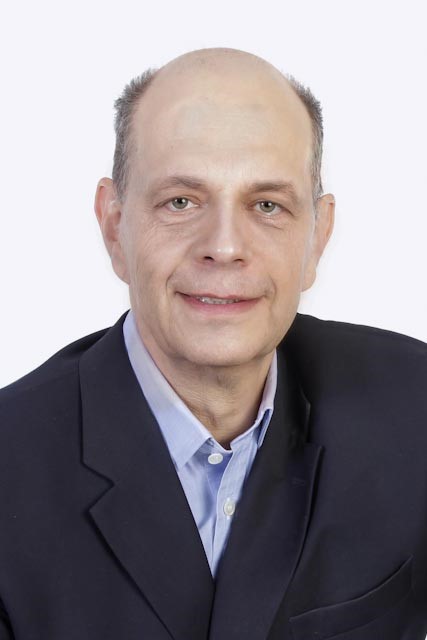
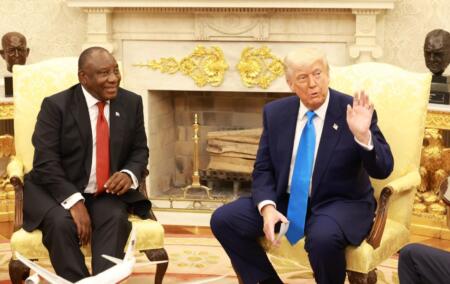
SA is now in a long stand-off with the Trump administration. Roelf Meyer, President Cyril Ramaphosa’s recent appointee as ambassador-designate to Washington, is meant to ease the relationship.
The expectation among many commentators and pundits that Meyer can do much to improve relations is unconvincing. Some take the view that Meyer is a safe pair of hands and that his past role as the National Party’s chief negotiator during the transition to democracy could help.
The Economic Freedom Fighters (EFF) are outraged by the appointment and say it is a “deliberate insult” to the struggle, done to appease “white supremacist whims.”
What the appointment might suggest is that the ANC believes that having a white representative in Washington is the way to convince the Trump administration not to be too tough on SA.
If there is indeed a racial component to Meyer’s appointment, the ANC is wrong in its reading of Trump. Above all, Trump likes praise. Herman Mashaba, leader of ActionSA, has at least in the past been full of praise for Trump.
But no ambassador can break SA’s stand-off with the US. That lies firmly in the Union Buildings and within ANC party politics.
The Trump administration has said it wants movement on four points to improve relations. First, it wants farm attacks to be classified as priority crimes so that they receive greater attention. Second, it insists that the act allowing expropriation of property without compensation not be used. Third, it wants to see a condemnation by the ANC of the “Kill the Boer, Kill the Farmer” chant. Fourth, it does not want black empowerment regulations applied to US companies.
While not among these four points, it is also crucial to ending the stand-off that the US be convinced that SA is, in fact, non-aligned.
Meyer has charm, is affable, and is probably well suited to a diplomatic role. He could do well lobbying the US on trade issues and help avoid further damage. But he cannot do much more.
Overall, it appears that Meyer will be more of a placeholder, serving to show that relations between SA and the US have not deteriorated to the point where Ambassadors are withdrawn.
But the signs are that Ramaphosa may have almost given up on the relationship with the US and is actively searching for alternatives. SA might be waiting out Trump’s term and hoping for better. The ANC view might be that of SA will simply have to bear the price of Trump in the meantime.
SA was recently excluded by the US from attending a Group of Twenty (G20) finance ministers meeting in Washington. It will not be invited to attend the G20 Summit the US will host later this year, nor be allowed as a special guest at the G7 Summit that France will host in June. This is not catastrophic, but it does hurt. Such meetings offer valuable opportunities to engage with other world leaders.
The US might also deny visas to some prominent South African politicians wishing to attend the World Cup later this year.
The ANC might be hoping that the Republicans lose control of Congress in the November midterm US elections. It may also be betting that another Make America Great Again (MAGA) candidate is not elected president in November 2028.
However, the Democrats might also adopt a tough stance toward SA. After all, relations were already deteriorating under the Biden administration.
In the longer term, the ANC may be persuaded that the US is in decline and that its global role will be greatly reduced. High public debt, an overstretched military, NATO allies seeking alternatives to dependence on Washington, and the rise of China could all contribute to a more multipolar world. And this could result in an international realignment that the ANC would want.
But this view overlooks the fact that US productivity leads the world, its growth rate outpaces Europe’s, its military remains the strongest globally, and it continues to lead in AI and other key industries. For now, there is also no viable alternative to the dollar as a global reserve currency. Yes, the world is changing—but not necessarily in the ANC’s favour. The emerging world order will also be without some of the ANC’s traditional allies: a Venezuela under Chávez, an Iran that exports revolution, and possibly a Marxist Cuba.
Many European countries are increasingly alarmed by the Trump administration but continue to tread carefully in their dealings with the US.
SA is now actively trying to mobilise like-minded countries under the banner of a “global progressive revival.” Ramaphosa’s allies in this initiative include Spanish Prime Minister Pedro Sánchez and Brazil’s President, Lula da Silva. Given the rhetoric, Washington is likely to be annoyed.
“This is an opportunity to confront the forces of reaction, who have gained much ground by offering people easy answers to complex problems,” Ramaphosa said in a speech in Madrid earlier this month.
He added that the “revival” stands against “unlawful wars of aggression and genocide in places like Palestine linked to ideologies of superiority…”
Other issues on the agenda include addressing the “climate crisis” and inequality within and between countries.
SA is attempting to present what it calls “progressive internationalism” as a moral alternative to the “forces of reaction.” In a recent letter to the Sunday Times, foreign affairs officials said this approach is about “non-alignment, multilateralism and a proper application of international law.”
It is hardly non-alignment when SA repeatedly conducts naval exercises with Iran, Russia, and China. Should a “progressive revival” not also champion human rights?
If the “progressive revival” demonstrated firm principles on human rights and genuine neutrality, it might be seen as less of an anti-US project.
There is, ultimately, not much that South Africa’s ambassador to Washington can do for the moment.
[Image: https://www.flickr.com/photos/governmentza/54537186943/in/photolist-2r6gkCB-2r6f8Q8-2r6gkC1-2r6f8Qd-2r6g5vD-2r6f8Pr-2r6aBK2-2r6gT9j-2r6gT8H-2r6aBJv-2r6g5ug-2r6f8NE-2r6f8MY-2pNHfjp-2pM88fD-2pM7rUy-2pM7rUi-2pM8CWP-2pM7rUt-2pzMsN8-2pzMsMS-2pzEKyU-2pzLc97-2pzKdtX-2pzEKyP-2pekuAY-2pem6CH-2pem6CC-2pem6Cx-2peeem4-2pem6C2-2pekuyU-2pekuyZ-2p3Y6ff-2p3YDRE-2p3Y6fk-2p3UzEZ-2oYUoA1-2oYUKrn-2oYPf62-2oYUKrH-2nDu4p9-2nDsHwx-2nDu4oc-2nDsPcc-2nDvbZt-2ntQmNm-2ntSMK8-2ntQmME-2ntSMK3]
The views of the writer are not necessarily the views of the Daily Friend or the IRR.
If you like what you have just read, support the Daily Friend