

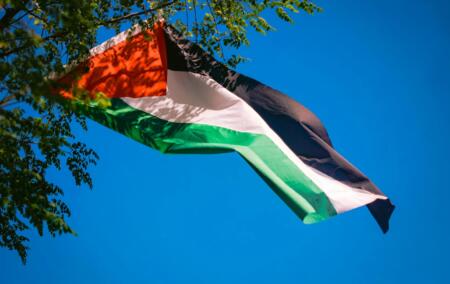
The recent ‘Palestinian flag row’ at Houghton Golf Club sparked widespread anger among many South Africans, but much of the reaction appeared to sidestep the merits of the incident, instead taking on a strongly emotional and, at times, reactionary tone. As expected, we are seeing a few political bandwagoners such as the EFF and ANC using this issue for political and electoral mileage.
These two parties, which are fixated on their anti-Israel tirade, did not take the time to establish facts before spewing hatred. Instead, they acted prematurely by not establishing whether the subject of the matter was a member of the said golf association or not.
The anger displayed by these two opportunistic political parties is deeply misplaced for several reasons. It does not require rocket science to understand that any structure, whether social, political, or economic, is governed by a set of rules which members or those associated with the organisation are not only expected to be familiar with, but also to adhere to. Where those rules are violated, there are inevitably consequences in the form of appropriate disciplinary or punitive measures for any misconduct committed.
The mainstream media has not really probed the rules governing the Houghton Golf Club. It is still not clear if this particular Louis Seeco is a member of the club or not. Is he aware of the club’s rules, and does he even abide by the set rules of this organisation?
The club has made it clear that it caters to people of all backgrounds in South Africa, Jews, Muslims, Christians, Buddhists, and many others, which necessitates a high degree of sensitivity when it comes to political, religious, and cultural matters. It is not oblivious to the deeply divisive nature of the Israel–Palestine question globally, and therefore seeks to avoid having its premises turned into a political battleground where individuals feel compelled to defend their positions, rather than simply enjoying the game of golf.
“The Club does not promote, endorse, or take positions on political or religious causes. Our purpose is simple and clear: Houghton Golf Club is a golf club: an environment; all political and religious flags or symbols are not permitted anywhere on Club property,” the Club’s policy states.
It is a straightforward rule of the club that members should refrain from bringing politics or religious expression onto its premises to preserve neutrality. In a country like South Africa, characterised by rich multicultural diversity, it is essential to maintain such neutrality on matters of politics, faith, and culture, while fostering a shared sense of common aspirations and values that all can embrace. It would be understandable if other flags or symbols were demonstrating political or religious sides, but there were none; Seeco was the only one displaying his flag. He was made to adhere to the existing rules, just like anyone entering the premises of the Club. There was no need really to orchestrate or stage an outrage.
Associations like the Houghton Golf Club should be supported rather than targeted by unruly elements, as they play an important role in bringing together South Africans of different faiths, races, languages, and backgrounds.
It is increasingly evident that parties such as the EFF and ANC often thrive on division, particularly along racial lines. Many of their politicians have failed to meaningfully address the pressing issues affecting local communities and have instead shifted public attention toward international matters. Notably, both parties, despite being part of the local government in Gauteng, remained largely silent when residents in Johannesburg, Ekurhuleni, and Tshwane faced severe water shortages earlier this year. One is left to ask: why was there no similar mobilisation or public outcry then?
[Image: https://www.pexels.com/photo/palestine-flags-waving-behind-tree-19322197/]
The views of the writer are not necessarily the views of the Daily Friend or the IRR.
If you like what you have just read, support the Daily Friend