

In a rare display of unanimity, France’s National Assembly voted 254-0 this week to repeal the “Code Noir,” or Black Code, a decree signed in 1685 by King Louis XIV in order to govern slaves across France’s colonies.
The decree turned human beings into chattel, allowing them to be worked, beaten, sold, raped and killed.
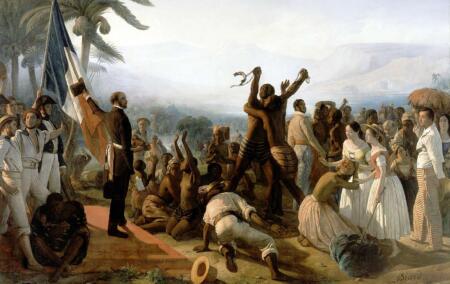
Although France abolished slavery in 1848, the Code Noir languished among the statutes … until this week, and a vote that is viewed as an important step in reckoning with France’s colonial past.
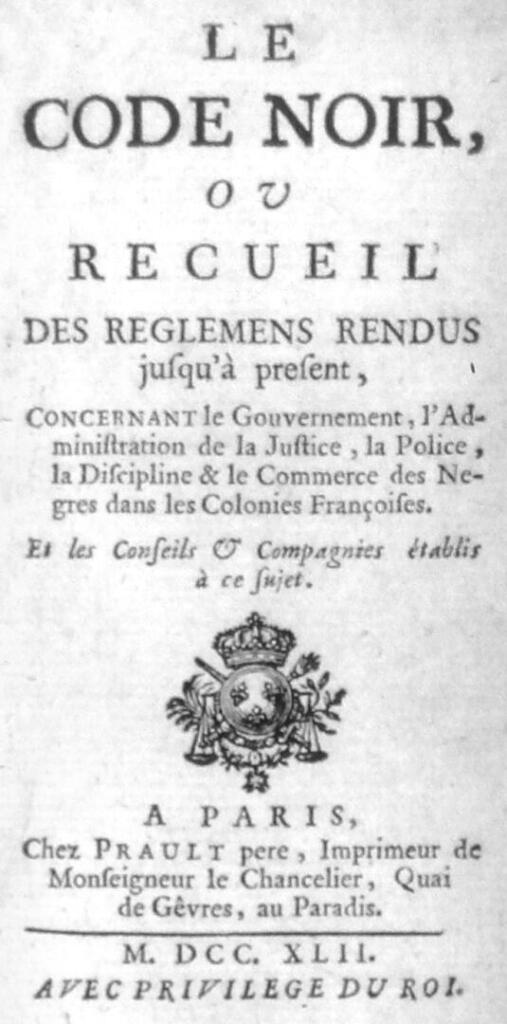
[Frontispiece of the Code Noir, 1742 edition]
The 60 articles within the code encompassed every aspect of a slave’s life. Article 44 declared a person “movable property”, while other clauses decreed those who fled be mutilated, and that the word of an enslaved person counted for nothing.
The Code Noir, President Emmanuel Macron said last week, “should never have survived the abolition of slavery” in the 19th century.
“The silence, even the indifference, that we have maintained for nearly two centuries towards this Code Noir is no longer an oversight. It has become a form of offence,” he said.
Macron added that the issue of reparations was one “we must not refuse”, but the country “must not make false promises”.
France was the third-largest slave trading nation, after Britain and Portugal. It shipped an estimated 1.4 million Africans to sugar plantations in its colonies. The wealth it produced are said to have built the cities of Nantes and Bordeaux.
The wealthiest of those plantations were on Saint-Domingue, a French colony on the western third of the Caribbean island of Hispaniola, established in 1687. In 1804, those enslaved in the colony rose up, securing independence in the territory that became Haiti. However, Paris forced the freed slaves to pay reparations to cover their owners’ losses, a debt they were still paying until 1947.
Max Mathiasin, a French MP from Guadeloupe in the southern Caribbean, who tabled the motion repealing the law, said he had bought copies of the original text but had never got around to reading them.
He is quoted as saying: “As the great-great-grandson of people who were enslaved, I had never been able to read it in full. This was made by human beings, against human beings.”
Mathiasin said the vote was “a way of restoring our ancestors, restoring our humanity”. It meant living up to the French Republic’s promise of liberty, equality and fraternity.
After abolishing slavery, France maintained a number of its colonies. The four oldest – Guadeloupe, Martinique, French Guiana on the north-eastern coast of South America and the island of Réunion in the Indian Ocean – were made French overseas departments in 1946. Their 1.9 million population, most descended from enslaved people, are French citizens and governed from Paris.
Although regarded part of France, they remain some of its poorest territories with unemployment almost double the rate in mainland France, with many households living below the national poverty line.
Pierre-Yves Bocquet, the deputy director of France’s Foundation for the Remembrance of Slavery, said the code was at the root of the country’s “colonial exception”, installing the idea that the founding motto of the French republic did not apply to certain people under its rule.
“Even today, we accept that people in the overseas territories can have fewer rights than in mainland France,” he said.
The repeal of Code Noir, said Bocquet, “will have no direct effect”. Whether it helps France fight racism and inequality in its overseas territories, he said, “remains to be seen”.
Steevy Gustave, an MP from the French island of Martinique in the Caribbean whose ancestors were enslaved, was tearful as he told the national assembly this week: “No vote alone can repair centuries of shattered lives.
“We are not descendants of slaves, we are descendants of human beings born free, then reduced to the worst – reduced to slavery.”
Some do not regard this week’s vote as the milestone it appears.
For Florence Alexis, a slavery expert and daughter of the Haitian writer Jacques Stephen Alexis, the real turning point came 25 years ago. In 2001, the Taubira law made France the first country to call the slave trade, and slavery, crimes against humanity.
She is quoted as saying: “It is easy for the French authorities, and for Macron, to do this, because it commits them to nothing.”
Sources: France24, Associated Press, The Guardian
[Image: Proclamation of the Abolition of Slavery in the French Colonies, 27 April 1848, 1849, by François Auguste Biard, Palace of Versailles]