

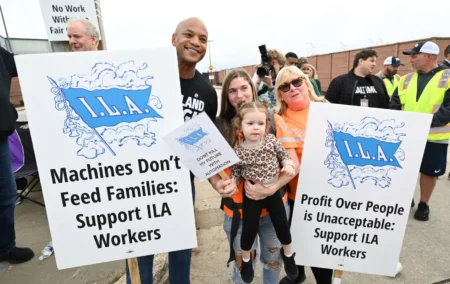
With every wave of automation, there are those who cry wolf about mass unemployment. Yet it has always been the engine of progress and prosperity.
Every generation discovers anew the terror that machines will render human labour obsolete. Every generation has been wrong.
The fear is older than computers. It is older than the assembly line. It is older than the printing press.
That fear is now back, in the over-hyped garb of artificial intelligence. We are told the robots are coming for our livelihoods, that this time the disruption is categorically different, that we stand at the precipice of mass technological unemployment.
One of the AI-positive billionaires, Elon Musk, predicts a future in which jobs are optional: you can work if you want to, but if you don’t, that’s also okay, because robots will produce everything you need.
He is wrong. We do not stand at the threshold of mass unemployment, whether voluntary or otherwise. We stand, as our ancestors did, at the threshold of greater prosperity.
Wrong calls
The fearmongering is neither new nor subtle.
In 2013, a widely cited study by Carl Frey and Michael Osborne stated the following: “According to our estimate, 47% of total US employment is in the high-risk category, meaning that associated occupations are potentially automatable over some unspecified number of years, perhaps a decade or two.”
That figure was repeated breathlessly across newsrooms and conference stages, becoming a kind of secular doomsday clock. Two thirds of “a decade or two” have now elapsed, and yet American unemployment in recent years has hovered near historic lows.
Elon Musk has warned repeatedly that AI will render human work unnecessary.
Andrew Yang built an entire 2020 presidential campaign on the premise that automation had already gutted American manufacturing and was coming for truckers, retail workers, and call-centre staff next. That necessitates, in his telling, an urgent universal basic income to cushion the inevitable collapse.
Trump won, in part, because he bet against this: he promised to revive blue collar employment in the US – a promise he has yet to fulfil.
Echoes of history
Go back further and this fear echoes through history.
In 1930, John Maynard Keynes famously coined the term “technological unemployment”, though he at least had the wisdom to frame it as a temporary phase of adjustment.
In 1964, a group of intellectuals calling themselves the Ad Hoc Committee on the Triple Revolution sent President Lyndon Johnson a memorandum warning that “cybernation” – that is, automation by computer – would sever the link between jobs and income and produce permanent mass unemployment.
Its argument sounds almost exactly like the one we hear today: machines will establish “a system of almost unlimited productive capacity”, reducing the number of labourers needed and raising the skill level required to find productive employment, ultimately resulting in unavoidable structural unemployment.
And it is far from just a 20th century fear. Way back in 1589, Queen Elizabeth I refused William Lee a patent for his stocking-knitting machine, saying: “Thou aimest high, Master Lee. Consider thou what the invention could do to my poor subjects. It would assuredly bring to them ruin by depriving them of employment, thus making them beggars.”
The workers and those who claim to speak for them have been crying wolf for a very long time, and yet the sheep are more numerous and better fed than ever.
Job destruction is desirable
While automation and artificial intelligence will not cause a substantial increase in unemployment, they will make many jobs easier, or entirely obsolete.
And that is a good thing. Jobs ought to be destroyed. The more work that can be automated, the better off we’ll be. It has always been thus.
For most of human history, the overwhelming majority of people worked in agriculture, scratching subsistence from the soil.
In the United States around 1800, eight or nine of every ten workers was engaged in farming. Today that figure is under 2% – and yet Americans eat more than ever, and export the surplus to the rest of the world.
What happened to the displaced 80%? They did not starve, nor did they sit idle while the 2% of workers employed in farming fed them.
The tractor-pulled plough, the combine harvester, the mechanical planter, synthetic fertiliser, and selective breeding made agriculture many times more productive than it had ever been. It obliterated agricultural jobs by the tens of millions.
And precisely because those jobs were destroyed, human hands and minds were freed to do everything else: to manufacture goods, cure diseases, build cities, compose music, and write columns warning against the fear of automation.
Every productivity revolution builds upon the last
Had we frozen agricultural technology in 1800 to “protect jobs”, we would have preserved not employment but poverty. The destruction of farm labour was not a tragedy to be mourned; it was the foundation of the prosperity that followed.
This is the essential and counterintuitive truth: to become more productive, it is necessary to automate work. Productivity means producing more with less human effort – and “less human effort” is not only a synonym for “greater productivity”, but also for “destroyed jobs”.
The two are not in tension. They are the same phenomenon viewed from opposite ends. Think Schumpeter’s “creative destruction”.
We don’t want millions of people ploughing with oxen. We don’t want thousands of people milking cows. We don’t want people to hoe and weed and harvest by hand.
We want people to be free to do more productive things.
As farms gave up their workers, the newly free workers sold their labour to factories. The Industrial Revolution offers the most famous protest against this logic, and its most famous failure.
The followers of the mythical Ned Ludd of early-nineteenth-century England smashed the mechanised looms and stocking frames they believed were stealing their jobs.
They were not stupid; their individual fears were often well-founded, for particular weavers in particular towns did lose their traditional livelihoods.
But the aggregate verdict of history is unambiguous. Mechanised textile production collapsed the price of cloth, put better clothing within reach of the common person for the first time, and created vastly more employment in mills, railways, shipping, and the dozens of industries that grew up around cheap textiles and cheap energy.
The steam engine displaced the muscle of men and horses, and in doing so multiplied human output beyond anything the agrarian world could imagine.
Real wages, after the wrenching early decades, climbed and kept climbing. The descendants of the Luddites did not inherit unemployment. They inherited a standard of living their loom-smashing ancestors would have considered the stuff of kings.
Typists and clerks
There is a far more recent example, within living memory. When I went to school in the 1980s, the girls (and only the girls) were taught typing, on mechanical typewriters. (The boys got to do manly things like woodwork and metalwork.)
Ironically, not even the girls would ever use their ability to operate a mechanical typewriter, and here I am, with a life-long career based entirely on the ability to type.
The typing pool was once a fixture of every large office: rows of typists, almost always women, transcribing dictation and producing correspondence. Armies of clerks maintained ledgers by hand, filed paper, and performed arithmetic that we now offload to a spreadsheet without a thought.
The personal computer and office software annihilated these jobs. The work done by bank tellers was replaced by automated teller machines. Postmen, post office clerks, and company mail room workers were almost entirely replaced by email.
But are our streets filled with throngs of angry, unemployed clerks and typists, hurling bricks through the windows of computer stores?
When ATMs proliferated, the obvious prediction was the extinction of the bank teller. Yet the number of tellers did not collapse for decades; ATMs made each branch cheaper to operate, banks opened more branches, and tellers shifted from counting cash to relationship-based work that machines could not do.
The computer revolution did not produce a generation of unemployed typists. It produced a vastly larger economy of software engineers, IT support staff, digital designers, data analysts, and entire professions that did not exist before – roles that the typist, or her daughter, could fill, and at far higher wages.
Repeating pattern
The internet repeated the pattern at compressed speed. It gutted travel agencies, classified-advertising departments, video-rental chains, and much of the print-media business model.
Travel agents were a textbook casualty. And yet the internet birthed e-commerce, digital advertising, the app economy, cloud computing, streaming media, and the sprawling ecosystem of online businesses that now employs many millions and serves billions.
The video store clerk’s job vanished, as did the video store. Yet the work of producing, distributing, and recommending streaming content employs far more people and creates far more value than the film, television and video industry of yesteryear ever did.
Lump of labour
The reason the doomsayers are perennially wrong rests on a fallacy: the belief that there exists a fixed lump of work in the world, so that any task given to a machine is a task taken from a human.
This “lump of labour” fallacy is false. Human needs and wants are effectively unlimited.
When automation makes existing goods cheaper, it frees up income and effort to satisfy wants we could not previously afford to address. In doing so, it creates entirely new categories of work.
There is no fixed quantity of jobs any more than there is a fixed quantity of human desire.
What is required is not protection from the machine but the freedom to adapt to it: open markets, flexible labour, light regulation, and an education system that prizes adaptability over the memorisation of soon-obsolete skills.
These are the same policies that are required to prevent unemployment in the first place. These are the same policies that South Africa so desperately lacks, which explains why “labour-intensive public works” is not a solution to unemployment.
Although it seems likely that South Africa’s actual unemployment rate is much lower than the official rate suggests, increasing the cost of producing things by deliberately employing more people than are needed to do so is a waste of resources, and makes the South African economy less productive, less competitive, and ultimately, less prosperous.
Is AI any different?
Artificial intelligence is a tool of automation; the latest and most powerful in a four-thousand-year sequence.
It will destroy jobs. This column does not deny it, but insists upon it, because that destruction is the mechanism of progress.
Tasks that are routine, predictable, and codifiable will increasingly be done by machines, just as ploughing, weaving, calculating, and filing were before them. And so, they must be.
AI seems awesome in its ability to mimic human behaviour, but we should take care not to over-estimate AI.
What we commonly refer to as “AI” is mostly limited to large language models, or LLMs. These are very good, very large mathematical models, but they do not comprehend what they are doing. They have no understanding. They are not human. They cannot make moral choices, or intuitive decisions.
They only seem human because they mirror things humans created in the first place. They’re feeding our own intelligence back to us, and saying, “Look how clever we are!”
System 1 and 2
More specifically, what LLMs are capable of could be considered System 1 thinking.
Daniel Kahneman’s dual-process theory of thought, detailed in Thinking, Fast and Slow, describes two modes of thought: System 1 is fast, automatic, intuitive, and effortless, while System 2 is slow, deliberate, logical, and effortful.
System 1 operates continuously and unconsciously, relying on heuristics and past experiences to generate quick judgments and emotional responses. It handles routine tasks like reading facial expressions or driving on an empty road, but is prone to cognitive biases and errors when facing complex or novel situations.
System 2 allocates attention to complex computations, self-control, and critical thinking, such as making moral choices, or solving complex problems. System 2 thinking normally operates in a low-effort mode, endorsing System 1’s suggestions, but is activated when System 1 encounters difficulties or when deliberate reasoning is required.
Beyond LLMs
Some of the best models, when given excessive computing power, can do things that look like System 2 thinking. Some have solved previously-unsolved problems in mathematics, for example.
But mathematics (like coding, which LLMs do with alacrity) is a formal, unambiguous language. It is far easier to do pattern recognition on a well-structured, well-defined, and well-circumscribed body of knowledge like maths or computer programming than it is to think about the sort of unstructured, poorly defined, emotion-filled and subjective reality that humans deal with daily.
AI is not (yet) good at System 2 thinking. It could be, but that would require far more than just a pattern-matching language model. It would require a world model, which would enable a computer to draw inferences from a digital representation of the world just like we draw inferences from the physical world around us.
Constructing such world models is possible, in principle, but we’re a long way away from anything that could be described as System 2 thinking in computers.
And even then, they’d be good at physics and biology, but probably not at psychology or weighing moral choices.
Universal basic income
These observations about AI as just another wave of automation, no different from those that came before it, merits a digression on universal basic income.
This is widely sold as a lifeboat against the coming flood of permanent unemployment, but it is an answer to a problem that does not exist.
The flood of unemployment is not coming. A UBI may be defended on other grounds: in a wealthy society, a simple unconditional cash floor could replace the tangled, interventionist, and often perverse machinery of the existing welfare state, reducing bureaucracy and respecting the dignity of recipients to spend as they judge best. Respectable classical liberals can debate this on its merits.
But it is nothing more than a welfare reform. It is not a necessary emergency measure.
Countries that keep their economies free and their markets open have nothing to fear from automation-driven mass unemployment, because such unemployment has never materialised and the economic logic explains why it never has.
Adopt a UBI if it makes for better, leaner welfare. Do not adopt it in a panic about robots.
But what will we do?
The usual debate-ender about the threat of AI, or the necessity of a UBI, is, “But what work will fill the space AI clears?”
Elon Musk clearly can’t think of anything useful for most of us to do, once AI takes all our present jobs. (But then, he is over-rated.)
The reason it is a debate-ender is not because that question has no answer, but because we do not, and to a large extent cannot, know the answer.
By definition we cannot fully know. The typist could not have described “influencer”, or “content moderator”, or “web designer”. The clerk could not have anticipated “online tutor”, “SEO specialist”, or “mobile app developer”.
And yet the internet created 2.4 jobs for every job it destroyed.
Let’s speculate
We can speculate sensibly. As machines master the codifiable – the sort of jobs that can be reduced to repeatable, predictable patterns – human comparative advantage will shift toward what remains stubbornly human: judgement under genuine uncertainty, persuasion, care, taste, and trust.
Expect growth in roles that direct and audit AI systems: prompt designers, model auditors, AI ethicists, and the engineers who build and maintain these systems.
Expect a premium to be paid for deeply human jobs: nurses, therapists, coaches, artisans, hospitality, and live entertainment, where the point is partly that a person is doing it.
Expect new industries born of AI-driven abundance, as cheaper intelligence makes previously uneconomical ventures viable. Think things such as low-cost personalised medicine, bespoke education tailored to every individual, space-related industry and ocean resource development, and forms of creativity and craft we have no name for yet.
But specifically? For every new job I can anticipate, there will be ten more I can’t even begin to imagine. Your guess is as good as mine, and if yours is any good, you’re on a good wicket.
Adapting, and getting richer
Yes, it means that education will have to adjust to focus less on mechanistic skills and more on social, creative, inventive, or frontier research skills. But education has always needed to keep up with the times.
(Those girls who were trained to be typists at my school were victims of a school system that trained people for the jobs of ten years earlier, instead of for the jobs they’d actually have ten years in the future.)
Workers have cried wolf about automation for hundreds of years.
Each time, the relentless march of progress paid them no heed. Each time, jobs got automated away. Each time, we found better things to do with our hands and our hours. Each time, society – including the poor – became more prosperous.
Each time, unemployment remained a function of socialist ideology, corruption, cronyism, patronage politics and misguided intervention to “create jobs”.
There is every reason to believe that history will repeat itself.
We are on the cusp of an unpredictable new world, but it will not be a world of mass unemployment.
[Image: ILA.webp]
Caption: Maryland governor Wes Moore joins anti-automation protesters during the October 2024 dockworkers’ strike along the east coast of the US. (Photo supplied.)
The views of the writer are not necessarily the views of the Daily Friend or the IRR.
If you like what you have just read, support the Daily Friend