

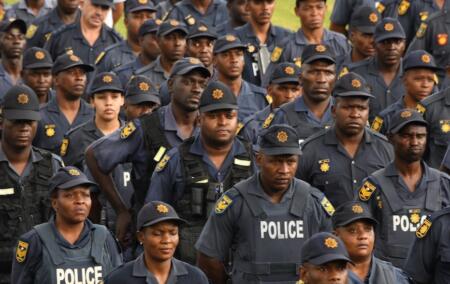
Tomorrow, the March and March movement plans to enforce its own “deadline” for undocumented foreign nationals to leave South Africa. In readiness for any trouble, the state has deployed police, with the South African National Defence Force on standby, at a cost of around R600 million. Private security companies, including Fidelity, have offered armoured vehicles, helicopters and drones to support the police response. Three foreign nationals have already been killed in the run-up to the deadline.
Whatever happens on the day, the more important story is the one already written. 30 June is not the first time the state’s claim to a monopoly on the legitimate use of force in South Africa is being tested. It was tested in July 2021, when ten days of unrest following Jacob Zuma’s jailing cost the logistics sector an estimated R50 billion, destroyed more than 200 shopping centres and malls, and left trucks burning on the N3 for days with no effective state response. South Africa failed that test; will 30 June confirm the long-term trend that the South African state is losing its monopoly on force?
A state that loses control for one week and restores it is in crisis. A state that loses control repeatedly, in predictable and escalating ways, over five years, has a structural problem; the evidence points to the second.
Consider who is making the public case for the state’s responsibility – and who is declining it.
The March and March movement’s founder, Jacinta Ngobese-Zuma, has said her organisation will accept no responsibility for any violence connected to 30 June.
“Whose responsibility is it to protect the country?” she asked. “Is it us? It’s definitely not our responsibility.”
She is right that public order is the state’s job. The fact that a private movement feels entitled to set a national deadline, expects the state to manage the consequences, and disclaim all responsibility for what follows, is itself a sign of how little the state’s authority now constrains behaviour.
The danger here is not 30 June in isolation. It is what an unaddressed pattern does to South Africa over years.
Price of capital
The first cost is to the price of capital. Investors do not price in single events; they price in patterns. A country where logistics corridors, commercial districts and municipal order break down periodically, without timely and decisive state response, carries a structural risk premium in its currency, its bond spreads, and its insurance and reinsurance costs. That premium does not fall when the immediate crisis passes. It falls only when the pattern stops repeating, and it has not stopped repeating since 2021.
The second cost is the quiet privatisation of security. Mining houses, logistics firms, retailers and now apparently private security companies fielding armoured vehicles and drones are building permanent capacity to do what the state cannot reliably do. This indefinitely raises the fixed cost of operating in South Africa. It also entrenches a two-tier country: those who can buy protection, and those who depend on a state that increasingly cannot supply it.
The third cost is to investment that cannot be reversed quickly. To be sure, portfolio capital flows out and can flow back in. But factories, distribution centres and warehouses cannot be relocated on a six-month view. Once logistics planners start routing around South African corridors as a standing risk-management decision rather than a temporary precaution, that decision is difficult to undo even if conditions improve.
The fourth cost is fiscal, and it connects directly to Johannesburg’s current crisis. A state that cannot secure public order in a city will struggle to collect revenue, maintain infrastructure, and service debt in that city. Security failure and fiscal failure are not separate problems – they reinforce each other.
The fifth cost is the slowest to show up and the hardest to reverse. When people stop expecting or trusting the state to protect them, they organise their own protection, often along community, ethnic or political lines. This is the mechanism, slow and steady, by which a state’s monopoly on force disappears. This is the sum of many small, locally rational decisions to stop waiting for a state that has not shown up before and cannot be relied upon to show up next time.
Sustained work
None of this is inevitable. South Africa’s police and defence force can still hold the line in most places, most of the time, and the planning ahead of 30 June shows a state capable of taking the threat seriously when it chooses to. The test is not whether the state can deploy R600 million and a defence force backstop for one day under close public scrutiny. It is whether it can do the unglamorous, sustained work of enforcing the law consistently, in the small towns and townships where nobody is watching, long after the cameras and the commentary have moved on.
The country has roughly five years of evidence that it has not passed that test. Tomorrow will add one more data point. What happens after will either hasten or halt state capacity deterioration.
[Image: https://www.flickr.com/photos/governmentza/49703580768]
If you like what you have just read, support the Daily Friend