

Following last week’s reshuffle of the GNU cabinet, South Africa has a new minister of forestry, fisheries and the environment, the DA’s David Maynier. The country also needs a new approach to climate change: one that is far more realistic than the “net zero” illusion and helps achieve the GNU’s promise of growth, jobs and renewed industrialisation.
The net zero goal
The “net zero” goal was put forward in 2018 by the UN’s International Panel on Climate Change. It aims to ensure that, on a “net” basis (in which man-made emissions released into the atmosphere are weighed against those taken out), there are no additional CO₂ emissions across the world from 2050 onwards. That goal is unrealistic and cannot be attained.
As renowned climate expert Dr Bjørn Lomborg wrote in The Telegraph in the United Kingdom (UK) in May 2026: “In 2006, the world generated 82.6 per cent of its total energy (not just electricity) from fossil fuels, according to the International Energy Agency. In 2023, the last year with global data, the share was 81.1 per cent.”
Reliance on fossil fuels cannot in practice be substantially reduced because emerging giants such as China and India, both with populations of around 1.4 billion, need cheap and reliable energy to generate growth and reduce poverty. Already, thus, the rich world accounts for “only 13 per cent of remaining 21st-century emissions,” adds Dr Lomborg. Hence, “even if all rich countries achieved net zero by mid-century, it would avert less than 0.1°C of warming by 2100, using the UN climate panel’s own model.”
Net zero costs and consequences
The costs of trying to attain net zero total some $16 trillion since 2006 – and are likely to increase further to tens of trillions of dollars a year. The renewables currently seen as crucial to the net zero drive might be fuelled by free sunshine and wind, but their costs are nevertheless enormous because of the duplication they require.
Energy from solar panels and wind turbines is always intermittent, whereas modern societies require reliable electricity around the clock. This necessitates substantial back-up systems. Batteries are supposed to satisfy this need but cannot do so for more than ten or so minutes. Hence, most back-up comes from fossil-fuel power plants.
Every country that switches to renewables to help achieve net zero pays twice over: once for its renewables and then again for reliable back-up power. Resulting high energy costs are triggering de-industrialisation and extensive job losses in various European countries, including Germany and the UK.
Lessons from Germany and the UK
In Germany, once a model of green ambition, public support for the country’s “Energiewende” has dwindled in response to high electricity prices and an exodus of manufacturing capacity. Some 300,000 industrial jobs have been lost since 2019, while a further 150,000 are likely to vanish in 2026, says Gesamtmetall, Germany’s Employers’ Association in Metal and Electrical Engineering. According to a recent member survey conducted by the Machinery and Equipment Manufacturers Association, “40 per cent of all companies are thinking about moving manufacturing abroad.”
The picture in similar in the UK, where non-domestic electricity prices have risen by some 68% since 2019. Not surprisingly, energy-intensive sectors – such as steel, chemicals, and plastics – have contracted sharply, resulting in hundreds of thousands of job losses.
A recent report, entitled Premeditated Industrial Destruction? and written for the Great British Business Council, a UK-based business policy group, captures much of the malaise. The number of oil refineries in the UK has dropped from 18 in the 1970s to four. Steel production capacity has declined from around 15 million tonnes to roughly six million over the past ten years. Chemical output has diminished by some 40% since 2021.
This last loss is particularly serious because various “foundational” chemicals are “essential in the production of plastics, fertilisers, pharmaceuticals, industrial materials, most consumer goods and scores of other products,” as The Telegraph recently reported. If factories producing foundational chemicals continue to close, the UK will become ever more dependent on imports for all such items.
Through its determined pursuit of net zero, the UK has reduced its emissions by roughly 290 million tonnes of CO₂ since 1990. In the same period, however, global emissions have increased by around 1.07 trillion tonnes. What then has the UK achieved in terms of the net zero goal?
South Africa and net zero
South Africa should avoid treading the same path as Germany and the UK. Already, however, the ANC has embraced the net zero approach via the Climate Change Act of 2024. This was adopted by Parliament before the May 2024 election and signed into law in July, soon after the GNU was formed. Parts of the Act were brought into force in March 2025. However, provisions dealing with carbon budgets and mitigation plans require the prior adoption of ministerial regulations.
Draft regulations were gazetted for public comment in August 2025. Fortunately, however, they have yet to be adopted. The GNU can thus draw back from their flawed approach – and rethink how best to cope with climate change.
The draft regulations cover most of South Africa’s industrial base, from electricity production to mining, cement, iron and steel, aluminium and chemicals. The emissions threshold they set – at 30,000 tonnes of CO₂ equivalent a year – is low enough to sweep in not only the largest emitters but also mid-tier firms lacking the specialist resources of multinational corporations.
Eskom and all other companies with emissions above this arbitrary threshold will have to comply with mandatory carbon budgets and costly mitigation plans. They will also have to submit comprehensive annual compliance reports, backed by extensive third-party verification. For many companies, this in itself will be a major burden.
Non-compliance will be punishable by fines of up to R10 million and/or prison terms of up to ten years for directors. In addition, companies that exceed their carbon budgets will face higher carbon tax rates. Effectively, non-compliance will often be punished twice.
The biggest risk is that Eskom will be pushed into the premature decommissioning of its coal-fired power stations before reliable and affordable alternatives are in place. This could trigger a return to costly loadshedding at levels worse than in the 2023 peak year. Little could be more deadly to business confidence and the country’s growth potential.
As the IRR commented in its submission: “The draft regulations run directly against the commitments made by the GNU to revive growth and create jobs. Deindustrialisation is advancing, with mining and manufacturing shedding capacity instead of adding it. Eskom is struggling to restore reliability after years of loadshedding, while mining and heavy industry already face crippling energy prices. Imposing inflexible carbon budgets in this context risks forcing premature plant closures and major production cuts.”
Innovation, adaptation and growth as the key solutions
Though people have always relied on innovation to help solve problems, far too little money (roughly $25 billion a year) is currently going into green R&D. Since this sum is “about one-hundredth” of overall green spending, R&D funding could easily be raised to $140 billion a year, says Dr Lomborg.
This increased R&D funding could be used to explore various options. One of the most promising is “fourth-generation” nuclear power in the form of small modular reactors. Current nuclear plants are prohibitively expensive, but small modular reactors are far simpler and cheaper. If they live up to their potential, reliable nuclear power could soon become more affordable than fossil fuels. The entire world could then make this switch.
Fossil-fuelled power plants could be decommissioned, while small modular reactors could be installed in the same localities to take advantage of existing transmission grids. Carbon emissions would fall significantly in all countries, including China and India. In addition, the two million people who still burn dung, wood and paraffin inside their homes for cooking and heating could start enjoying the enormous benefits of cheap, reliable electricity.
A greater focus on climate adaptation is vital too. For millennia, people have used walls, dams, fire breaks and other interventions to counter floods, droughts, fires and other extreme weather events. As technology has advanced, moreover, adaptation has helped achieve a remarkable decline in the global death toll from natural disasters.
Writes Dr Lomborg: “On average in the 1870s, five million people a year died from such disasters. A century ago, about half a million people a year did. In the past decade, however, the death toll worldwide was fewer than 10,000 people a year.” In the period since 1920, moreover, the global population has almost quintupled, making this much diminished death toll all the more extraordinary.
Promoting economic growth and countering poverty is essential too. As Dr Lomborg pointed out in a 2020 book entitled False Alarm, it would cost an estimated $100 billion per year to lift some 650 million extremely poor people across the world out of their current destitution. This would not only alleviate great suffering, but also enable increased spending on adaptation to shield these individuals from climate risks.
By contrast, on the net zero approach, rich countries are set to “spend tens of trillions of dollars per year…to make a small temperature change in a century’s time,” notes Dr Lomborg. The contrast is stark. Choosing the net zero option rather than the credible alternatives to it, he adds, “is not just inefficient. It’s morally wrong.”
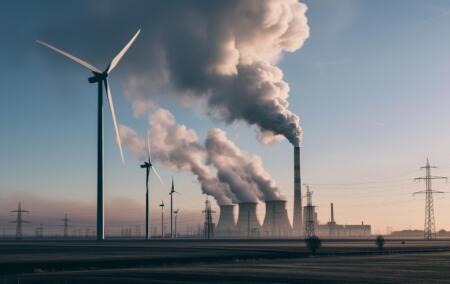
[Image: Wind Turbines and Coal Plant in Rural Landscape by wirestock]
If you like what you have just read, support the Daily Friend