

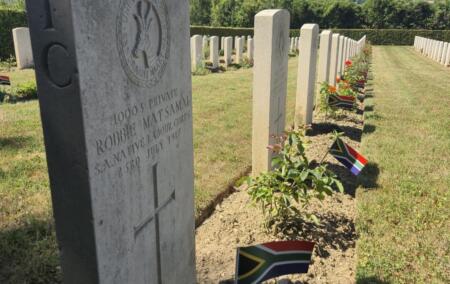
There is a particular discipline required of a head of state standing at a war memorial: to say something adequate about a debt that cannot be repaid, but deserves to be acknowledged. President Cyril Ramaphosa did exactly that while visiting the commemoration marking 110 years since the 1st South African Infantry Brigade was fed into the wood beside the village of Longeuval, which the brigade was ordered to hold regardless of cost. Partway through the ceremony, a UNESCO commemorative plaque was unveiled, formally recognising the memorial’s historical significance, an acknowledgment that what happened in this wood has outgrown any single nation’s private grief.
What the President said while standing there is worth taking seriously on its own terms, not merely as ceremony.
Ramaphosa’s address resisted the easiest temptation available to a politician at a battlefield, of turning suffering into triumph. Instead, the President was explicit that the courage of the men who held Delville Wood should not be mistaken for glory. “War is not glorious to those who lie wounded in the mud,” he told the gathering. “There is no glory in a mother receiving a telegram informing her that her son will not return.” The honour, he insisted, belongs not to the war itself but to “the courage, loyalty and humanity shown by those who endure it.” That distinction matters more than it might first appear, it is the difference between commemorating a battle and commemorating the men who survived, or failed to survive, what the battle actually was.
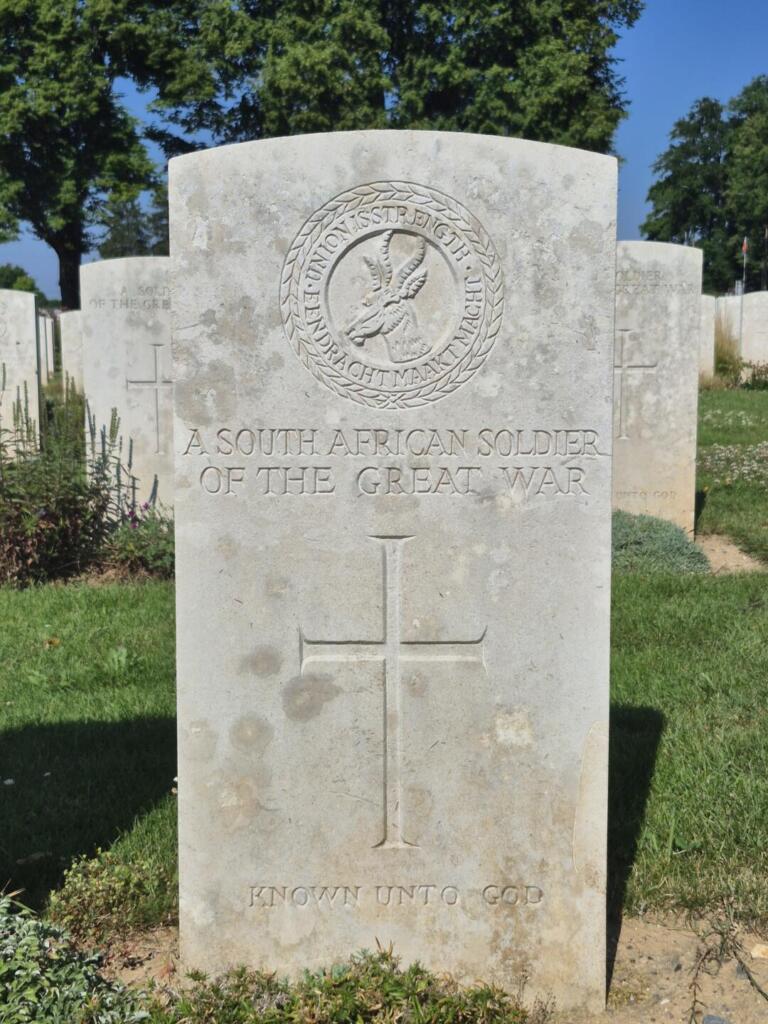
The most consequential move in the speech was definitional rather than descriptive, Ramaphosa used the ceremony to insist that Delville Wood cannot be honoured in isolation from the South Africans denied the right to carry arms in that same war; the men of the South African Native Labour Corps who kept the front supplied, and the more than 600 who drowned when their troopship, the SS Mendi, went down in the English Channel. He was direct about what had kept their sacrifice separate from the Brigade’s in national memory for so long: not equal treatment, but equal humanity nonetheless. “Their experiences were not the same,” he said. “Their treatment was not equal. But their humanity was equal. Their courage was equal. The grief of their families was equal.” He returned to the same point later, more plainly still: “Sacrifice has no colour, and courage belongs to no single community.”
This is not a rhetorical flourish so much as a redefinition of the object being honoured. A ceremony that once marked the endurance of a single brigade was, on this anniversary, made to carry the weight of every South African who paid a price in that war; armed or unarmed, recognised or not.
The scale of what was actually asked of these men becomes clearer with a historian’s eye on the terrain rather than the ceremony. Military historian Dr Evert Kleynhans has pointed out that Delville Wood was never a contained action, the wood and the village of Longueval were, in his words, “structurally and tactically inseparable,” which is why the fighting spilled into the streets of the village itself, hand-to-hand, simply to secure a foothold. The bombardment that followed was, in his description, “apocalyptic” in scale, and it altered the local geography permanently; the ground beneath this year’s ceremony still carries those scars.
That detail reframes the nature of the sacrifice itself, with Kleynhans noting that, for the modern towns of Longueval and Albert, the Brigade functioned as an improvised international shield; men who had crossed thousands of miles to absorb a German offensive that would otherwise have fallen directly on French civilians. Their endurance was not only a South African act of national sacrifice; it was, in a very literal sense, protective of people who were not their own countrymen. That is, in Kleynhans’s own words, why the commemoration remains “a living, lasting testament to the unbreakable bonds of friendship and shared heritage that bind South Africa and France together,” a bond visible this year in the joint SANDF and French military presence at the memorial, and in the choice of Longueval, rather than Pretoria, as the place a South African president chose to make these remarks.
Ramaphosa closed his address the way commemorations rarely allow themselves to close, not with consolation, but with a direct address to the dead themselves, sorted by what history had denied each group in turn. To the men of the wood: “Your courage will not be forgotten.” To the labourers: “Your contribution will no longer be treated as a footnote.” To the men lost in the Channel: “Your courage continues to speak across the generations.” And to all of them together, a single closing claim that the ceremony existed to make true rather than merely assert: “You belong to one national memory. You are part of one shared history. You are mourned by one people.”
Kleynhans’s own description of the wood as “the ultimate crucible of South African resolve,” ground held “at all costs” until the unit that held it was almost entirely consumed, sits comfortably beside that claim rather than in tension with it.
That argument carries different weight in a South Africa still marked by real division and real inequality. Ramaphosa made the connection explicit, describing a national memory that “cannot be divided according to race” and closing on the country the dead left behind: “A country in which citizenship is equal… A country in which every life has equal value.” Longueval does not claim South Africa’s many races and cultures were made the same by this war; only that, in the Wood and in the cold water off the Isle of Wight, they were made equal in what they gave. A country of many peoples remains one people where it has learned to grieve them together.
[Image: Ricardo Teixeira]
If you like what you have just read, support the Daily Friend