

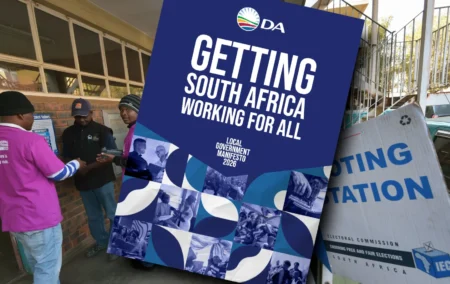
The DA’s local government manifesto is the most economically literate platform in South African party politics. That is faint praise, but it does not merit more than that.
The Democratic Alliance (DA) has launched its manifesto for the 2026 local government elections, under the title Getting South Africa Working for All.
Carol Paton, writing for News24, pointed out its most remarkable feature: how boring it is.
“…the DA manifesto, the first to be launched, is bland and technical,” she wrote. “As leader Geordin Hill-Lewis said, local government should not be exciting. It should be as boring as switching on a tap to get water or flicking a switch to get electricity.”
I agree. In a country where depending on local government services has become a game of chance, actually meeting low expectations is an aspirational campaign promise.
“Quiet and clever”
Paton says that the manifesto is “quiet and clever”, mentioning the ANC “only fleetingly, and only once”. She undercounted. I found fourteen references to the ANC across 48 pages.
However, her thesis holds despite the correction. By the standards of local electioneering, in which manifestos are often extended exercises in blaming the ANC – or in the case of the ANC, blaming apartheid, racism, imperialism, bad weather and adverse global market conditions – the DA’s manifesto is admirable for its partisan restraint.
Where they do blame the ANC for the status quo, they dispense with it briskly, and get on with the business of explaining, in detail, how the DA proposes to fix things. That is good.
The chairperson of the party’s federal council, Ashor Sarupen, told Paton the public no longer needs to be told what is wrong with ANC governance. He is right, though some of the recent numbers bear repeating.
Severe crisis
According to the Auditor-General’s consolidated report on the 2024/25 municipal audits, tabled in June this year, only 39 of the country’s 257 municipalities (15%) achieved clean audits. In all, 72 municipalities improved and 38 municipalities regressed, although that superficially good news hides the fact that the improved municipalities accounted for only 13% of total local government expenditure, while those that regressed were responsible for 24% of the total.
Households and businesses owe municipalities R484 billion, of which almost R425 billion (~88%) is older than 90 days and unlikely to be recoverable.
Municipalities burnt more than R24 billion in fruitless and wasteful expenditure, R145 billion in irregular expenditure, and R118 billion in unauthorised expenditure over the last three reported years. Forty-five percent of municipalities adopted unfunded budgets in 2024/25.
Note that the manifesto cites older, somewhat lower numbers for some of these statistics. What is not in dispute, however, is that local government is in severe crisis almost everywhere, and that is so predominantly where the DA does not govern.
Solid liberal pedigree
There is a great deal in the DA manifesto that a classical liberal should applaud, and some of it is genuinely brave.
The document’s core is the diagnosis that municipal failure is not a mystery but a choice: cadre deployment put unqualified loyalists in charge of complex infrastructure, and the revenue that residents pay for water and electricity was diverted to salaries, bailouts and theft rather than pipes and substations. Its central promise is to end the former and ringfence the latter.
Around that core are several proposals with impeccable liberal pedigrees.
The property rights agenda is the strongest. The manifesto commits to accelerating title deed delivery for state-subsidised housing, releasing unutilised state land, and amending the Prevention of Illegal Eviction Act to curb orchestrated land invasions.
Turning the dead capital of the townships into tradeable, bankable, inheritable property is the single most empowering thing any government in this country could do. The City of Cape Town’s successful Title-Deed-to-Door programme shows the DA means it.
The housing policy focuses on deregulation rather than construction. It seeks to encourage densification of well-located suburbs and the construction of mixed-income housing through zoning reform.
Where every other party promises to build houses, the DA proposes to make it easier for people to build them for themselves – a distinction that embraces the classical liberal philosophy of government as expressed by Henry David Thoreau in Civil Disobedience: “Government never furthered any enterprise but by the alacrity with which it got out of its way.”
Economic freedom for the poor
The manifesto’s treatment of informal traders is economic freedom for the poor, which is the constituency classical liberalism most needs to serve and most often fails to reach.
It proposes simplified online registration for trading permits, reserving the impoundment of goods for serious offences only, and new trading spaces in high-income areas where the customers actually are.
The informal economy provides at least a fifth of South Africa’s jobs, and perhaps many more that simply aren’t counted. Treating its participants as entrepreneurs rather than nuisances is long overdue.
Then there is the silence-is-consent principle for municipal permits: if the bureaucracy fails to respond within a defined period, the application is automatically approved. This quietly revolutionary mechanism shifts the cost of bureaucratic sloth from the citizen to the state, which is exactly where it belongs.
The safety chapter is built on subsidiarity – the devolution of policing powers, budgets and investigative capacity to capable municipalities. While this idea originates with the painful experience of Cape Town, where the national police service has failed to contain gangsterism and organised crime, it led the DA to the positively Hayekian observation that “local communities know best how to tackle local crime challenges”.
The same logic animates the demand that municipalities be freed to buy and sell electricity without waiting years for national approval, and the continued fight to devolve passenger rail.
And the manifesto reiterates, albeit in a single brief paragraph, the DA’s commitment to replacing race-based black economic empowerment with a needs-based model that targets poverty instead of skin colour.
Paton reads the brevity as tactical reticence, and she is probably right, but the substance matters more than the volume: it is the only empowerment policy on offer from any major party that is compatible with non-racialism.
And yet…
Paton makes an important observation almost in passing: “Ironically, many of the solutions come straight out of the National Treasury. They are not outside of ANC policy, but ANC municipalities have been reluctant to embrace them.”
In many practical ways, the ANC’s stated policies are indeed more liberal than socialist. That’s our liberal constitution at work. Conversely, in some ways the DA really is ANC-lite.
Consider the manifesto’s “bold solutions”, as it labels them.
Ringfencing water and electricity revenue for infrastructure? That is precisely the conditionality of the World Bank’s Metro Trading Services Program, which the manifesto itself cites, and which the (ANC-led) national government signed up for.
Spending at least 8% of asset value on repairs and maintenance? That – as the manifesto concedes – is National Treasury’s own benchmark. The DA’s promise is merely to comply with it.
Cost-reflective tariffs and funded budgets? Treasury circulars have demanded these for years.
Bringing in external service providers where municipalities cannot deliver? That is Section 78 of the Municipal Systems Act, on the statute books since 2000 – the manifesto candidly calls it “an underused and powerful legislative tool”.
Long-term concession agreements? The manifesto proposes amending Section 33 of the Municipal Finance Management Act to streamline them – a reform Treasury itself has been working toward in its PPP regulations.
Even ending cadre deployment, the manifesto’s flagship, is less a policy innovation than a promise to obey the law as written. The Zondo Commission condemned cadre deployment as the well-spring of corruption and failed service-delivery. Merit-based appointment requirements and consequence management already exist in the Municipal Systems Act and the MFMA. All that’s been missing is a governing party willing to be bound by them.
The proposal to make accounting officers personally repay losses is not radical either – material irregularity powers pointing in exactly this direction were added to the Public Audit Act in 2018.
New, better management
None of this is a criticism of the proposals themselves. It is a clarification of what the DA is actually selling.
The manifesto’s genuine innovations – the poverty-based empowerment model, the silence-is-consent principle, somewhat deeper private-sector involvement than Treasury orthodoxy contemplates – are improvements at the margin.
I would have liked to see, among the “bold solutions”, the proposal that delinquent public servants be disqualified from public service in the same way delinquent directors are disqualified from holding directorships. This would make sure that corruption is punished not only by the idle threat of criminal conviction, but by long-term removal from the trough, which may be the scarier consequence for would-be skelms.
The core product, while substantially liberal, is not a radically new policy framework. It is the old policy framework, faithfully executed. The DA’s differentiator is not what it believes; it is that it claims to do what the rulebook says, while its opponents do not.
That reframes the election in a way that flatters nobody. It makes the DA’s pitch less visionary than its rhetoric suggests: this is better management, not fundamental reform. And it makes the ANC’s failure even more damning than the DA claimed: its municipalities cannot even implement its own local government policies.
What a liberal still finds wanting
For the classical liberal ideologue – and I gladly own up to the label – the manifesto leaves much to be desired. For all its market-friendly language, its deeper structure is merely managerial.
The municipality remains owner, operator, monopolist and price-setter throughout.
The private sector is invited to design, finance, build and maintain, but always as a contractor to the council, “under strict performance agreements”, and never as a private competitor for the customer.
Paton noticed the same thing from the political desk: policy and tariff-setting remain firmly in the council’s hands.
Ringfencing is a case in point. Restricting a municipal monopoly’s revenue to its core function is better than looting it, obviously, or squandering it on pay increases and “security upgrades” for councillors’ houses. But it is still central planning of a captive revenue stream, not a market.
The one place the manifesto gestures at genuine structural reform – separating water service authorities from water service providers to enable competitive tendering – is the exception that proves the rule.
The electricity “prosumer” proposal is another tell. Paying households for surplus solar power fed into the grid is welcome, but the manifesto promises a “fair, standardised rate”. That is an administered price, set by the very municipality that has a financial interest in keeping it low.
A liberal would let willing buyers and sellers discover the free market price.
Illiberal bits
Then there are the frankly illiberal bits.
The manifesto promises by-laws to progressively ban single-use plastics, including plastic bags in grocery stores. This is a misguided, coercive type of paternalism one expects from a European Green party, and not from a party of individual freedom in a developing country, where the lowest possible consumer prices should be priority number one.
The liquor licensing section promises stricter trading hours and crackdowns on “illegal establishments”. Whoever wrote that perhaps didn’t consider that the shebeen owner is precisely the informal entrepreneur (and employer) celebrated in another chapter.
The safety chapter proposes a considerable expansion of the municipal surveillance state – CCTV networks, AI pattern recognition, gunfire detection, municipal intelligence-gathering and inter-platform data sharing – with privacy relegated to a single subclause about “existing privacy laws alongside strict ethical safeguards”.
Waste-to-energy “investment” is municipal industrial policy in a bleeding-edge technology with a decidedly patchy economic record elsewhere.
And bulk-procuring a single standardised financial software system for all municipalities replaces one kind of procurement risk with a monoculture of procurement risk.
Selective evidence
A word, too, on the manifesto’s use of evidence, which seems a reasonable ground for critique in a manifesto I called “economically literate”.
Every figure I checked traces to a real source, which is more than can be said for some other manifestos. But the framing is not always neutral.
The claim that Western Cape municipalities spend R2,860 per person on capital expenditure against Gauteng’s R1,055 is real – it appears in Ratings Afrika’s municipal financial sustainability index report – but it refers to budgeted capex.
On total per-resident spending, Stats SA has Gauteng ahead.
Gauteng spends more per head overall; it spends less on capex specifically. That is a real and damning distinction about consumption versus investment, but not the same claim as “DA municipalities spend more per capita”.
The claim that air pollution costs the economy “up to R960 billion annually, around 14 percent of our annual GDP” launders a Greenpeace Africa/CREA advocacy estimate built mostly on the imputed value of statistical life-years.
This is a speculative welfare cost, not lost production. It is not comparable to GDP at all.
Moreover, this focus ignores the fact that indoor air pollution is responsible for more death and disease than outdoor air pollution, and one of the key solutions to this problem – access to cheaper electricity – conflicts with the desire to reduce pollution from a largely coal-fuelled power station fleet.
Environmental lobby groups routinely exaggerate their claims, abuse statistics for advocacy purposes, and over-emphasise issues that align with their own narrow fundraising objectives. A party running on evidence-based policy should hold its own claims to better standards.
The verdict
The DA’s local government election manifesto is not a blueprint for smaller government. While liberal in its core principles, it is not much more liberal than the existing guidelines for local government devised by the National Treasury. It is not a charter for substantially greater economic freedom.
It is not a Blueprint for Growth, to borrow the title of the Institute of Race Relations’ policy series, which shows what a genuinely liberal reform programme looks like: unleashing private sector growth through deep deregulation and paring back the state.
What it is, though, is a serious, forward-looking programme for much-improved governance, infrastructure and service delivery – written by a party that has actually run municipalities, knows where the valves and substations are, and clearly believes that the unglamorous rulebook, faithfully applied, is worth more than ideological poetry.
In a local government landscape where the vast majority of municipalities cannot produce a clean set of books, that is not to be sniffed at.
Given the DA’s governing track record and national footprint, it should leave the party comfortably in the lead as the least-bad option on the ballot – which, in a diverse, proportional-representation democracy, is the only kind of option there is.
Its manifesto ought to appeal to a wide cross-section of South Africa’s population, including black voters who are disillusioned with the party that, for all the credit it deserves as the party of liberation, has largely failed to deliver the promised better life for all.
The classical liberal in me wanted a manifesto that asked whether the municipality should be doing things. Instead I got one that asks only how the municipality can do things, competently.
I will take it, the way a thirsty man drinks municipal tap water: gratefully, while reserving the right to point out that in a free market, someone would have sold him something better.
[Image: The cover of the DA’s manifesto for the 2026 local government elections. Background: South Africans cast their vote in Diepsloot during the 2016 local government elections. GCIS]
The views of the writer are not necessarily the views of the Daily Friend or the IRR.
If you like what you have just read, support the Daily Friend