

One of the most amusing scenes in Monty Python’s Life of Brian takes place in a market square in biblical Israel, in which various would-be prophets are proselytising their flavours of deities and mysticisms, trying desperately to gather up a decent audience to become adherents.
So it is with grid-scale energy solutions.
If we ignore fossil fuels (and we really shouldn’t – they are still the dominant energy source and will be for some time) and try to cut through the extraordinary amount of energy-tech hype spewed out by various true believers, it is easy for confusion to reign. Solar will save us! Biowaste! Power plants in space! Sodium-ion batteries! Wind, waves, geothermal, hydropower, fusion, natural gas! Drill, baby, drill!
Monty Python’s marketplace prophets yelling over each other while the rest of us scratch our heads.
I have tried to unravel this tangled landscape several times, but the tsunami of claims and counterclaims and facts and fiction has always got the better of me. But recently I stumbled across a fellow named Ramez Naam, author and energy investor and reputedly one of the five most respected energy forecasters in the world.
I watched a presentation of his, replete with graphs and charts and his simple and clear explanations, and everything fell into place.
But first a digression. Grid-scale power (generally defined as tens to hundreds of megawatts) has become, very suddenly, the most sought-after commodity in the world. Not because of heating, or transport, or factories, or the Straits of Hormuz or climate change, but because of AI.
AI is now (and will be for the foreseeable future) the most insatiable sink for energy in history – there is no end to accelerating demand in any forecast from any research institute or consultancy you might query. Whether or not this makes you uncomfortable, the raw truth of it is that it has become the most important geopolitically entangled race in technology history.
There will be no stopping the pushing and shoving for new energy generation (and no pausing it). It is a very large cat now out of its bag and it is now one of the primary drivers of capital allocation worldwide.
Insane amounts
And so insane amounts of money are being deployed to solve AI’s overriding demand to consume electrons now, today, this minute. Ramez points out that there is a surprise in all of this drama. It is that we actually have enough power generation already. There are plenty of electrons being produced worldwide.
What we don’t have is “poles and wires”. Or, in the words of Microsoft’s CEO Satya Nadella, “[i]t’s not a supply issue of chips; it’s actually the fact that I don’t have warm shells to plug into”. Transmission and distribution are bottlenecked to the point of asphyxiation, and there is no fast solution to that, at least not fast enough to satisfy anyone.
Which has led everyone to look anywhere but their local or regional electricity utilities, whose demand forecasting did not foresee AI (I’m not blaming them, no one did). As an example – in the last fifteen years Ramez says that the wait time for connection to the grid in an average US state has gone from 15 months to 45 months. 45 months in an era of AI progress is like never. Bottom line – utilities cannot cut it, because they can’t upgrade their grids quickly enough.
Which, according to Ramez, leaves us four, maybe five options, and it is into these that all the venture capital (and institutional risk capital) is being deployed.
First, there are the deserts, where the sun is always switched on. There are already grid-scale solar/battery plants up and running at extremely low prices (not that the AI buyers care – they will buy at almost any price, because energy costs are not their major spend – chips are). The flagship is the Masdar/EWEC plant in the UAE, which guarantees continuous delivery of 1GW to the grid, 24/7, every day of the year.
Other deserts beckon. But there is a proviso. The major AI companies, at least those in the West, will not locate their data centres in a desert in a country that might one day turn on them and seize those data centres (and model weights). And even if they are allies, they will not locate them in countries with overenthusiastic regulators bent on years of paperwork in triplicate. That leaves scant options – Chile, perhaps, or Australia if it softens its regulations.
Outer space
Secondly, there is outer space, where Elon Musk and a few others are heading. Lots of sunlight to harvest, no anti-AI activists or land permitting, and proven satellites to house the GPUs that do the computation.
The unspoken Achilles heel here is the number of SpaceX Starship launches that would be needed to get to terawatt grid-scale (Musk’s stated aspiration). It is somewhere of the order of 10,000 rocket launches per year. That is airline-scale cadence. One questions whether the FAA or any other governing body would allow this. Plus, one rocket failure and you’re grounded.
Thirdly there is nuclear. Both fission and fusion. The US, at least, is easing the path, sweeping aside long-embedded regulations, with the government offering loans and backstops. But the timeline is a bit hand wavy. Early 2030s for the first new generation plants. There is one fusion startup, Helion Energy, which is promising commercial switch-on by 2028, but few believe that, given that fusion is still in the R&D phase (unlike fission). If you are an AI lab, 2030 is a frustratingly long wait for compute.
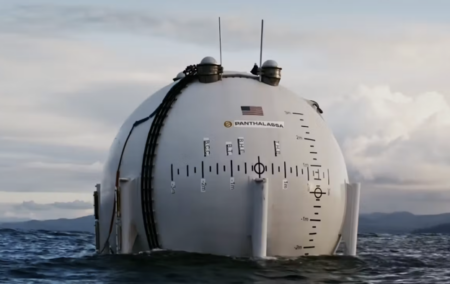
Fourthly – an oddity. Oceans. Ramez describes some really science-fictiony stuff here, including a company called Panthalassa (see the photo above) which has three power-generation plants and a fourth rumoured to be planned for the Arctic seas where the waves are powerful and the sea is cold, both very good things. Their target price for power generation is 2 cents per kilowatt-hour, which is stupidly cheap compared to any other technology. Oh, and again – no land permitting, regulations, activists and politics.
If you want to feel really, really good about the human race and what it can achieve (rather than what we read in the news every day), please watch this short video about how they built this.
Ramez lets one more long-shot contender in, which is geothermal, describing a couple of companies (Fervo, Quaise) that are using fancy technologies like plasma beams to drill 20 kilometres down into the Earth’s crust to exploit temperatures of 500 degrees, almost anywhere on the planet, potentially unlocking cheap grid-scale geothermal power at global scale.
Seven-year backlog
(There will be those who say – what about natural gas? The answer is simple. There is a global seven-year backlog for gas turbines.)
In any event, that’s it, according to Ramez*. The other blustering proselytisers may take their wares elsewhere.
These five are going to lead us to the promised land, such as it is.
*See his entire presentation here
[Image: via Panthalassa]
The views of the writer are not necessarily the views of the Daily Friend or the IRR.
If you like what you have just read, support the Daily Friend