

The President wants credit for putting out fires his own government started, and applause for a partnership that has existed since before the Constitution.
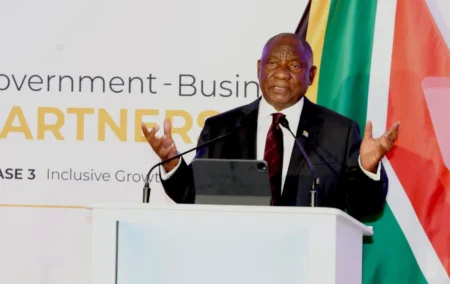
Last week, at a larney venue in Hyde Park, President Cyril Ramaphosa launched Phase Three of the Government-Business Partnership. Phase One, he explained, was stabilisation. Phase Two was reform. Phase Three “must be about growth”.
One admires the chutzpah. It takes cohones to stand in front of the country’s assembled big-business bosses and announce that after eight years in office you are now, at last, getting round to the growth part.
The speech concedes that the economy grows too slowly to dent unemployment. It says the true measure of reform is not the number of policies announced but the change reform produces in people’s lives. It even warns against confusing the absence of load shedding with the completion of energy reform.
If you read it quickly, it sounds like candour.
Read it slowly, though, and it is the same speech South Africans have been listening to since the New Dawn broke in February 2018, and in most respects since long before that.
What about NEDLAC?
Start with the premise. Government, business, labour and communities must come together, Squirrel argues, to pursue clearly defined national objectives.
We have that.
We have had it for thirty-one years.
It is called the National Economic Development and Labour Council (NEDLAC), established by Act 35 of 1994, signed in November of that year and launched in February 1995 – more than a year before the Constitutional Assembly adopted the Constitution.
It is an unelected “apex social dialogue institution” (not to be confused with the National Dialogue, which is a completely different species of dead fish). It has four constituencies: government, big business, organised labour and civil society.
All proposed labour legislation and significant socio-economic policy must be tabled there before it goes to Parliament. It has chambers for trade and industry, for public finance and monetary policy, for development and the labour market, and for energy security.
In other words, a government-business partnership is one of the first things the democratic government built. It’s been there all along, signing off on every significant piece of government policy and legislation.
So when the President talks of the government-business partnership established in 2023 as though the idea were novel, the obvious question is what happened to the last one? And the one before that?
Partnership after partnership
The 2018 Jobs Summit, held under NEDLAC’s auspices, produced an eighty-page framework agreement that was supposed to yield 275,000 additional jobs a year.
The 2020 Economic Reconstruction and Recovery Plan was described as a common programme agreed with social partners.
In the 2022 State of the Nation Address, Ramaphosa gave himself 100 days to finalise a comprehensive social compact to grow our economy, create jobs and combat hunger. It was reportedly redrafted eleven times and never concluded.
Thabo Mbeki, not a man given to public disloyalty, said of it in July that year: nothing has happened, nothing.
If NEDLAC has failed (and it has), then Ramaphosa should be honest and say so. Propose to reform or dissolve it. Explain why this new partnership will be different.
Instead, we get a new body with no statutory authority, with no democratic accountability, and with as-yet invisible outcomes.
Setting fires to put out
Consider the “achievements” Ramaphosa recounts in his speech.
The partnership, we are told, was born in crisis: load-shedding was wrecking businesses and households, rail and port performance was collapsing, and South Africa had been greylisted by the Financial Action Task Force.
Each of those three crises was the direct consequence of government policy, government ineptitude, and government corruption, over decades.
Load-shedding began in 2008 and reached its worst level in 2023, after fifteen years in which the state refused to let anyone else generate electricity at scale, capitalised Eskom with debt instead of equity, used it as a vehicle for excessive employment, appointed (mostly) compromised cadres to run it, and watched procurement corruption lead to breakdowns and movie-style explosions.
Transnet’s decline can be laid at the same door.
The greylisting was the direct consequence of a decade in which the state’s capacity to investigate financial crime was deliberately dismantled.
Getting off the greylist in October 2025 is the achievement of an arsonist who puts out the fire he started. It is the achievement of a burglar who returns the family silver.
The correct response is relief, not applause. Ramaphosa cannot take credit for fixing what he and his predecessors broke.
Who kept the lights on
The energy claim deserves particular attention, because it is the one the government leans on hardest.
Eskom’s operational recovery is genuine. Its people have worked hard and the fleet is better run than it was in 2023.
Unplanned outages have declined since 2023, and available generation capacity was higher in July 2026 than it has been for years.
Yet total generation was lower in 2026 than in 2023, at the peak of load-shedding.
Fewer breakdowns alone cannot explain why the lights have stayed on.
What changed is demand.
When Eskom ran out of electricity to sell, begged customers not to buy its electricity, and ratcheted tariffs to dizzying heights, South Africans responded by… not buying Eskom’s electricity.
Estimated behind-the-meter rooftop solar has more than tripled in four years, reaching 8.3GW – and that’s not counting private commercial power generation. That is equivalent to four-and-a-half times the capacity of Koeberg nuclear power station. It is within a few hundred megawatts of Medupi and Kusile combined – built by homeowners, farmers, shopping centres and warehouses in under four years, while Eskom took the better part of two decades to build those two stations. It exceeds the total operational capacity procured under the government’s flagship REIPPPP and RMIPPPP programmes three times over.
Eskom’s residual demand fell 9.1 percent in the first twenty-nine weeks of 2026, and is 15.6 percent below the same period in 2022. Several gigawatts of load have simply walked off the grid.
That is what really happened since the launch of the Government-Business Partnership in 2023. Not a partnership. An exit. Private individuals, without asking permission, solved for themselves the problem the state had inflicted on them.
And how has the state responded to its most successful energy programme?
By requiring registration of small-scale installations. By hiking the monthly availability fee to extort more money for Eskom from solar-power users.
If anyone deserves credit for keeping the lights on, it isn’t Ramaphosa, or the government, or even big business. It is you, the private citizen.
What is achievement?
An “achievement” is not the cessation of a self-inflicted injury. It is not taking credit for meeting expectations when citizens lower their expectations. Keeping the lights on, prosecuting financial crime and keeping the trains running are not achievements. They are the most basic obligations of a minimally competent state.
An achievement is a promise to build something new, followed by the thing existing.
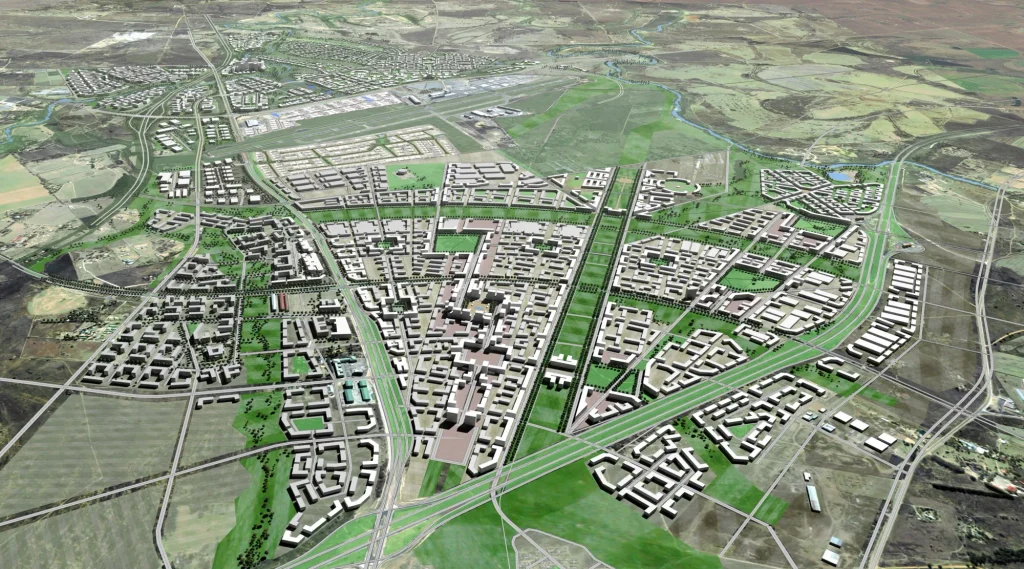
In 2019, Ramaphosa dreamed aloud of the first entirely new city of the democratic era, with skyscrapers, schools, universities, hospitals and factories. In 2020 he named it: Lanseria, a truly post-apartheid city, 5G-ready, a continental benchmark for green infrastructure, home to 350,000 to 400,000 people by 2030.
This is what it is going to look like, according to SMEC, a Singaporean engineering consultancy that claims to be involved with the project:
And today, with less than four years to go to the ten-year deadline, this is what it looks like, according to Google Earth:
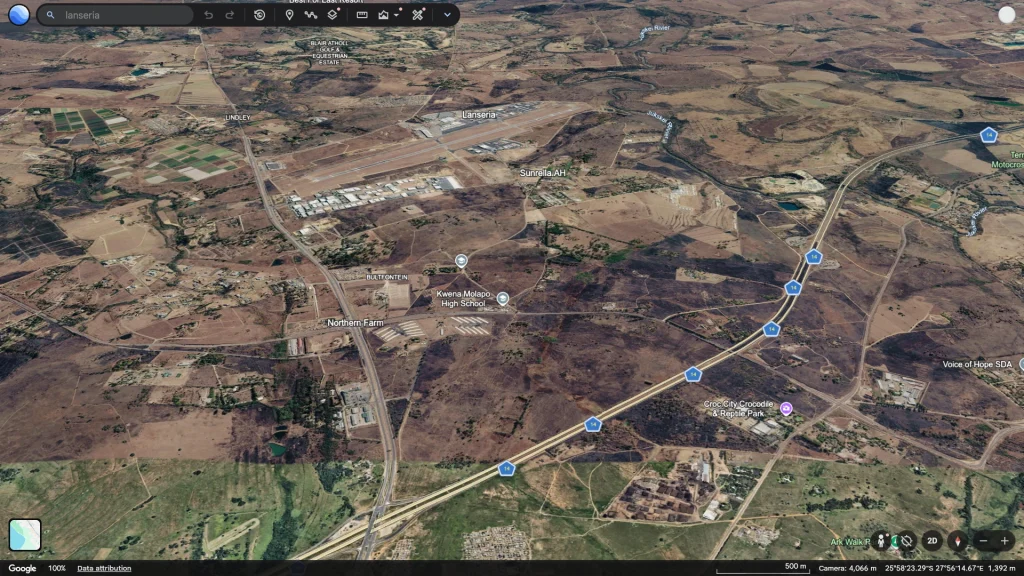
Nothing. I used to live right next to Lanseria 25 years ago. Nothing has changed since then, other than some upgrades to the airport itself. Not a single shovel of earth has been moved.
Four years from almost nothing to nine gigawatts of private solar power. Six years to… nothing.
The first fifteen years
None of this is to deny what the ANC did deliver. It is considerable. In 1996, 58 percent of households used electricity for lighting; today it is around 90 percent. In the first decade of democracy an estimated 13.4 million more people gained access to basic water supply. Millions of houses were built, and school enrolment became near universal.
That was real, but it happened early. That was overwhelmingly in the first fifteen years, when the state was building capacity rather than distributing it as patronage. That was when South Africa was still growing at near 5% per year.
Since then, the record is one of managed decay.
Non-revenue water has risen from 37% in 2014 to about 47%. The share of drinking-water systems failing microbiological standards went from 5% in 2014 to 46% in the 2023 Blue Drop report. Wastewater systems in critical failure rose from 39% in 2022 to 47% in 2025. The department now puts the repair bill at R400 billion. That’s just for repairs!
Johannesburg runs dry while the Vaal Dam sits at capacity, because the shortage is not of water but of competence, financial probity, maintenance, and timely infrastructure upgrades and replacement.
Growth that never arrives
Phase Three’s immediate objective is growth above 3 percent. Growth was 0.8 percent in 2023, 0.5 percent in 2024 and 1.1 percent in 2025. It has averaged around 1% for 15 years, and in every one of those years, Ramaphosa promised higher growth.
Unemployment rose to 33.6 percent in the second quarter of this year – 8.5 million people, 43.8 percent on the expanded measure, 47.4 percent among the youth.
The 2018 investment drive targeted R1.2 trillion and booked R1.5 trillion in pledges, of which R634 billion – less than half – has actually been deployed in eight years. The response is a new target of R3 trillion.
Ramaphosa talks about progress, and says we “must” do more. But there hasn’t been much progress. Doing more of the same will result in, well, more of the same: stagnation, capital destruction, decay.
Ramaphosa says that “confidence must lead to investment”. But you don’t order investment into being. You cannot command companies to grow. You cannot order business to employ more people.
You need to make it possible, and even attractive, to grow and employ people.
The recent ratings upgrades are real, and there have been a few genuine reforms. But confidence is a bet on future policy, not a substitute for output. Sentiment has improved solely on the expectation that the state will do less, not more.
Get out of the way
Ramaphosa says Phase Three “should expand the partnership’s work into tourism, agriculture and agro-processing, and mining”.
That’s the same tourism sector that has been waiting a decade for the Department of Transport to issue operating permits for tour vehicles without demanding they stick to set routes, as if they were minibus taxis.
Every sector the government has tried to plan for – without exception – has become worse for the experience. Despite subsidies and master plans and import tariffs – or rather, because of them – prices have risen, employment has fallen, competitiveness has declined, and companies have gone out of business.
Big business might be okay with a “partnership” with the government. They are the recipients of juicy government contracts to build (and not deliver) smart cities, after all.
But the broader economy does not want a “partnership”. To grow, it needs only one thing: for government to get out of the way.
Let the market decide which sectors are to bloom, and which to wither. Let the market decide which companies succeed, and which fail. The government not only shouldn’t pick winners, it cannot pick winners, because it simply does not have the information available to it to make such choices.
Remove the barriers, and investment will come. When investment comes, growth and employment will follow. The government has to do nothing but deliver basic services and remove red tape.
And all this unrest and ethnic nationalism and revolutionary fervour and hatred of immigrants? When an economy grows at 5% or 10%, everybody will be too busy working to hate their neighbours and plot sedition.
Shame on you
The speech ends where these speeches always end: government cannot do it alone, business cannot do it alone, labour cannot do it alone.
It is the oldest move in the book: convert the governing party’s failures into a shared national responsibility, so that nobody in particular can be held to account for it.
Fool me once, shame on you. Fool me twice, shame on me. We are well past twice.
[Image: President Cyril Ramaphosa speaking at the launch of Phase 3 of the Government-Business Partnership at Summer Place, Hyde Park on 20 August 2026. GCIS.]
The views of the writer are not necessarily the views of the Daily Friend or the IRR.
If you like what you have just read, support the Daily Friend