

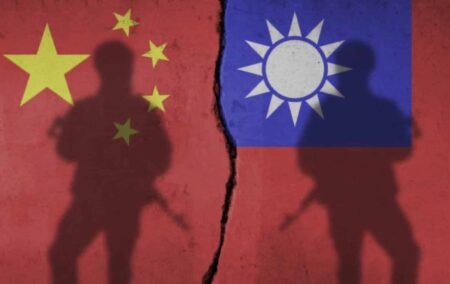
On 21 July, Monday last week, the Government Gazette carried a notice, No. 6444, entitled “Status of the Taipei Liaison Office in South Africa”. Henceforth, the Taiwan’s mission to South Africa would no longer be “recognised” at its Pretoria premises. It would “recognise” its offices in Johannesburg and Cape Town, which would be renamed Taipei Commercial Offices.
The Notice explained:
Following democracy in South Africa in 1994, the country aligned with international consensus and adhered to United Nations General Assembly Resolution 2758 (1971}, which recognises the People’s Republic of China (PRC) as the sole legitimate representative of China.
In 1998, South Africa concluded a bilateral treaty with the PRC in which it formally established diplomatic relations, committed to the One China Policy and, in doing so, agreed to sever diplomatic relations with Taiwan, whilst maintaining non-political, non-diplomatic engagements, focusing on technical cooperation in areas such as trade, investment, tourism, science, and education.
According to South Africa’s commitment to the One China Policy, South Africa has called upon Taipei to relocate its Commercial Office from the capital, Pretoria, to Johannesburg, which is more appropriate given its status as the country’s economic hub.
I found this mixture of dry bureaucratese and congratulatory posturing (which characterises a lot of government communication) intensely annoying. In part, this is because I am personally connected to this. I lived in Taiwan, and I am a passionate supporter of its right – more accurately, the right of people of the island – to determine their own fate and future, and this without the interference of the PRC or any other state.
There is a rather grotesque counterargument that one hears from time to time: yes, Taiwan has a right to a say in its future, but this must be seen against the equal right of the PRC and its 1.4 billion people. Taiwan is a free society and the first democracy in the history of Sinic civilisation; its people have the capacity for real choice.
The PRC’s population does not, hence the idea that that they can be reduced to a singular state-ordained position. The “people” in the People’s Republic have already been “united” and the appropriate stance allocated to them. I don’t find that intellectually convincing or ethically compelling.
Connection to the PRC
And all evidence is that a minority of Taiwanese (and a declining one at that), feel a connection to the PRC or wish for any sort of “reunification”. The conduct of the PRC in its own territory and more recently in Hong Kong are strongly dissuasive to a population that is accustomed to free elections and civil liberties, not least some of the freest media in Asia.
Taiwan’s people should not be forced under the control of a political system of which they want no part. If that means recognised independence or a formal separation from the PRC, I’d be very much in favour.
The PRC’s position may be explained by the complex history of the Chinese Civil War and the territorial reshuffles after the Second World War (making this issue a still unresolved outgrowth of that conflict), but in a moral sense I see something that looks remarkably like an imperial claim. The PRC’s One China Policy smacks to me of Imperium Romanum, the British Empire, the Thousand Year Reich, or the Greater East Asia Co-Prosperity Sphere. Modern China itself, incidentally, is essentially an empire.
Still, the analyst in me has to acknowledge that unencumbered moral choices are typically not available. South Africa’s switch of diplomatic recognition from Tawain to the PRC in 1996 were more or less inevitable given the size and international presence of the latter. At this writing, the PRC has been South Africa’s largest national trading partner for well over a decade (although this relationship is smaller than that with the European Union market as a whole). South Africa’s ties with the PRC are objectively important.
Still, nothing precluded cordial and respectful relations between South Africa and Taiwan. Indeed, Nelson Mandela, who had stated that severing relations with Taiwan would be “immoral”, pledged after the switch that relations should remain “at the highest possible level”.
Last week’s announcement shows something else. Since no diplomatic relations exist between South Africa and Taiwan, the location of its offices should have been of little more significance for South Africa’s government than those of a body like the World Wildlife Fund or of a foreign company.
This was an act calculated to humiliate Taiwan, to say that not only does this government not recognise it but regards it with animosity and wants it out of sight. It’s a deeply hostile, albeit somewhat petty and performative, act.
Pressure
Observers may say that this was responding to pressure from the PRC. I’m not so sure. Perhaps the PRC government had suggested it, but if so, they would have been speaking to a very receptive audience. An act like this, rich in vindictive self-importance, would not be out of place with the conduct of South African officialdom and the political principals that have a particular sense of their own exceptionalism, at home and internationally.
Rather, this can better be understood as a geopolitical statement by South Africa. It stands with the PRC, autocracy and all. The South Africa government, under the ANC, has long seen itself as aligned with it. (“Non-alignment” has always been something of a myth.) This has a long pedigree. As an ANC foreign policy document put it: “The rise of emerging economies led by China in the world economy has heralded a new dawn of hope for further possibilities of a new world order.”
Certainly, if the leadership of the PRC is accepted, then such normative ideas as democracy and universal human rights – the latter being central to the South African indictment of Isreal – become untenable. And this has in fact been a glaring contradiction for South Africa.
When relations were opened between the PRC and South Africa, there were (naïve) hopes that South Africa would positively influence its counterpart. If anything, it went the other way. After a trip to the PRC by then Deputy President Thabo Mbeki in 1998, deputy foreign minister Aziz Pahad batted aside concerns that the South Africa side was derelict in its human rights tutelage stating: “I think we all agree that there are specificities in each country which are not universal forms of human rights. We are adapting to the specific conditions of each country.”
I’ve said it before: if human rights are “specific” to particular countries or cultures, then they are not “human rights” at all. This was a remarkable concession. In its dealings with the PRC above all (but also others, like Cuba, Russia and latterly Iran), South Africa has exhibited a capacity for normative flexibility.
While criticism flowed thick and fast at the United States or other “imperialist” countries, I can think of nothing comparable directed at the PRC. Not on the treatment of dissidents, nor on the lack of civil liberties, nor on the use of capital punishment, nor on the settlement of Han Chinese in Tibet and Xinjiang (something with parallels to Israeli settlement in the West Bank), nor the suppression of Hong Kong’s democracy movement, nor the mass internment of Uighurs, nor the PRC’s threats of force against its neighbours and interference with their freedom of navigation.
The PRC has also been the rock on which South Africa’s principled commitment to multilateralism foundered. In 2012, the Philippines invoked the United Nations Convention on the Law of the Sea to challenge Chinese encroachment into the South China Sea; the PRC’s refused to participate in the arbitration and rejected the outcome, which favoured the Philippines.
South Africa, which might simply have ignored the issue, chose to chide those who were “politicising” the matter (though that was rather tautological, since the matter was inherently political). States, its statement continued, should “resolve their relevant disputes through direct consultations and negotiations.” Bilateralism, in other words. The virtues of multilateralism and the “institutions of global governance” were, in this instance (and with this protagonist), apparently vastly overrated.
Moral underside
South Africa’s relationship with the PRC has exposed the moral underside and orientation of its diplomacy. Though in its qualitied defence, South Africa is hardly the only country to suffer these maladies.
It did strike me that DIRCO’s statement has been well-nigh ignored in the media (amusingly, IOL carried an article about travel to Taiwan on the day.) Unsurprisingly, a great deal of bandwidth was taken up by news out of the United States about South Africa’s deteriorating relationship with that country. Last week, we saw a Bill being moved through Congress calling for a review of links between the two countries and setting out an extended list of grievances against South Africa. Russia, Iran, Hamas, lawfare against Israel, and South Africa’s thrall to the PRC all featured.
Among that last set of concerns was South Africa’s posture vis-à-vis Taiwan, and specifically the proposed eviction from Pretoria and downgrading of Taiwan’s representation. Much the same point has previously been made by Senator Ted Cruz.
The US does not, formally, recognise Taiwan. The same applies to numerous countries with a broadly pro-US orientation. Taiwan’s integrity and security is, nevertheless, a matter of profound concern to them. Moral questions aside, the US has ambivalent yet important defence commitment there. Ceding Taiwan to the PRC would represent a momentous geopolitical shift.
Not only would it open unimpeded access for the PRC’s navy into the Pacific, but it would give the PRC a chokehold on the trade routes serving Japan and South Korea. It would also place the PRC in a position to flex its muscles even more strongly towards the South: over Vietnam, the Philippines, Brunei, Malaysia, Indonesia, and Australia.
Beyond that, Taiwan occupies a critical place in the global economy through its semiconductor industry. PRC control of this asset would give it leverage over the world that would rival any conceivable military challenge it could pose. Many who view the current Western (and specifically US-led) global system with scepticism might welcome the Chinese challenge as the reset of the world on multipolar terms. I doubt it: the PRC seeks dominance in East Asia and ultimately hopes to displace the US as the dominant player across the world.
Multipolarity with Chinese characteristics, perhaps? Those who despise the US might find this appealing, although I’d further caution that a PRC-centric world order would be one in which appeals to freedom or to democracy would have a very limited cachet.
Those wishing to explore the matter could do worse that read a 2016 contribution, Authoritarianism Goes Global: The Challenge to Democracy, edited by edited by Larry Diamond, Marc Plattner, and Christopher Walker.
It sets out how authoritarian powers have moved beyond simply protecting their own domains to promoting their own models and the legitimatory arguments behind them. I’m afraid I’ve seen evidence of this thinking gaining a foothold in unexpected places – among think tanks and academics whose critiques would never be tolerated in the PRC, but who nevertheless feel that the Chinese model is a fine thing – and I shudder for the turns that South Africa could take with the right kind of prompting. Troubled though we are, we remain free, and things could be a good deal worse for us.
Fate
The fate of Taiwan is not just a matter of concern to itself and the PRC. Nor, as some ideologues (more than a few of whom are in South Africa’s foreign policy circles) might have it, is this an issue for challenging the imperialist bogeyman in Washington. It’s a matter of profound importance for a string of countries with varying relationships with the US and with South Africa. Indeed, the absence of formal recognition has not stopped deepening defence ties between Taiwan and its Asian neighbours.
Their fates are structurally intertwined as regards the PRC. It’s doubtful in the extreme that South Africa’s policymakers realise this or understand just how severely its grandstanding could come back to bite it.
Doubtful and, unfortunately, not surprising. All countries are well advised to be prudent in the exercise of their diplomacy and the conflicts in which the involve themselves, even the most powerful. Both the US and the PRC, for example, learned to their costs in the 1970s the difficulties of military intervention in Vietnam. In the best of circumstances, a mid-sized power like South Africa needs to be circumspect in choosing its interventions, diplomatic or otherwise, especially in conflict situations; there are enormous risks and very doubtful benefits for a small country to intervene in matters over which it has no influence.
For a challenged and visibly distressed and declining power like South Africa, this is doubly true.
There is, unfortunately, a sense of make-believe around South African diplomacy. It suffers a toxic combination of exaggerated self-image, ideological messianism and practical incapacitation.
This all comes out strongly in the Notice of the 21st: it referred to the Department of International Relations and Cooperations – an entity that does not exist (it’s the Department of International Relations and Cooperation) – and states that Taiwan’s Pretoria mission “will no longer be recognised as of 31 March 2025”, a date nearly four months in the past. The disorder in the Notice mirrors the disorder in the system.
Effectively expelling Taiwan’s mission from Pretoria makes a crude statement: this is where we stand, this is whom we oppose, and this is whom we owe our fealty. In the current global environment and with relations with the US at the lowest point – the lowest, probably, since the first American consulate was opened in Cape Town in 1799 – it is a decidedly hazardous one.
Shill
And lest I be accused of being a shill for American imperialism, let me say that what I am advocating is first and foremost a rational ranking of South African goals, a realistic appraisal of its capacities to achieve them, and a sober evaluation of the consequences of any given course of action. South Africa has chased goals that were beyond its means, without the diplomatic skills or capital to manage the challenges of doing so, and without an evident appreciation of the consequences. The collapsed relationship with the US is the prime symptom.
Of course, I come at this with strong personal views. I believe that a free society is a superior moral proposition to an authoritarian one. I also believe that free societies are better placed to deliberate on divisive issues. This is possible in Taiwan where both pro-independence and pro-unification views are aired, but not in the PRC. It is also possible in South Africa, which, I reiterate, warts and all, is a free society.
When reading the Notice, I took strong exception to the implied link between recognition of South Africa’s democracy and recognition of the PRC. It was certainly a legitimate decision taken by a democratically constituted government. No one’s disputing that. But it represented an early abandonment of those high-minded principles that are still invoked with decreasing credibility by South Africa today. And no South African was or is required to endorse it.
In September last year, President Ramaphosa led a delegation of ministers from the Government of National Unity to the PRC. At a media conference – as much homage to his hosts as report back on his work – President Ramaphosa gushed:
And in fact last night I had the opportunity to inform [President Xi Xingping] that even one of the leaders of the parties that have now joined in the GNU who initially was not so well disposed to the One China Policy – having visited China for the very first time, for the very first time as one of my ministers – publicly said that he now subscribes and embraces One China Policy. President Xi Jinping was rather pleased with that.
Well, if that leader – generally understood to be a reference to John Steenhuisen – felt that way, that would be his good right. He is the minister responsible for the interests of the country’s farmers, and perhaps taking the knee before the PRC leadership is something that needs to be done in their interests.
Being a South African allows me to hold and express my own views on this matter. Unlike President Ramaphosa, I am singularly uninterested in whether President Xi is pleased with any particular stance. President Xi has the luxury of being largely disinterested in the opinions of his own subjects, if those displease him; it’s the nature of autocracy. But I certainly feel no compulsion to recognise the PRC’s claims. And on this matter, the government of my country does not speak for me.
If you like what you have just read, support the Daily Friend