

This Week in History recalls memorable and decisive events and personalities of the past.
28th July 1402 – Ottoman-Timurid Wars: Battle of Ankara: Timur, ruler of the Timurid Empire, defeats forces of the Ottoman Empire’s Sultan Bayezid I
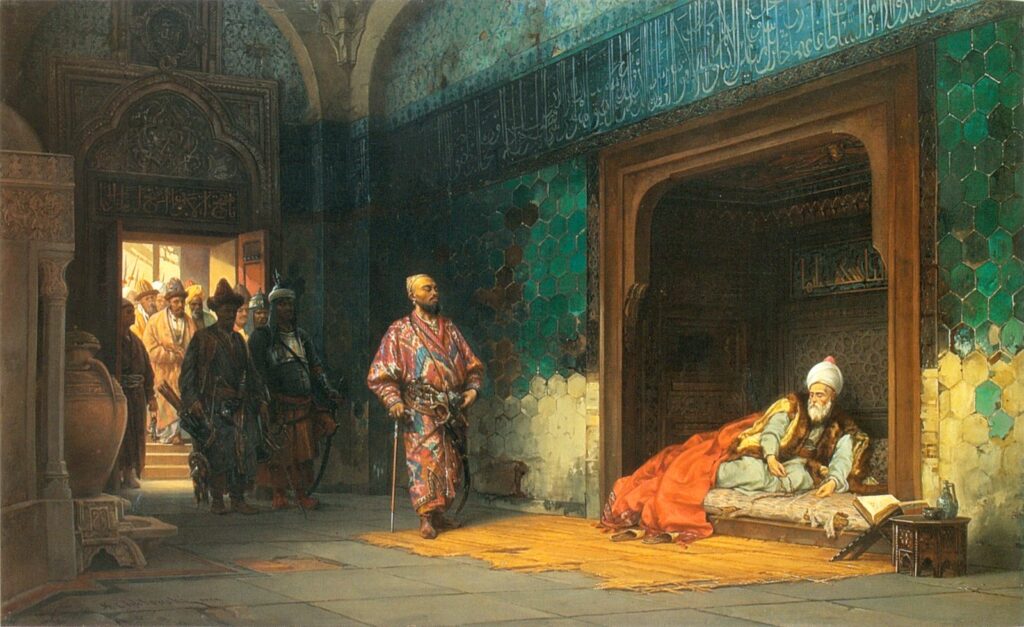
Painting depicting Bayezid I being held captive by Timur, by Stanisław Chlebowski, 1878
Of all the world’s historical figures who had the most impact, Timur − or Tamerlane, as he is known in the West – is among the least well known outside of Central Asia.
Timur began his career as a fairly low-level bandit in Transoxiana, which is modern-day Uzbekistan, in the mid-1300s. In time, through his own skill and political and military cunning, he managed to gain control of one of the successor Khanates that were the remnants of the collapsing Mongol Empire.
Using this seat of power seat, based in the city of Samarkand, Timur cut a bloody swath across the entire Middle East, establishing by conquest a massive empire at the cost of millions of lives.

Earliest known portrait of Timur, commissionned right after his death in 1405–1409, by his grandson Khalil Sultan for an illustrated Timurid genealogy
Timur was born in the 1320s near the city of Kesh. He belonged to a Mongol tribe which had become thoroughly Turkified over the past few decades. His name means iron in the Chagatai language.
His father was a minor noble of the tribe, though there is some dispute among historians about just how wealthy and influential Timur’s father was.
The most famous story from Timur’s early life concerns injuries he suffered when trying to steal a sheep from a shepherd: his arrow wounds − one in his right leg and another in his right hand, which caused him to lose two fingers − would disable him for life, and gave rise to his nickname, Timur the Lame, or Tamerlame as he is known in the West.
During the 1360s, Timur gained prominence as a military leader with Turkic troops and he took part in numerous campaigns in Transoxiana with the Khan of the Chagatai Khanate. He became so successful in his military adventures that he eventually managed to take the Chagatai Khans as his puppets and reduce them to the position of figureheads.

Timur on horseback, in a battle with Tokhtamysh Khan, from a manuscript of 1420–1440
In his lifetime, Timur was not accepted as a descendant of Genghis Khan and, therefore, according to Mongol traditions, would be barred from becoming Khan, which is why he used puppet rulers to govern in his name. He therefore set himself up as a sort of regent or protector of the heirs of Genghis Khan. He also often went by the title of Amir, meaning general.

Depiction of Timur granting audience on the occasion of his accession in Balkh in 1370. [Zafarnama (1467), commissioned by Sultan Husayn Bayqara]
A devout Muslim, Timur sought to claim the supreme title of the Islamic world, Caliph, but this too was denied to him because of his lineage. There was no way in which he could link himself to the Quraysh tribe of the Prophet Muhammad, and therefore was not considered eligible to be the Caliph of the Islamic world. However, Timur created an image of himself as a figure of power ordained by God, with the title, the Lord of Conjunction.
Timur led numerous conquests across Central Asia, Iran and Russia. By 1381, he had conquered most of the eastern regions of Persia, known as Khorasan. He then headed west, crossing the Zagros Mountains and conquering his the way into Anatolia. The fledgling Ottoman Empire at this time ruled over a significant portion of Anatolia. After a dispute over vassalage and tribute, Timur decided that the Ottomans had challenged his right to rule.
And, so, in 1400-1401, Timur invaded Ottoman territory. At the time, the Ottoman army had been campaigning in Europe. In fact, it had been engaged in a blockade of the great city of Constantinople. However, Timur’s invasion forced the Ottomans to abandon this blockade and march to Ankara in central Anatolia to protect it from Timur’s army. On 28 July 1402, near the city of Ankara, the Ottoman army faced off against the Timurids. Some 140,000 Timurid troops confronted the Ottoman army under the command of Sultan Bayezid I, whose forces numbered only around 85,000.

Timur reviews his troops in the plain of Sivas in the Battle of Ankara in mid-summer 1402 [from Ibrahim-Sultan’s Illustrated Zafar-nameh of 839/1436]
While the Timurid army was made up of diverse troops, mostly Turkic tribes from across Iran, eastern Anatolia and Central Asia, the Ottoman army was a truly mixed bag, containing fanatical Islamic warriors known as Ghazis, slave soldiers called janissaries, as well as European Balkan Christian troops such as Serbian knights and Albanian soldiers. In the course of the battle Timur would remark on the bravery and skill of the Serbian knights in particular, whose heavy black plate mail resisted Timurid arrows.
But the Ottomans would be crushed in this battle, and the Sultan taken prisoner.

Cigarette card depiction of Bayezid I in front of Timur
As a result, Timur had free reign over all Anatolia. He marched to the Aegean coast, where he besieged and took the city of Smyrna, which was a stronghold of the Christian Knights Hospitallers.
The Battle of Ankara was a total disaster for the Ottoman state, fracturing what had remained of it and bringing it to almost total collapse. There followed a civil war, the result of Bayez’s sons battling over who would succeed their father, which lasted 11 years. This would significantly hold up Ottoman expansion across Europe and is one of the reasons why the city of Constantinople would survive until the year 1453.
Timur’s campaigning was not confirmed to the west. Famously, he invaded India, much of which at the time was ruled over by the Islamic Delhi Sultanate based in the city of Delhi.

Timur celebrates his conquest of Delhi in 1398
A few years before fighting the Ottomans, Timur had sacked the city of Delhi, carrying out massacres of hundreds of thousands and looting this once great and wealthy city of enormous amounts of its wealth. Later in his life Timur even had designs on conquering China and made alliances with various Mongol tribes with a view to invading the Ming Empire and restoring Mongol control.
Ultimately it is believed by many that Timur’s true aim was to reunite the entirety of the Mongol Empire all the way from its domains in Hungary to China and Korea.
On the way to launching his campaign against China 1405, however, Timur died.

Shah Rukh (right) leads the Timurid army towards China on 19 February 1405, after Timur’s death
While his empire would endure for some time after his death its momentum was stopped. It would never again threaten to conquer the world. In his wake Timur had drastically changed the political situation in the Middle East and Central Asia, and left an enduring legacy.
The descendants of Timur who ruled over the Timurid Empire would eventually invade India once again and form the Mughal Empire.

Group portrait of Mughal rulers, from Babur to Aurangzeb, with the Mughal ancestor Timur seated in the middle. On the right: Shah Jahan, Akbar and Babur, with Abu Sa’id of Samarkand and Timur’s son, Miran Shah. On the left: Aurangzeb, Jahangir and Humayun, and two of Timur’s other offspring Umar Shaykh and Muhammad Sultan
This would come to be one of the great empires that controlled most of the Indian subcontinent until it was supplanted by the Maratha Confederacy and then the English, later British, East India Company.

Company painting depicting an official of the East India Company, c. 1760
If you like what you have just read, support the Daily Friend