

Busi Mavuso’s free-market case for an independent grid operator is excellent, and consistent with the president’s stated policy. The Eskom board’s objections are also legitimate. But this is not a binary choice.
Something rare and valuable is happening in South Africa’s electricity sector: a genuine policy debate between people who all, at least nominally, want the same thing.
In his State of the Nation Address on 12 February 2026, President Cyril Ramaphosa announced that the government would press ahead with establishing a fully independent, state-owned Transmission System Operator – an ITSO that would own and control the national grid outright.
This overrode a plan announced only weeks earlier by electricity and energy minister Kgosientsho Ramokgopa, under which the National Transmission Company South Africa (NTCSA) would remain a subsidiary of Eskom Holdings, with a separate operator handling system and market functions but no transfer of the wires themselves. Eskom CEO Dan Marokane and the board backed that plan, citing lender constraints.
Business Leadership South Africa (BLSA) came out swinging for the Presidency’s position. Its CEO, Busi Mavuso, argued that Eskom had turned the lights back on and must now finish the reforms, and that the real prize is a competitive electricity market.
Eskom board chairman Mteto Nyati fired back, accusing BLSA of advocating political interference to force the utility to surrender its transmission assets.
The row has become a public showdown, and it threatens to derail the entire reform process. That would be disastrous for South Africa’s growth prospects.
As a classical liberal, my sympathies in any fight between organised business and a state-owned monopolist are not hard to guess. Indeed, I’ll give Mavuso her due: her argument had me nodding along like the free-market acolyte I am. It is not merely good politics. It is good economics.
The right ideal
Mavuso’s case for separating the grid from the incumbent generator is a staple of electricity sector liberalisation everywhere, and for sound reasons. A transmission network is the closest thing electricity has to a natural monopoly. Whoever controls access to it controls the market.
When the entity that owns the gatekeeping infrastructure also competes in generation, it has both the incentive and the means to favour its own fleet – and even if it behaves impeccably, nobody can be sure that it does.
That is not a theoretical concern in South Africa. The South African Independent Power Producers Association has formally complained to the Competition Commission that Eskom’s dual role as market participant and gatekeeper of grid access is a structural conflict of interest.
Independent producers (IPPs) say they have power to sell, but cannot get onto the grid. This is a well-documented problem, particularly because many IPPs operate numerous renewable energy projects that are individually quite small, are often located far from existing grid infrastructure, and therefore require many long-distance high-voltage power lines, which are difficult and expensive to build.
Whether or not the connection backlog is reasonable given Eskom’s capital constraints, the appearance of self-dealing is corrosive. Appearances matter enormously to investors being asked to commit billions to energy generation projects.
Vertical separation
Mavuso is also right that vertical separation is settled policy, embodied in the Electricity Regulation Amendment Act, which requires a fully independent TSO within five years of its commencement.
And she is right about the prize: a competitive wholesale market in which an array of independent producers – including Eskom – sell electricity on a free-market basis to a neutral grid operator. That is the correct destination. Ramaphosa’s SONA described it. I endorse it without reservation.
The question is not whether to go there. It is how, and how fast, and in what order, to get there.
In all large-scale utility liberalisation projects, with or without privatisation, the question is rarely whether to do it, but how. The list of failed attempts is long, and failures tarnish the very free-market principles upon which the liberalisation project is premised in the first place.
And on that question, how, the Eskom board’s objections deserve a fairer hearing than they have received.
Nyati’s objections
It is tempting to dismiss the board’s resistance as special pleading – an incumbent defending its turf. Incumbents rarely give up their assets or power without a fight.
I’m also far from convinced (as is Mavuso) that BLSA’s position amounts to advocating political interference in the unbundling process.
But consider the broader substance of Nyati’s argument.
His objections come down to this: forcing Eskom to surrender its transmission assets courts financial catastrophe. Abrupt legal separation of the grid risks triggering cross-default clauses in the agreements underpinning Eskom’s R400 billion-plus debt, potentially destabilising the utility just as it has restored operational stability.
Nyati and the board also dispute that transfer would achieve anything: an independent TSO would face the same sub-investment-grade sovereign ceiling and so wouldn’t borrow meaningfully more cheaply, while the real constraint on grid expansion is execution capacity, not ownership.
Stripping the assets would leave a diminished Eskom carrying legacy municipal arrears and social obligations its competitors don’t bear, threaten its ability to repay creditors, and hand a natural monopoly to an untested board of political appointees.
Since regulation, not shareholding, is what guarantees fair grid access, and there is in any case no statutory obligation to transfer ownership, whether and when to do so should be a considered decision made after rigorous analysis, and not a rushed response to political pressure.
Eskom’s debt
The debt problem is real. Eskom carries over R400 billion in debt, much of it raised against a consolidated balance sheet that includes the transmission assets.
Its CEO has warned that an abrupt legal separation of those assets risks triggering cross-default clauses in existing lender agreements – and this is not a hypothetical conjured up for the occasion; lenders themselves have raised it.
A forced transfer that tips Eskom into default would destabilise the very system the reform is meant to strengthen, impairing its ability to fund continued generation maintenance during the transition. That would be a fast track back to load-shedding.
Creditors have property rights too. A liberal reform programme that begins by unilaterally rearranging the security underpinning existing contracts is off to a poor start.
XHEAD: Cheaper capital
The cheap-capital argument is weaker than it looks. The central financial claim for an asset-owning ITSO is that a clean balance sheet with ring-fenced, regulated revenue could borrow more cheaply than Eskom, unlocking the roughly R440 billion the grid build-out requires.
This is questionable, at best. South Africa’s sovereign rating, even after Fitch’s June 2026 upgrade – the first in two decades – sits at BB, below investment grade. Eskom was subsequently upgraded to B+, explicitly on the strength of sovereign support.
A newly separated ITSO, domiciled in the same jurisdiction, exposed to the same currency, regulatory and political risks, with no ring-fencing track record, would be rated at or near the same level. It could not borrow its way to investment grade by hiding behind a new corporate name.
Tellingly, NTCSA’s own board – the nucleus of any future ITSO – has resisted taking on further debt, preferring build-and-transfer procurement precisely to keep new projects off its balance sheet.
The entity that is supposed to become the great independent borrower is signalling, through its own procurement design, that it does not believe its balance sheet can carry the load.
Ownership doesn’t really matter
The Eskom unbundling project does not involve privatisation. (It is arguable that it should, but it doesn’t.)
That means ownership is not the binding constraint on a grid build-out.
The grid must grow by roughly 14,500km by 2034, requiring about 1,400km of new high-voltage lines a year. In the most recent reported year, Eskom built 73km – about 5% of the required pace.
That is an execution failure, and regulators have recorded that Eskom historically underspent its transmission capital allocations year after year. Money was available; lines were not built.
Transferring the deeds to the wires does not conjure up the engineering, procurement and construction capacity that has been missing. It merely hands the same execution problem to an entity with no track record at all.
Regulation vs ownership
Regulation makes the ownership question largely moot, and this point cuts to the heart of the entire dispute.
An ITSO would not be a free agent. It would be a regulated state-owned monopoly, governed by NERSA’s grid access rules, market code and revenue determinations.
But if regulation is what guarantees non-discriminatory access, then the same regulation applied to an Eskom-owned NTCSA guarantees the same thing.
There is no reason, in principle, to believe a regulated NTCSA inside Eskom would treat independent producers any differently from a regulated ITSO outside it. The rules matter. The (state-owned) shareholding structure does not.
This is where an oft-overlooked principle of free-market economics comes in: contestability. A market does not require active competition in every segment to be free; it requires freedom of entry.
If the grid is open to all comers on transparent, enforceable, published terms – and NERSA’s new Grid Capacity Allocation Rules, gazetted in December 2025, replaced the old first-come-first-served free-for-all with exactly such readiness-based, queue-protected, publication-mandated rules – then the market is contestable regardless of whose name is on the title deed.
Risk cuts both ways
The case for divestiture rests on fear of Eskom’s bias. Divestiture itself carries risks too, however.
An ITSO with a politically appointed board, a clean balance sheet and monopsony buying power would face its own temptations: to favour politically connected producers, politically fashionable technologies, and politically convenient allocation decisions.
South Africa’s recent institutional history does not suggest that politically appointed boards of monopoly state entities are reliably immune to rent extraction.
Handing the grid from a currently well-managed owner – the management team that ended load-shedding – to an untested body of political appointees poses higher risks. It is not a low-risk reform.
The spectrum in between
The error in this debate is the assumption that there are only two options: full asset transfer as soon as possible, or business as usual with Eskom in control.
The binary imperative is intuitively appealing, but analytically false.
Between the poles lies a spectrum. Governance-only separation now, with asset transfer later on defined milestones. Phased transfer of specific asset classes, with negotiated lender consents rather than forced novation. Joint ownership structures. Even unbundling the grid itself into discrete regional networks with differentiated ownership.
None of these has been subjected to the rigorous socio-economic impact assessment and economic modelling that ought to precede a decision of this magnitude.
There is no statutory obligation on Eskom to transfer ownership of the grid – the ERAA mandates an independent operator, not expropriation of the assets – and the current rush to do so is elegantly explained in principle, but risky in practice.
Better yet, the most promising avenues for solving the two actual problems – the glacial build rate and fair access – already exist, and require no resolution of the ownership fight at all.
Build-out and access
On build speed, the Independent Transmission Projects (ITP) programme is procuring transmission segments from private developers under concession-style contracts, with NTCSA as the buyer of transmission services.
Phase I covers some 1,164km of 400kV lines, with a final request for proposals expected in the second half of 2026. A World Bank-backed Credit Guarantee Vehicle de-risks the private capital without sovereign guarantees.
Under this model, developers borrow against long-term regulated transmission services agreements; the TSO’s own credit rating is irrelevant, because the TSO is the customer, not the borrower.
Comparable programmes internationally have mobilised over $24 billion and nearly 100,000km of lines, with competitive bidding in Peru coming in about a third below cost estimates.
This is privatisation of the build, which is where private capital and competitive discipline are actually needed – while the Development Bank of Southern Africa’s own market sounding found concession models preferable precisely because they preserve public ownership of the underlying infrastructure.
This is a genuine third way, already under way.
On fair access, NERSA’s new allocation rules, a licence regime that has already been used to force an “independence roadmap” on NTCSA, and the new independent Electricity Market Advisory Forum together address the gatekeeping problem through enforceable rules and surveillance rather than by shuffling assets from one state-owned entity to another.
Level playing field, both ways
There is one more asymmetry that the free-market side of this debate should be embarrassed to have overlooked. Everyone demands a level playing field for independent producers. Almost nobody demands one for Eskom.
The market around Eskom has been liberalised. Eskom itself has not. It remains shackled by the Public Finance Management Act’s procurement strictures, NERSA price control, administrative discretion, obligations to supply below cost, and – critically – a mountain of legacy municipal debt.
Eskom’s debtors book now exceeds R130 billion, growing from R28 billion in 2020, with the fourteen worst municipalities paying about 31 cents in the rand.
Independent producers carry none of this burden. A “competitive market” in which one competitor is compelled by the state to carry the sector’s social obligations and bad debts while its rivals bid unencumbered is not a free market. It is a handicap race.
If Eskom is to compete, Eskom must be liberated: freed from PFMA-style constraints incompatible with commercial operation, freed from uncompensated social mandates, and relieved of, or compensated for, municipal arrears it has no lawful means to collect.
Market liberalisation and Eskom liberalisation should be conterminous.
What should happen
Let me venture some recommendations that balance free-market ideals with pragmatic considerations.
First, proceed speedily with what works and needs no ownership resolution: the ITP programme, the Credit Guarantee Vehicle, and the wholesale market launch. Every month spent quibbling about the ownership question is a month not spent building lines.
Second, make grid access demonstrably neutral now. Publish the connection queue. Enforce the new allocation rules. Move the allocation decision – as distinct from technical connection studies – to a demonstrable arm’s length from any Eskom generation interest. This would answer the IPPs’ legitimate grievance faster than any asset transfer could.
Third, ring-fence transmission revenue, insulating the grid business from the municipal collection disaster regardless of who owns it.
Fourth, fix the playing field in both directions: resolve the municipal debt crisis one way or another – this is, after all, a case of the state (i.e. the taxpayer) owing the state (i.e. the taxpayer) – and liberate Eskom from the regulatory and social burdens its competitors do not carry.
Fifth, treat asset transfer as a destination, not a precondition.
Commission the socio-economic impact assessment and modelling of the intermediate scenarios that should have preceded the SONA announcement. Cautiously thread any eventual transfer through the negotiated consent of lenders, at fair value – not by decree, and not with a haircut.
Creditors have property rights in the assets that secure their loans. Expropriating the grid below market value to create a “free market” would be a perverse contradiction.
Destination vs terrain
Mavuso is right about the destination. Nyati is right about the terrain.
The president’s ideal – many producers, one neutral grid, real competition – is both laudable and achievable. But it is better to get there by contestable rules, private construction, and a financially rehabilitated Eskom, instead of by way of a rushed change of nominal ownership that has the appearance of reform while courting default, delay and a new politically appointed monopoly.
The real prize, as Mavuso rightly says, is a competitive electricity market. But let’s avoid overloading the circuits on the way there.
[Image: highvoltage.webp]
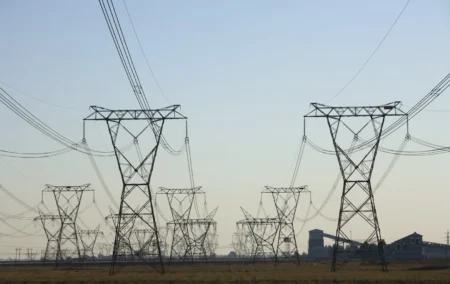
Caption: High voltage transmission lines near Lethaba Power Station in the northern Free State. (Photo: World Bank Photo Collection, under CC BY-NC-ND 2.0 licence).
The views of the writer are not necessarily the views of the Daily Friend or the IRR.
If you like what you have just read, support the Daily Friend