


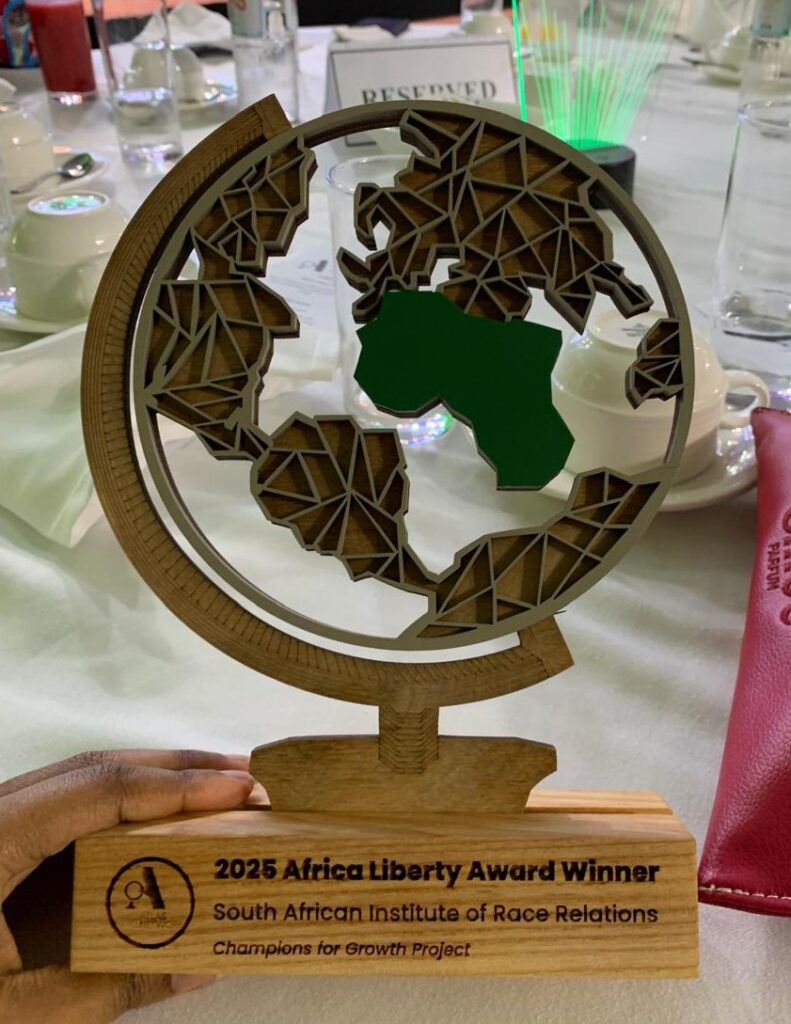
The Institute of Race Relations (IRR) was last night awarded the prestigious Atlas Network 2025 Africa Liberty Award at a gala event in Nairobi, given in recognition of “the region’s most outstanding policy accomplishments championing individual rights and economic freedom”.
The IRR was one of three finalists, alongside Ghana’s Africa Centre for Entrepreneurship and Youth Empowerment (ACEYE) and Tanzania’s Liberty Sparks.
The award was received by IRR Strategic Engagements Manager Makone Maja. The awards ceremony was hosted by Atlas Network in collaboration with Students For Liberty.
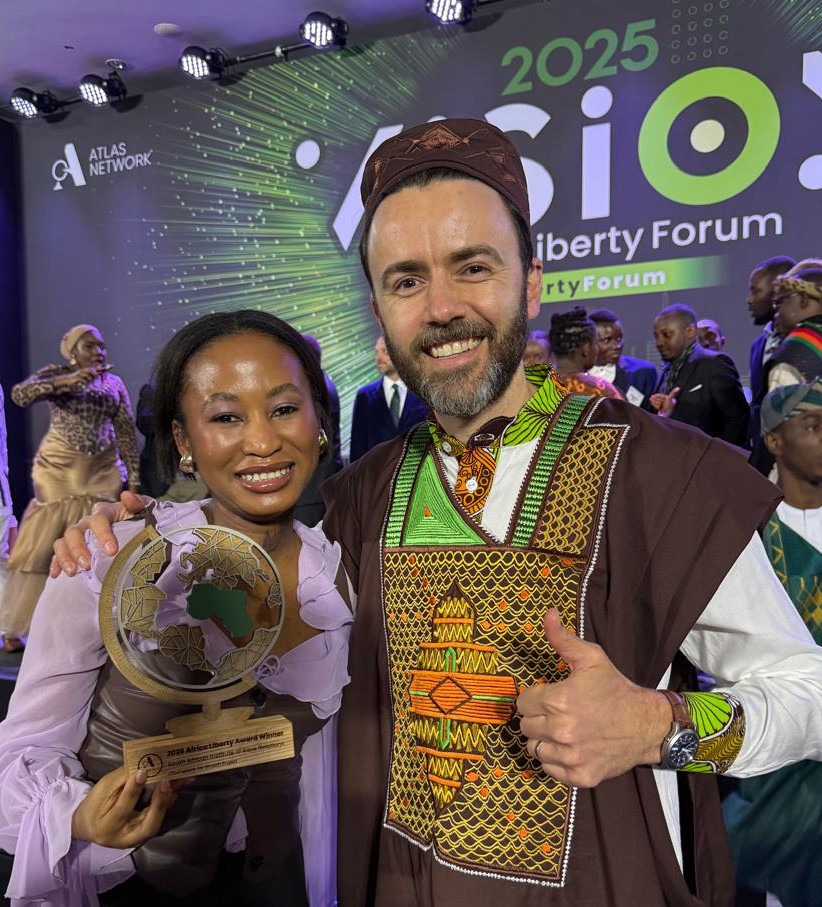
Makone Maja with Free Market Foundation CEO David Ansara
The Africa Liberty Award is part of the Templeton Freedom Award prize program sponsored by Templeton Religion Trust—named for the late investor and philanthropist Sir John Templeton.
The program sponsors awards in Africa, Asia, Europe, the Americas and the Middle East to recognise “high-achieving organisations that make innovative contributions to economic freedom and human progress”.
IRR CEO Dr John Endres said last night he was “deeply honoured” that the organisation had won the 2025 award.
He said: “This honour belongs to every one of my colleagues whose determination, intellectual rigour, and hard work have made this possible. I also warmly congratulate the other finalists on their impressive and worthy projects. We are privileged to be part of the Atlas Network, and through it to share a tenuous but inspiring connection with Friedrich Hayek and Sir Antony Fisher, figures who helped change the course of history by championing liberty and free markets.”
Endres added: “South Africa’s greatest challenge today is its chronic lack of high economic growth. That is the problem we have set ourselves to help solve, above all through our Champions for Growth project, which includes the publication of eight Blueprint for Growth policy papers that lay out concrete steps to lift the country’s growth rate.
“Encouragingly, we are seeing signs that our work is gaining traction, with economic growth increasingly moving to the centre of political debate and policy proposals. But much more remains to be done. We will continue our efforts for South Africa to rise out of stagnation and embark on a high-growth path that expands the horizons of opportunity for all.”
In her acceptance speech in Nairobi last night, Maja said: “This achievement wouldn’t have been possible without the support of the John Templeton Foundation. By investing in Atlas Network’s effort to promote free enterprise and economic freedom, you’ve helped spark real momentum for reform − not just in South Africa, but across Africa and the world.
“Thanks to you, our message is reaching millions, and for the first time, government ministers are embracing free-market policies that reflect our proposals. It’s a powerful step forward for prosperity and opportunity in our country.”
Maja added: “Our whole team at the Institute of Race Relations truly appreciates your support.”
On Atlas Network’s website, CEO Brad Lips said of African civil society efforts to promote liberty and growth: “In some of the world’s poorest countries, the African freedom movement is giving hope to the continent and the rest of the world, and this is especially true in Ghana, South Africa, and Tanzania.
“Freedom champions in these three countries are not only reinventing public policy research and advocacy, but leveraging their new discoveries by engaging directly and daily with local communities. They are redefining excellence for the think tank community by working with local constituents on the ground and making sure that those in power understand their concerns.”
Lips added: “Every step of the way, think tanks and civil society organizations are taking their local expertise and harnessing it to reach the halls of government, ushering in key policy reforms. Because of their relentless efforts, countries like Ghana, South Africa, and Tanzania are getting closer and closer to the freedom and free-market prosperity that is proven to lift millions of people out of poverty.”
The Atlas Network citation on the IRR’s entry reads: “With one-third of South Africa’s workforce being unemployed and half of the population living in poverty, the South African Institute of Race Relations (IRR) launched its Champions for Growth Project, the opening phase of a thought leadership initiative aimed at boosting economic growth and cutting unemployment rates across the country.
“Through eight policy papers, each focused on a particular theme, the project set out the central tenets of a free-market reform platform that counters the collectivist approach of South Africa’s most prominent policymakers. Beyond the policy community, the IRR is fighting a battle of ideas by reaching mass audiences, launching its own media platform—the Daily Friend—while leveraging the existing digital media landscape to reach millions of South Africans.
“The IRR’s mission to promote the Champions for Growth Project and collaborate with national ministers has elevated the profile of economic growth in South African discourse, with the country’s ruling coalition (the Government of National Unity) even listing economic growth as a top priority in its own platform—an encouraging sign of progress. For the first time ever, South African ministers are now proposing free-market reforms that align with the IRR’s own proposals, while the media criticism of government overreach spreads far and wide.”
[Image: By David Ansara. From left, Matt Warner, President of Atlas Network, Michael Kyande of finalist and runner-up Liberty Sparks Tanzania, the IRR’s Makone Maja, Emmanuel Acquah of the finalist and runner-up Africa Centre for Entrepreneurship and Youth Empowerment (ACEYE) in Ghana (finalist and runner-up), and Dr Tom Palmer, Executive Vice President for International Programs at Atlas Network.]