

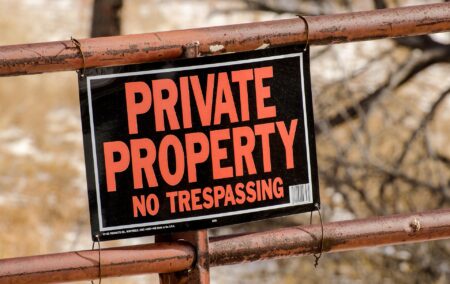
The Democratic Alliance (DA) has taken up the fight against the misnamed Prevention of Illegal Evictions from and Illegal Occupation of Land Act (PIE), primarily by proposing an amendment making it unambiguously unlawful to incite land invasions. But this does not go far enough. PIE needs to be unbundled, and the right to counter-spoliate must be extended.
Anti-eviction legislation is now a normal – though nonetheless problematic – legal phenomenon around the world. It made sense that South Africa would adopt legislation of this nature in the 1990s.
But anti-eviction law is meant to protect people who were initially lawfully present and were now subject to being put out of the property for a valid reason. It is supposed to regulate that process in a fair and humane way.
South Africa’s eviction legislation, including PIE and the Extension of Security of Tenure Act (which applies to rural property), protects – a perverse term in this context – people who are unlawfully present from the get-go, against the express wishes of the owner.
Whereas anti-eviction law elsewhere regulates what needs to happen after the lawful relationship between landlord and tenant has broken down, in South Africa it specifically concerns per se illegal land invasions.
The PIE Act is therefore used both by tenants who have since ceased being lawful occupiers of their landlord’s property, and by violent (often politicised) invaders who came onto property without any valid legal reason.
“Go to court!”
Among a few other minor changes, the DA’s proposed amendment to PIE would make it illegal for anyone to “incite, arrange or organise for a person to occupy land without the consent of the owner or person in charge of that land.”
This is a necessary change, and while the title of the Act may have implied that the law already did this, PIE in fact only made being paid or bribed to arrange or permit a land invasion illegal. Thus, politicians had a free hand – which the Economic Freedom Fighters (EFF) in recent years has made generous use of – to encourage illegal land occupation.
While the DA should be supported completely in this endeavour, the party is still operating on the PIE logic of “go to court.”
This is something we should be very careful about, in this and in every other debate or dispute about law.
Too easily or blithely saying, “well, the courts will decide,” or “let’s take it to court,” assumes too much about the person who actually has to go to court. It is especially problematic in the context of ownership.
Making the judiciary the absolute first resort in an owner’s protection of their property necessarily devalues the notion that they are in fact an owner. Ownership is meant to grant the right to – reasonably and proportionally – vindicate and defend what belongs to us against trespass.
Ownership is the great equaliser. The uber-wealthy go to court. Not all property owners in this country, though, are rich. Ownership is supposed to mean that both rich and poor owners are equally entitled to protect their property.
To dismissively say, “well, go to court,” is to say that the rich get to protect their property, and the poor, if they cannot rely on overworked law clinic students, have to accept that the law does not protect theirs.
After all, organisations like Legal Aid and the Human Rights Commission make it very clear that they will default to protecting and representing unlawful occupiers, rather than lawful owners trying to vindicate their property rights. In so doing, these organisations reveal the hierarchy of constitutional rights in South Africa: the so-called and mal-conceptualised “right to housing” is regarded as preceding the right to property.
The notion that nobody may be evicted without a court order is implicitly premised on the idea that there are capacitated courts everywhere across South Africa that are reasonably accessible to the average person. But this is a total fantasy.
Necessary changes
The PIE Act should – in addition to declaring inciting land invasions a criminal offence – unbundle ordinary anti-eviction law from (pro-?)trespass law, as well as extend the right of owners to counter-spoliate and physically defend their property.
The right to counter-spoliate already exists in our law, but it is arbitrarily limited.
If an owner is sitting on their porch and witnesses a land invader entering the property and start to pitch a tent, that owner is allowed to use proportional physical force to stop the invader from doing so. However, if the owner was absent when the tent was pitched and the invader has managed to effectively “move in” to the tent as if it were their home, the owner has to go to court and obtain an eviction order. No more force may be utilised to remove the trespasser from the property.
This has obviously been abused.
To any sober person, the tent could never qualify as the constitutionally protected “home.” But because the courts have in large part interpreted tents and other informal structures to qualify as such, land invasions have become a serious problem for both property owners and municipal governments now tasked with providing “alternative accommodation.”
If there is an insistence on protecting the so-called “rights” of trespassers, this protection must stand on more reasonable ground.
The right to counter-spoliate must extend beyond the arbitrary moment that a tent becomes a “home.” Owners should at the very least have days, if not weeks, to use reasonable and proportional force to remove (non-former lawful tenant) trespassers from their property. Only if someone has, in good faith, come to actually live on the property for an extended period of time without objection from the owner should the protections kick in and require a court order to be obtained first.
Those who act in bad faith, specifically with the intention off triggering PIE “protections” – especially as part of a political campaign – should receive no legal protection whatsoever.
This approach, though far from being the ideal liberal policy, would represent a happy compromise that gives owners, especially poor owners who do not have attorneys on speed dial, due recognition of their property rights while also protecting the bona fide homeless.
[Image: Lisa Johnson from Pixabay]
The views of the writer are not necessarily the views of the Daily Friend or the IRR.
If you like what you have just read, support the Daily Friend