

Few countries have ever paid a greater price for overindulging ideals.
It is rather easy to argue that the current suffering in Ukraine could have been avoided had Europeans, particularly Germans, supported adequate deterrence instead of savouring green policies and multicultural pretensions. Despite their country having the world’s largest proven oil reserves, most Venezuelans were plunged into poverty due to their rulers overindulging Marxist ideals. The kleptocrats who have run Zimbabwe, Africa’s breadbasket, introduced progressive land reforms that triggered a profound economic decline and mass hunger.
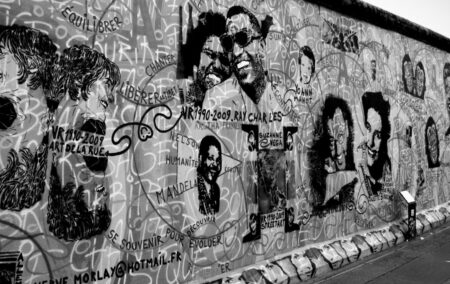
Ideals can uplift cultural norms or be weaponised by opportunistic politicians. The post-Cold War period began with the fall of the Berlin Wall and the idealistic zeal that it inspired was soon personified by Nelson Mandela’s prisoner-to-president narrative and his admirable character.
Justifying moral opposition to apartheid was not difficult; nor was exploiting its demise. Within a decade of Mandela’s retiring, Jacob Zuma became president as the ANC was endorsed by nearly two-thirds of voters.
The ANC exploited our having the world’s highest income inequality to justify policies which have favoured the politically connected while provoking the world’s most severe youth unemployment crisis. More than half of SA’s “born free” blacks who have left school are poor, unemployed or both. Few of them will ever achieve even a modest version of prosperity. The resulting impediments to growth will persist for many decades − Venezuela and Zimbabwe are similarly afflicted.
The thirty-year post-Cold War period spanned the demise of the Soviet Union to Russia’s 2022 invasion of Ukraine. SA’s “negotiated revolution” provided a spiritual-like epicentre for believers in the cleansing power of that recently ended era’s zealous idealism.
Celebrating victimhood
SA should be Exhibit ‘A’ for those arguing that overindulging idealism, by celebrating victimhood, undermines poverty alleviation. Many European countries now similarly evidence how idealistically over-embracing multiculturalism can backfire.
It isn’t easy to mix groups with hard-edged cultural differences. Nor is it easy to govern national economies amid today’s rapidly evolving global economy. Repercussions from three decades of bingeing on idealism have provoked a pivot toward a transactional-styled world order. This profoundly challenges SA’s political nimbleness as our ruling party’s electoral support relies heavily on patronage which, in turn, is justified politically by manipulating ideals.
Whereas constitutional democracies are designed to balance the interests of diverse groups, the ANC learned that it could frustrate opposition parties and critics by merely brandishing one word, inequality. From there it could tap into a great reservoir of idealism to frame our national dialogue using fairness criteria.
Such idealism-laced politics appeals to majorities of voters in many European countries and the large majority of voters in SA who support the ANC, MK or the EFF. The common foundation is a downgrading of politics focused on how best to balance trade-offs among the interests of various stakeholder groups. Instead, what emerges is staunch advocacy politics grounded in Marxist-inspired oppressor-versus-oppressed narratives.
Such paths lead to DEI-styled policies including the ANC’s version, which combines BEE with a growing emphasis on localisation. The historical record clearly cautions against sidelining evidence-based decision making, logic and merit to splurge on ideals.
Patronage-heavy
As indefensible as the ANC’s BEE policies have become, they are central to supporting the party’s patronage-heavy electoral strategy. The party’s leadership isn’t considering a strategic rethink. Rather they have sought to reignite support for the ideals they exploit by launching a new national dialogue initiative.
Various groups have objected to this initiative or at least withheld their support, thus far. Although their motivations and intentions are suspect, the party’s leaders are correct to assert that we need a new national dialogue. Yet leading voices critical of ANC policies focus on incompetence and corruption rather than unpacking how legal-but-unaffordable patronage is promoted through manipulating ideals. Did we become so intoxicated on idealism that we can see what is broken but we lack the clear-headedness to distinguish between what is possible and what isn’t?
When earlier this year President Ramaphosa called for “South African solutions for South African problems” there was little if any public pushback. His appeal to our patriotism was accepted across the political spectrum despite its being virtually impossible to noticeably improve our nearly flat GDP trajectory, let alone our ultra-elevated unemployment, without surging exports.
We largely agree that unemployment, particularly youth unemployment, must be our top priority. We also agree that government corruption and incompetence must be dramatically reduced. While doing those things would probably spur commodity exports, this would expand the government’s ability to fund the ANC’s otherwise unaffordable patronage without noticeably reducing unemployment.
The presumption at the centre of our national discourse is that the only way to create jobs for our poorly educated school leavers is to grow the economy. This is wrong on multiple levels.
Probably the most romanticised version of such thinking is that our entrepreneurs will spur economic growth and job creation. This can only happen if they discover ways to hire South Africans to add value to exports. Rather, most of our entrepreneurs focus on domestic consumers.
Wrongheaded
Due to the perverse effects of BEE and localisation policies, our business people target our domestic consumers. Among the clues we have long ignored regarding how wrongheaded this is, most of the world’s fastest growing emerging economies emphasise value-added exporting. Another clue is that SA’s per capita income is lower than it was fifteen years ago.
It is as if an ocean-facing country insisted on subsisting by fishing in a large inland lake despite abundant indications of overfishing. To have entrepreneurs that then invent better ways to overfish will solve nothing.
Expecting education or inward-focused entrepreneurs to spur our economy ignores the fact that our national spending capacity is inadequate and we can’t realistically hope to change that without increasing value-added exports. Much of the growth in developing economies over recent decades has come from peasants migrating from fields to factory floors. Most such successes were not contingent upon meaningful education gains. Often those accrued to the children or grandchildren of urbanised lower-skilled workers.
We also want to believe that ousting the ANC from the Union Buildings in 2029 will trigger adequate growth. It is possible that a much more centrist coalition will emerge and this would certainly improve the odds for favourable outcomes. But our economy is currently so misconceived and uncompetitive that it is quite likely that an external shock would trigger much damage before deep fundamental reforms could stabilise our political economy.
ANC leaders have launched a national dialogue initiative to support the party’s interests, not SA’s. That responses from other elements of our society have been so feeble traces largely to idealism having been overindulged. We need to be, individually and collectively, much more realistic.
[Image: https://www.publicdomainpictures.net/en/free-download.php?image=berlin-wall&id=69423]
The views of the writer are not necessarily the views of the Daily Friend or the IRR.
If you like what you have just read, support the Daily Friend