

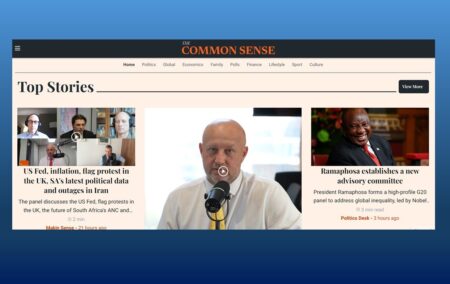
The Common Sense officially launched yesterday as a new “third-space tech-based media company” which will seek to “amplify the values of South Africa’s centrist majority”.
It says it aims to “occupy a space between our readers’ home and work lives where we offer affirmation, reassurance, community, and a sense of social cohesion”.
The mastermind behind the project is former CEO of the Institute of Race Relations (IRR), Dr Frans Cronje, now of Frans Cronje Private Clients. He is also chair of the Social Research Foundation.
Two other key figures in the new outfit are former Daily Friend deputy editor, and IRR head of campaigns, Marius Roodt, and economist and former IRR analyst Bheki Mahlobo.
The Common Sense says it commits to “stress(ing) the bridge issues that unite people and not the wedge issues that are used to divide; and celebrat(ing) all the things that are good about South Africa and the world because it is in so many respects a wonderful time to be alive”.
Its menu of offerings, both news and opinion, covers politics, global events, economics, family, polls, finance, lifestyle, sport and culture.
Under the About Us tag, it says: “As a tech-business we are heavily invested in engineering bespoke large language models that are transforming the world of economic, political, and geo-strategic analysis.”
A landing-page piece headlined, Belief in the Centrist Majority Shapes the Launch of The Common Sense, notes: “Drawing from their three years together as director both of South Africa’s Social Research Foundation (SRF) and the advisory firm Frans Cronje Private Clients, Frans Cronje and economist Bheki Mahlobo, together with a team of peers, argue that an overwhelming majority of South Africans stand united by common sense and shared values – a foundation that The Common Sense, the new tech-driven media company they have launched, pledges to amplify in public debate.
“South Africa’s public conversation is dominated by conflict, division, and what Cronje and Mahlobo call ‘the echo chamber of extremes’. Yet as they step into new roles at The Common Sense, their time together has made them believe more strongly than ever that South Africa’s prospects hinge not on fringe voices, but on the silent majority whose moderate, pragmatic values stretch across race, class, and geography. ‘If you look past the noise,’ Mahlobo says, ‘you find a country more united by common sense and practical ambition than any headline would have you believe.’”
The piece says the “priority for The Common Sense is to place this centrist consensus − the real ‘centre of gravity’ of South Africa’s society − at the heart of national debate.”