

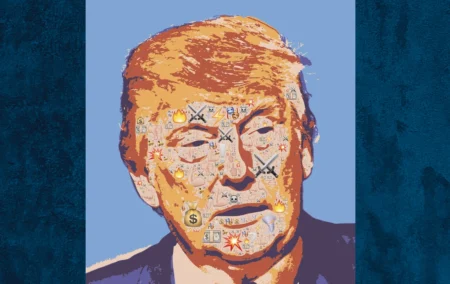
The once-great US of A is on a downward spiral, ruled by a megalomaniac who arrogantly exudes ignorance. I did tell you so.
My wife and I were drawing up a budget the other day. Poring over the dispiriting numbers – electricity and fuel through the roof, groceries at outrageous prices, a bunch of internet-related expenses – I had a brainwave worthy of an alumnus of the Wharton School of the University of Pennsylvania.
“If we just stopped buying from all these places that never buy anything from us – petrol stations, supermarkets, doctors, Eskom – we would make thousands every month! Do they ever buy your art? Do they ever buy my writing? No! We are carrying these businesses! We’re being taken for a ride! It can’t go on like this!”
My wife was struck silent, as one would be by such a bold display of staggering genius. “I’m the best in the world at budgeting,” I told her. “Nobody knows budgets better than I do.”
So that’s decided, then. From next month, we’ll buy no electricity, no fuel, and no food, and we’ll be rich! See ya, losers!
Too stupid
This sounds like a parody, but it isn’t. It isn’t even funny, because it’s so stupid.
Yet this is exactly what the smartest man in the world, the God-Emperor of North America himself, Donald Trump, said on Wednesday: “Interest Rates in the United States should be 1%, or less, because we are the Best Credit in the World — BY FAR. Our Country is BOOMING with new Investment! If we stopped Trading with every country that we have a Deficit with, which is most of them, we would make, at least, 1.5 trillion Dollars a year. The word ‘Deficit’ is nothing more than a fancy word for LOSS. We are ‘carrying’ almost every country in the World, and that cannot go on any longer. LOWER THE INTEREST RATES FOR THE UNITED STATES OF AMERICA, AND FAST! President DONALD J. TRUMP”
Or, if you prefer to hear it from his own mouth, here he is taking questions from a reporter, appropriately posted by @Poeslawisalive: “[unclear] deficits? For instance, if we lose $50 billion a year with a country, and we say, ‘We’re not going to trade with you anymore,’ we don’t lose $50 billion. It’s very simple.”
This is a stunningly ignorant claim, and it has implications on so many levels.
First, there can be no doubt that Trump – despite reporting to the contrary back in the day – was never “first in his class” at Wharton. He apparently did graduate, though only with a bachelor’s degree and not the prestigious MBA for which the school is famous.
He made an impression on very few of his professors and classmates. Those that do, recall he was a lot more focused on the real estate business he inherited from his father than on actually studying. He told the world it was one of the hardest schools to get into (which is true of the MBA course, but not the undergraduate programme), but multiple of Trump’s family members have said that he got in because he paid someone to take his entrance exam, his father was a generous donor to the school, and his brother knew someone in the admissions office.
I don’t know whether any of that is true, other than that he was not anywhere near the top of his class. What I do know is that if he ever knew anything about economics, he has long since forgotten it. A trade deficit is not a difficult concept to understand, yet Trump not only keeps repeating his ignorant misunderstanding of the term (no, it is not a “loss”, to either party in the trade or their country), but he has based his entire economic policy on the claim that trade deficits constitute an economic emergency (they do not; they are not even a bad thing).
Explaining trade deficits
What Trump doesn’t know (or just lies about) is that running a trade deficit, as measured in dollars, means you’re running a surplus as measured in goods and services. For every dollar an American sends overseas, they get more than a dollar in value back. If they didn’t, they wouldn’t enter into the transaction in the first place.
Running a deficit means that the US buys more from other countries than other countries buy from it. And since money doesn’t buy happiness, but goods and services sure do, that means Americans – being richer than everyone else – are buying more of the stuff that makes them happy than anyone else in the world.
A normal person runs a trade deficit with everyone except their employer. A country runs a deficit with every country that is smaller or less productive than it is.
Being able to run a trade deficit is a sign of economic strength, not weakness, as I have written before, more than once. But hey, I didn’t graduate from Wharton, so why not hear it from Justin Wolfers, a professor of economics who actually wrote a textbook on the subject, explaining “what bilateral trade deficits are, so that you can better understand – and perhaps be infuriated by – the intellectual error that’s transforming our economy”.
Achieved very little
Unsurprisingly, Trump’s tariff wars have achieved very little by way of positive protection for the US economy, and have done a great deal of harm to the global economy and America’s position in the world.
The most recent symptom is Canada’s desire to form ties to the European Union, and the EU’s apparent willingness to admit it as an “associate member”. That isn’t a very smart move by Canada, but America’s one-time allies can hardly be blamed for seeking support from each other while the one-time leader of the free world descends into authoritarian isolationism.
It hasn’t done the US any good, either. Of course, tariffs are a tax on US importers – both firms and individuals – and not a tax on foreign exporters, as Trump likes to pretend. But the goal of the policy was to bring manufacturing jobs and investment back to the US. It has not done so.
Despite lofty “reshoring” investment commitments (comparable to the investment promises about which Cyril Ramaphosa routinely boasts), the tariffs coincided with a decline in domestic factory investment rather than a boom, and the headline surge in foreign direct investment is almost entirely acquisitions of existing American companies rather than new plant.
Construction spending on manufacturing facilities, which peaked in the third quarter of 2024, under Biden’s CHIPS Act and Inflation Reduction Act, has fallen 30% since Trump’s inauguration. US manufacturing employment has declined by about 75,000 jobs since January 2025.
The manufactured goods trade deficit actually widened by 5%. The overall trade deficit did decline, but that was driven largely by higher exports of gold, oil and natural gas, rather than by stronger manufacturing performance.
Almost all capital is going into power generation and AI data centres, both of which would have happened without tariffs, and neither of which does much for employment (though it does hold promise for productivity improvements).
Sycophants, not advisers
Second, that Trump is still repeating such a cringeworthily moronic claim is proof that he has surrounded himself not with advisers, but with sycophants.
Either nobody has the balls to take him aside and show him Professor Wolfers’s textbook, or nobody around him even knows that he is wrong.
What is scary is that both alternatives are equally plausible. That his cabinet and staff are spineless bootlickers is abundantly evident in the fact that they take every soundbite opportunity they get to stroke Trump’s ego and meekly defer to him.
And that his cabinet is questionably qualified is also true. The Trump administration is “riddled with unqualified leaders”, argues the left-leaning Center for Economic and Policy Research. Jeffrey Sachs, distinguished professor at Columbia University says Trump’s cabinet contains only a single bachelor’s degree in engineering, while China’s cabinet is loaded with science and research PhDs.
Not that there aren’t degreed people at cabinet level; there are, but they’re mostly lawyers and political science types. Scott Bessent, the Treasury Secretary, for example, who strongly defends Trump’s unsound trade war policies, has financial trading experience at Soros Fund Management, but he has a degree in political science, not economics.
Once lauded for being among the Soros minions who broke the Bank of England, recent record-level Treasury bond yields have “humbled” Bessent, per the New Yorker.
The only Trump official with a bachelor’s degree in economics is Howard Lutnick at Commerce. (Jay Clayton, the recently appointed Director of National Intelligence has a Master’s in economics, but isn’t in an economics role.)
Sachs is technically wrong about the number of engineering degrees: Chris Wright, the energy secretary, has a bachelor’s in mechanical engineering, but Clayton has a bachelor’s in engineering too – though once again, he’s not in a relevant role.
The point is that Trump’s cabinet is not exactly brimming with economics experts or highly qualified technocrats who could call Trump out.
The typical response on the right to this observation is summarised by Andrew Mercer of the non-partisan news outlet Political.org: “Many Trump supporters enthusiastically back the appointment strategy, arguing that Washington insiders and career bureaucrats sabotaged the first term and that loyalty to the president’s mandate is itself a qualification. Right-leaning commentators frame the ‘deep state’ pushback as proof that Trump is finally dismantling entrenched institutional resistance. Some conservatives do quietly acknowledge concerns about specific nominees’ lack of agency expertise, but publicly rally around the broader disruption agenda.”
There’s a word for regimes where loyalty to a leader is itself a qualification.
It’s the economy, stupid
The third observation is that interest rates are – besides being set by a nominally independent central bank which should not be ordered around by a petulant president – are a signal of economic performance.
Trump says that the US is credit-worthy. Buyers of sovereign debt beg to differ. I also think I’m far more credit-worthy than my bank is willing to concede, and it’s the bank that decides.
Trump promised to cut the inflation he claims was caused by Joe Biden (but was actually caused by the global pandemic response). He didn’t. It went up.
His defenders will say it’s a temporary blip caused by higher fuel prices, but gasoline prices – up 27.4% year-on-year – accounted for only a third of the latest consumer price index increase. Food price inflation has also gone up, not down.
Speaking of gasoline prices, he promised to “cut energy prices in half within 12 months”, deliver “$2 a gallon”. “Mark it down, and you can get very angry at me if we don’t do it,” he told a rally in Indiana, Pennsylvania in August of 2024.
The average gasoline price at Trump’s second inauguration was $3.229. The most recent reported figure is $4.455. That is – how best to put it – not halved. And it’s set to get even worse, causing anger and protests around the world.
Payroll growth averaged 31,000 a month over the 12 months to August 2026, against gains in the 140,000–200,000 range in late 2024 and January 2025. August itself was more positive, but the labour participation rate has declined as long-term joblessness increased as a share of all unemployment, which rose only marginally.
The US economy is extraordinarily large and deep, and therefore very resilient to shocks, but even so, GDP growth has been sluggish, at less than half the long-term average of over 3%.
Consumer sentiment is in the toilet. Measured by the University of Michigan at 47.8, it was lower than the worst month post-Covid, exceeding only May 2026 in the last ten years. At Trump’s inauguration, it stood at 71.1 points, and during his first term, it averaged about 95.
Despite all the noise about DOGE – which cruelly cut poverty relief and health programmes such as PEPFAR in South Africa that keeps many HIV/Aids patients alive – there has hardly been a blip in federal spending, which continues to rise as if Biden were still in charge.
The federal budget deficit (the excess of spending over tax revenue) sits at $1.8 trillion for FY 2025. That was only marginally less than Biden’s final year in office, and more than in 2022 or 2023. The current financial year ends on 30 September, but so far, it already exceeds the deficit for the whole of FY 2025.
As a result, the federal debt continued its relentless march towards $40 trillion, roughly double what it was when Trump first set foot in the Oval Office in 2016.
For the record, he pledged at various times not to increase the national debt, to reducing a portion of it, and to paying all of it off by using tariff revenues that even with the most rosy forecasts and calm legal waters couldn’t have raised even a tenth of that amount.
Forever war
Then there’s the Iran war. Almost everything I wrote about it, six months ago, now seems prophetic. It has been very expensive for the US, and even more expensive for the world in terms of higher oil prices. It has achieved essentially nothing good: Iran is still ruled by an Ayatollah, presiding over a hand-picked Guardian Council, which imposes strict Islamist theocracy upon the Iranian parliament, executive government, judiciary and people. It still seeks to build nuclear weapons. It still swears to annihilate both the Great Satan (the US) and Little Satan (Israel). It still provides material support to proxy militias around the Middle East.
And despite the damage both Iran and its proxies have sustained, they are still capable of closing the Strait of Hormuz at will, holding the US and the world over a barrel in a way that they did not (or could not) before Trump shot from the hip in February, and might even be able to close the Bab al-Mandab Strait into the Red Sea, using Yemen’s Houthi militias.
And there is no sign that the war will come to any conclusion. Trump has ordered it ended. He has insisted that Iran stop messing about and admit defeat. He has demanded that other countries take over policing the Strait of Hormuz. He has thrown his toys and yelled his head off, but he has no cards. Iran holds all the cards. It alone can decide when this conflict ends, and for now, keeping the US occupied in the Middle East is good for Iran, and even better for its backers in China and Russia.
For someone who promised to end “forever wars”, he’s not doing a very good job. Perhaps that’s what you get when you put a looks-maxxing Fox News pundit in charge of the military.
Most corrupt ever
There’s the staggering corruption, that makes Jacob Zuma look like a rank amateur. Trump, his friends and his family have made billions off the presidency. And Trump has no shame: he is even offering early access to his Truth Social posts – the personally owned platform where he conducts much of his official executive business – to paying subscribers who want insider information before everyone else gets it.
If I listed all the corrupt and probably corrupt business involving Trump and his inner circle, I’d be here all week, and this piece wouldn’t get any shorter. So let’s hand the microphone to the pseudonymous intelligence analyst and investigative reporter behind The Leah Files, who constructed a rigorous model to assess exactly how corrupt US presidents and various historical world leaders have been.
Trump and his family made literal billions from personal and family ventures in which he is both a player, and, as president, referee. The self-dealing is on a scale that is hard to believe.
Leah’s report shows Trump leading the global pack as the worst leader ever by reported corruption alongside Teodoro Obiang, Mobuto Sese Seko, Suharto and Sani Abacha. By documented corruption, which limits the scoring to convictions, guilty pleas, court rulings, official findings, special counsel reports and sworn financial disclosures, Trump ranks alongside Viktor Yanukovych of Ukraine (remember the private zoo?) and the Tweed Ring of Tammany Hall, which ran New York for five years in the 19th century.
Either way, he far outranks his own first term, as well as the second-most corrupt president on record, Richard M. Nixon.
Promises kept
He has kept some of his promises, and some of those are good things. Taking a chainsaw to environmental red tape and green technology nonsense was in many ways a good thing. Defunding education is less defensible, but he did say he was going to do it, and he did.
He made his 2017 tax cuts permanent, as he promised, though he replaced them with massive tariffs, and wasn’t able to cut government spending to account for the difference.
He said “drill, baby, drill”, which is great, and that has increased America’s energy exports.
He has kept his promise to pardon the January 6 insurrectionists, even if they were violent. He also pardoned a raft of other people: anyone he considered a friend, or whose family could raise a sufficient bribe, or who was convicted of crimes to which Trump himself is sympathetic, like fraud, got a get-out-of-jail-free card. He also secured sweeping tax and legal immunity for himself and his family, which remains valid even after he leaves office.
But mostly, he has kept his promise to use the institutions of state to go after the scapegoat groups against whom he whipped up his populist movement: immigrants, left-wingers, liberated women, and LGBTQ+ people.
Ignorance, avarice and hatred
We’re less than two years into Trump’s second term, and all of the worst fears about him have turned out to be realised.
I was told that my concerns, expressed back in 2024, were just a touch of the Trump Derangement Syndrome. I was right, however. He is a moron. He is an authoritarian fascist. He is narcissistic and cruel. He is greedy and corrupt. He has damaged crucial institutions that safeguard civil liberties, protect law and order, and guarantee freedom and property rights.He has harmed both America’s and the world economy.
The only derangement that remains is on the part of people who still, after all this, support him.
I get the anti-establishment appeal he had back in 2016. I thought him a crass and uncouth real estate salesman with odious tastes even then, but the prospect of seeing the cosy Washington establishment ripped asunder seemed exciting. Hillary Clinton was an awful candidate, and though Trump was too, I can see how he would have at least seemed the lesser of two evils (and perhaps a promising candidate) to people who oppose big government and like free markets.
His first term was not that bad, but his ignorance was on full display. And the movement that grew behind him grew increasingly toxic. It was openly hostile towards women, black people, and other minorities. Its entire worldview was based on white nationalism, religious fundamentalism, and hatred directed at out-groups. It was economically populist, in the same destructive way that the far left is economically naïve and dangerous.
Libertarian optimists might still have thought he was just being bombastic, and if he actually delivered what he promised – less spending, lower taxes, less government, more freedom, and fewer wars – he would be better than any alternative.
None of those caveats and qualifications still hold true. He, and the people around him, have shown their true colours. He is nothing more than a malignant narcissist with more bombast than brains, who has never read a book (including the one he had ghostwritten for him), and who understands neither economics, nor constitutional democracy, nor the institutions of freedom, nor American exceptionalism, nor foreign policy, nor war.
He is a moron, and a dangerous, evil moron at that. Anyone who still supports him, even after having witnessed all of this, is not just wilfully blind, but must be equally ignorant, tolerant of corruption, sympathetic to hatred, or outright evil.
[Image: An artwork depicting US president Donald Trump covered with various icons. Public domain image from Picryl.]
The views of the writer are not necessarily the views of the Daily Friend or the IRR.
If you like what you have just read, support the Daily Friend