

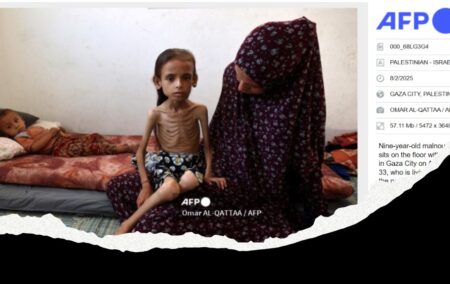
When the world saw the skeletal figure of nine-year-old Mariam Dawwas from Gaza in August, the reaction was immediate: outrage, condemnation, and accusations that Israel was starving children. The photo flooded headlines, social media, and even reports by international organizations. She became the global “face of famine”.
Her emaciated frame, hollow eyes, and fragile body were splashed across front pages and television screens from London to Los Angeles. International organizations issued statements. Politicians thundered against Israel. Social media exploded with outrage. Mariam was declared the face of a famine, the innocent victim of an alleged Israeli blockade starving Gaza’s children.
Yet as shocking as the image was, the reality behind it was more disturbing still, not because Mariam was suffering, but because her suffering was cynically manufactured into a false narrative. She was not starving due to famine at all. She suffers from a congenital intestinal malabsorption disorder, a disease that prevents her body from absorbing nutrients despite being fed and treated. Healthy siblings were deliberately cropped out of photos to conceal the truth, her medical records were ignored, and a human tragedy was transformed into a weapon of propaganda.
Over the past few months, the news has been awash with reports on the unfolding humanitarian crisis in Gaza. Even as Israel increased the level of humanitarian aid entering the embattled enclave, gradually reducing the intensity of the crisis, the media did not slow its onslaught of coverage. Traditional news sites and online personalities amplified the image of famine by highlighting individual cases of malnutrition, many of which turned out to involve pre-existing medical conditions. Analyses by The Free Press, investigative journalist David Collier, and others revealed that children profiled as famine victims were in fact already battling lifelong illnesses. In many cases, this critical context was concealed from the public.
Leaked medical records
The evidence of this deception is irrefutable. Leaked medical records from Al-Rantisi Children’s Hospital prove that Mariam was diagnosed with her condition 18 months before any famine claims emerged. She had been receiving therapeutic milk, intravenous fluids, antibiotics, and high-dose vitamins. Malnutrition was the result of her illness, not of starvation. Yet not one of the global outlets that ran her story questioned the narrative. Instead, they repeated the pre-packaged line: no underlying condition, only hunger, only blockade, only Israel to blame.
What makes this more damning is that Mariam’s case is not an exception. Again and again, the same pattern has emerged: images of sick or disabled Gazans are paraded as famine victims, their true conditions erased. One of the first was Mohammed al-Mutawaq, whose photo appeared on the front pages of The New York Times and others. He was not starving but has cerebral palsy, a disorder that increases the risk of malnutrition due to severe motor difficulties.
The same happened with Osama al-Raqab, a five-year-old with cystic fibrosis who had been transferred to Italy for advanced treatment on June 12, yet his image continued to circulate months later, stripped of medical context. In late July, Al Jazeera reported that 27-year-old Karam Khaled al-Jamal had died of starvation, but he had in fact suffered from muscular dystrophy and partial paralysis since birth. Four-year-old Abdullah Abu Zarqa, filmed saying he was hungry, was later confirmed by the IDF to have a genetic disease which caused bone thinning and deficiencies; he had been receiving treatment in East Jerusalem even before the war began.
Other cases followed the same script: 17-year-old Atef Abu Khater, who stopped eating after severe burns caused psychological trauma; 14-year-old Mosab al-Debs, who required a feeding tube after a brain injury but was presented as starving; six-year-old Najwa Hajjaj, suffering from a chronic oesophageal condition, used as another famine symbol; and 25-year-old Hamza Mishmish, disabled since birth with cerebral palsy and a weak immune system, were described by NPR as dying of malnutrition. Even Youssef Matar, another child with cerebral palsy, had his image circulated by Reuters and The Guardian without clarification.
Carefully constructed narrative
In each of these cases, the real suffering was not denied, but its cause was deliberately distorted. Illnesses and disabilities became props in a carefully constructed narrative, designed to indict Israel rather than inform the public.
The complicity of global media in amplifying this propaganda cannot be brushed aside. Sky News, for example, reported directly from the hospital that held Mariam’s medical records. Those records listed her malabsorption disorder, yet reporters chose to write instead that she had no underlying condition and was dying solely from hunger. This was not oversight. It was wilful blindness, a conscious choice to tell a politically convenient story rather than the medically documented truth.
The manipulation pipeline is clear. Local photographers and stringers, often with ties to Hamas, produce emotive but misleading images. These flow to wire services like AFP and Reuters, which dominate Western newsrooms. By the time the photos appear in The New York Times or The Guardian, they are stripped of context and presented as objective journalism. The public is never told that the photographer glorified terrorists or ignored medical documentation. The deception is complete: it is propaganda crafted in Gaza, laundered through Western media, and sold globally as truth.
The consequences are devastating. For Mariam and others, their real conditions were erased. Instead of rallying support for specialized treatment, the world was mobilized to condemn Israel for a famine that never existed. For Mohammed, Osama, and Karam, lifelong illnesses were hijacked for political theatre. Beyond the personal tragedy, the cost is borne by truth itself. Journalism became not the first draft of history but the mouthpiece of propaganda.
Even when the truth emerges, it struggles to break through. Independent investigators like David Collier exposed cropped siblings, medical contradictions, and fabricated narratives. Watchdog groups documented the biases of the very photographers behind the stories. Yet none of this pierced the mainstream. Corrections, if issued, were buried in obscure corners of newspapers long after the lies had done their damage.
Unmistakable
The double crime is unmistakable. First, against the children themselves, whose suffering was exploited and misrepresented. Second, against the global public, deceived into outrage against Israel for crimes it did not commit. This erosion of credibility will have lasting consequences. When the next real famine occurs, scepticism will prevail, and genuine victims may be ignored because the world has learned, rightly, to doubt.
The case of Mariam Dawwas is more than an exposé of bad reporting. It is proof of how easily propaganda dominates the international information ecosystem. The facts are indisputable: documented medical evidence proves Mariam was ill long before any famine claims; healthy siblings were cropped out; multiple children with pre-existing illnesses were misrepresented as famine victims; and the world’s most respected outlets repeated the lies without scrutiny. This is not an accident. It is complicity in deception.
Unless audiences demand evidence, context, and accountability, this cycle will continue. Propaganda will keep manufacturing famine, the media will keep amplifying it, and the truth will keep being buried. The choice is stark: either we live by deception, or we reclaim the truth, no matter how inconvenient it may be.
[Image: https://www.camera.org/article/no-known-accountability-afp-ignores-illness-of-skeletal-child-mariam-dawwa/]
The views of the writer are not necessarily the views of the Daily Friend or the IRR.
If you like what you have just read, support the Daily Friend