

South African fans of Donald Trump don’t seem to understand what “free speech” means. No, it doesn’t mean “speech has consequences”. It means the exact opposite.
On Tuesday, the United States Department of State issued a series of X posts announcing the revocation of visas for several individuals.
Their crime? Speaking their mind. They disrespected, and in some cases celebrated the death of, young conservative activist Charlie Kirk.
Said Big Brother: “The United States has no obligation to host foreigners who wish death on Americans. / The State Department continues to identify visa holders who celebrated the heinous assassination of Charlie Kirk. Here are just a few examples of aliens who are no longer welcome in the U.S.:”
Their second example was: “A South African national mocked Americans grieving the loss of Kirk, saying ‘they’re hurt that the racist rally ended in attempted martyrdom’ and alleging ‘he was used to astroturf a movement of white nationalist trailer trash.’ Visa revoked.”
The other examples were similar, involving visitors from Argentina, Mexico, Brazil, Germany and Paraguay.
Definitely not doxxing
The State Department performatively redacted the names of the people whose messages they reproduced, presumably hoping not to violate the X user policy against doxxing (disclosing someone’s identity, or “documents”, and thereby exposing them to online lynch mobs or real-world vigilantes and stalkers).
Despite their diligence, they must have been aware that a simple text search would reveal the authors of the posts.
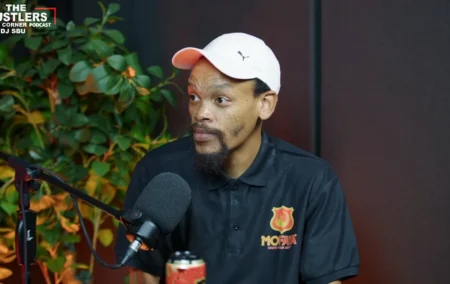
In the case of the South African national, it was Nhlamula “Nota” Baloyi, a 35-year-old music executive, minor celebrity, and a regular on DJ Sbu’s podcast, The Hustler’s Corner. (His identity has been widely published, so I’m not violating any privacy here.)
Big Brother went on to assure its American audience and the world: “@POTUS [the President of the US] and @SecRubio [Secretary of State Marco Rubio] will defend our borders, our culture, and our citizens by enforcing our immigration laws. / Aliens who take advantage of America’s hospitality while celebrating the assassination of our citizens will be removed.”
It stands to reason that the US government would disagree with and disapprove of the sentiments expressed. It does not, however, stand to reason that disagreement, or even disgust, entitles the US government to take punitive action against the people who expressed such sentiments.
South Africans cheering
Instead of jumping to the defence of their South African compatriot, a bunch of South Africans cheered the US State Department.
Some turned into Stasi snitches, reporting other South Africans, like Redi Thlabi and Trevor Noah, to the American government over things they said.
(And before someone brings up David Bullard, the right to free speech protects people from their government. There is no such protection from action by private clients or employers, and there should be no such protection. Private individuals and entities should be entirely free to protect their own reputation or mission by severing relations with someone for saying something that is detrimental to them or that conflicts with their values. That does not infringe on their freedom of speech, because they can happily go on making provocative jokes anywhere else.)
Clearly, fans of Donald Trump have forgotten his campaign promises to defend free speech. They’ve forgotten how they used to whine about “cancel culture”. Now that their hero is in power, they’re celebrating government crackdowns on opinions they don’t like.
That is just as offensive as celebrating the death of someone you disagree with.
Track record
Baloyi has a bit of a track record for saying controversial things. In February, the Human Rights Commission of South Africa dragged him to the Equality Court for saying that (gasp!) white people are Neanderthals and are inferior to black people.
He was made to apologise: “I specifically wish to apologise to the white community for my remarks. My words were hurtful and inappropriate, and I deeply regret any pain they may have caused.”
Aw, shame. He hurt some snowflake’s feelings! He was also sent to a re-education camp for “sensitivity training”, and made to do unspecified community service.
By that standard, half the comment section on my columns ought to be hauled before the Equality Court for expressing demeaning and abusive opinions about black people. (That I have to spend much of my time in the comments fighting racism is pretty sad.)
Now I don’t think Baloyi merited any of this heavy-handed government smackdown.
I support freedom of speech. I’m of the view that if you don’t do anything criminal, like whipping up a violent mob, making credible threats against someone, harassing or stalking someone, conspiring to commit a crime, committing fraud, spreading defamatory falsehoods, or chatting on a WhatsApp group about the group not being a chat group, people should be free to say whatever they want.
In particular, offensive speech ought to be protected. Inoffensive speech doesn’t need protection. Nobody wants to suppress inoffensive speech. Only speech that offends someone (particularly the government) needs protection from the government.
When I was a young reporter, I was told that the definition of news is something that someone, somewhere, doesn’t want published.
Limits on speech in SA
In South Africa, we have limits on free speech. In particular, the Equality Act says no person may express views that demonstrate a clear intention to be harmful or to incite harm and to promote or propagate hatred.
I’m delighted that “to be hurtful” has been removed from the law, but the remaining restrictions are still too vague and subjective.
I can understand the impulse to enact hate speech laws in South Africa, given its history, but if we’re going to do so, the bar for what constitutes harm should be pretty high, and actual harm should be demonstrated.
Personally, I abhor racist speech, and I abhor hate speech, and I think people who express such views in public have it coming if they get fired or ostracised. Yet I do not think these should be criminal offences which the government should prosecute and punish.
Baloyi knew the law in South Africa, and here, being mean is liable to get you reported to the government for corrective action. So, watch what you say.
First Amendment
The thing is, the US does not have South Africa’s Constitution, nor South Africa’s Equality Act.
It has the First Amendment, which is pretty clear: unless you’re committing a crime, “Congress shall make no law respecting an establishment of religion, or prohibiting the free exercise thereof; or abridging the freedom of speech, or of the press; or the right of the people peaceably to assemble, and to petition the Government for a redress of grievances.”
Full stop. It does not prohibit hate speech, or offensive speech. On the contrary, the US is famous for its free speech absolutism. Courts have ruled that literal Nazis were entitled to march through a largely Jewish neighbourhood (National Socialist Party of America v. Village of Skokie), provided they caused no harm, and that a Klan member could not be punished for calling for “revengeance” against Jews and black Americans (Brandenburg v. Ohio).
More relevant to the case at hand, in Snyder v. Phelps, an 8-1 majority decision upheld the right of the Westboro Baptist Church to express hateful sentiments such as “Thank God for dead soldiers” at an actual funeral of Lance Corporal Matthew A. Snyder, a Marine killed in Iraq.
Whatever your view on Charlie Kirk, the right to speak ill of the dead is most definitely protected under the First Amendment.
Responses
When I pointed this out in a post on X, a whole bunch of South Africans jumped to the defence of the Trump administration.
Several people responded with a variation on, “You have freedom of speech, but speech has consequences.”
This is a gross misunderstanding of free speech. The entire point of free speech is the freedom to speak without having to fear consequences from the state. If free speech has consequences, then it is not free. (Again, by “consequences” I’m referring to punitive action by a government, and not to private consequences, which are themselves protected freedoms.)
Another response raised the analogy of a household. To paraphrase: if a guest insults you, you kick them out. If a child in your household is rude, you discipline them.
But the United States is not a household, Trump is not its daddy, and the people in the United States are neither guests nor children. On private property, you’re absolutely right, you can kick out anyone you want, for whatever reason you want.
If a country were analogous to a private house, and a government could decide what you can and cannot say, you do not have freedom of speech at all.
What about visitors?
The question then becomes whether the First Amendment applies to non-citizens who are in the US on a visa.
As one response said: “First Amendment rights are extended to visitors but there are certain limits. They are not citizens and are held to different standards.”
Except that this is not true. The First Amendment does not say it applies only to citizens. It says, “Congress shall make no law…abridging the freedom of speech.”
It explicitly says the government cannot abridge the freedom of speech, of anyone.
In particular, the First Amendment fully protects anyone who is legally in the United States. (The position of people who are not legally in the US is more unsettled: there is no firm precedent on whether the First Amendment applies to them, though many legal experts argue that it does.)
In an amusing turn of events, the person who was arguing that the US action was legitimate turned to Grok, the AI integrated with X, for an opinion. “Grok, are South Africans on a visitors visa to America allowed to say what they want with impunity?”
Presumably they were hoping for some support, but Grok disappointed them: “Non-citizens on U.S. visas enjoy First Amendment protections for speech, as affirmed by Supreme Court precedents like Bridges v. Wixon. Governments cannot criminally punish protected expression, but visa revocations tied solely to offensive opinions face constitutional challenges and risk undermining free speech principles. South Africans, like others, can speak without impunity from prosecution, yet immigration discretion creates practical vulnerabilities—better to defend speech universally than selectively enforce boundaries.”
In short, the State Department’s punitive action of revoking a visa as a consequence of expressing a disagreeable opinion violates the US Constitution’s First Amendment, and it clearly violates the right to free speech in general.
Speech is not free if a government can punish you for speaking your mind.
Not isolated
This is not an isolated occurrence. The Trump Administration has been vigorous about punishing people who hold opinions that do not fit MAGA’s ideology.
Numerous civil servants have been fired for nothing more than expressing political opposition to the Trump administration. Last I checked, the civil service was supposed to be neutral, the Democratic Party was legal, and government employees who weren’t political appointees were free to express their support for either party.
Law firms have been punished for lawfully acting in the interests of their clients, when those clients have been opposed to Trump personally, or the Trump administration in general.
People on student visas have been ejected for expressing support for Palestine, and opposition to Israel. The Trump administration considers any and all such positions as anti-semitism and support for terrorism, and has unlawfully arrested students merely for expressing views with which the administration does not agree.
Trump has declared “Antifa”, a non-organisation with no known leadership, structure, legal status or location, as a “terrorist organisation”. Although some people who act under the Antifa banner have committed street violence, the majority are peaceful (if deplorably left-wing) protesters.
It is a gross violation of individual freedom to designate everyone who identifies with Antifa as “terrorists” when only a handful are actual rioters. Violent riots might be criminal, but it isn’t “terrorism”, either.
Besides, Trump has no legal authority to designate organisations or individuals as “domestic terrorists”.
Suppressing peaceful protest
Although peaceful protest is explicitly protected by the First Amendment, Republican politicians have described a planned “No Kings” protest as a “Hate America” rally.
“It’s all the pro-Hamas wing and the, you know, the Antifa people, they’re all coming out,” said House Speaker Mike Johnson.
“This is about one thing and one thing alone—to score political points with the terrorist wing of their party, which is set to hold a hate America rally in DC next week,” said majority whip Tom Emmer.
This rhetoric is calculated. By pre-designating protesters as “terrorists”, and “Antifa”, and “pro-Hamas” and anti-American, the administration means to intimidate and threaten would-be protesters, and justify a crackdown against them. This is clear suppression of the right to protest and the right of free speech.
I should make it clear that I am in no way defending what any of these people say. I am defending their right to say it, even if it is offensive, distasteful, or wrong. In fact, we should be protecting speech from state punishment especially when it is offensive, distasteful or wrong.
As Evelyn Beatrice Hall described Voltaire’s attitude: “I disapprove of what you say, but I will defend to the death your right to say it.”
I wish the supposed libertarians who have taken up with the MAGA cult would compare their libertarian principles against the actions of the Trump administration.
Clearly, many of the people who once claimed they were for free speech actually only want their own tribe to decide what speech is allowed, and what speech should be suppressed.
That is a gross violation of both libertarian and classically liberal principles on free speech.
[Image: Nhlamula “Nota” Baloyi, as he appeared on The Hustler’s Corner podcast with DJ Sbu on 3 February 2025 on YouTube]
The views of the writer are not necessarily the views of the Daily Friend or the IRR.
If you like what you have just read, support the Daily Friend