

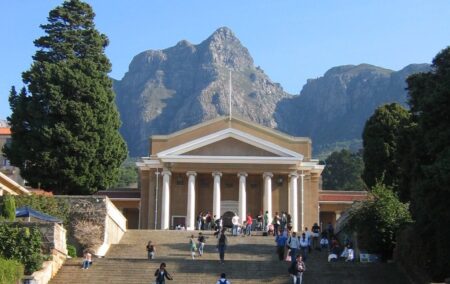
The Free Speech Union of South Africa (FSU SA) says the outcome of proceedings in the Cape Town High Court this week concerning resolutions adopted by the Council of the University of Cape Town (UCT) on scholarly relations with Israeli institutions will have significant implications for “the reputation and status of UCT as South Africa’s premier tertiary institution”.
The review proceedings scheduled for today and tomorrow have been brought by Professor Adam Mendelsohn, Head of the Department of Historical Studies, and the Isidore and Theresa Cohen Chair in Jewish Civilisation at the University of Cape Town. The proceedings arise from two UCT Council resolutions passed in June 2024.
In a statement, the FSU SA says this “crucial court case … fundamentally concerns academic freedom and the associated right to free speech”.
“The first resolution includes a clause which rejects the International Holocaust Remembrance Alliance’s definition of antisemitism on the grounds of falsely claiming that it conflates criticising Zionism and Israel’s policies as antisemitism, which is a misreading of the IHRA definition. It does nothing of the sort.
“The second resolution is an academic boycott: it prohibits UCT academics from entering into or continuing relations with any research group and/or network whose author affiliations are with the Israel Defense Forces and/or the broader Israeli military establishment.”
The “imposition” of the resolutions would “significantly inhibit his ability to perform his professional and academic obligations. As such they would negatively impact his right to academic freedom at UCT”.
The FSU SA says Prof. Mendelsohn’s challenge is that the Council was bound to exercise its powers according to the principle of legality. In so doing it was required to act lawfully, rationally and in good faith.
The argument is that the Council’s process failed to follow the principle of legality, in that:
- Certain members of the Council knew that the resolutions could be financially prejudicial to UCT and yet failed to disclose this to the Council before the decisions were taken, and despite being asked repeatedly about such potential consequences. Among the financial contributions placed at risk by the resolutions was a donation worth R200 million, and another for the building of a specialist hospital;
- Council failed to consider a risk report (2019) about similar resolutions, and three legal opinions on Council’s powers to pass resolutions limiting academic freedom;
- Council failed to consider the views of affected persons and stakeholders (staff and students) before taking its decision, as a matter of rationality and in terms of its own Risk Management Policy of June 2020;
- The decision is irrational as it rejects the IHRA definition of antisemitism on the purported grounds that it conflates antisemitism with criticism of Israel, which it does not, as it says the opposite. The second resolution is also too broad, too narrow, and too vague to achieve any legitimate purpose;
- Council had no authority to pass the resolutions under the Higher Education Act 101 of 1997, its 2010 policy on public statements, and the Regulations for Reporting by Public Higher Education Institutions.These instruments require Council to pass reasonable resolutions. Mendelsohn argues that they are not reasonable. They impose disproportionate limits on the constitutional right to freedom of expression, including academic freedom.
- There is a reasonable apprehension of bias as several Council members, including the Chair of Council, had publicly expressed their views on the subject matter of the resolutions, creating a reasonable apprehension that Council was biased.
“Although not relevant to the above grounds per se, the levels of antisemitism that have pervaded the UCT campus, particularly after the attack by Hamas on Israel on 7 October 2023, have been raised by amici to the court. The argument is that the resolutions contribute to an already poisonous atmosphere on the campus.
“Shortly after instituting the matter, Prof Mendelsohn was suspended because of complaints by colleagues over his opposition to the resolutions. An investigation completely cleared Prof Mendelsohn in May, but his “reintegration as the Head of Department has depended on mediation with his department. UCT has not convened mediation, so Prof Mendelsohn remains suspended”.
The FSU SA concludes: “The outcome of this hearing and the treatment of Prof. Mendelsohn for exercising his constitutional rights could have hugely negative implications for the reputation and status of UCT as South Africa’s premier tertiary institution.”
Image: By Adrian Frith – Own work, CC BY-SA 3.0, https://commons.wikimedia.org/w/index.php?curid=849444]