

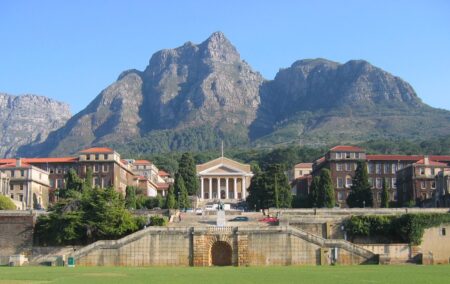
The University of Cape Town’s (UCT) anti-Israel position compromises the academic freedom espoused in the Constitution of the Republic of South Africa as a form of freedom of expression in Section 16.
It is appalling to see one of South Africa’s premier universities vehemently rejecting the International Holocaust Remembrance Alliance’s definition of antisemitism, where it claims the definition is false and that it conflates criticizing Israel’s policies with antisemitism.
In its efforts to discredit Israeli academics and scholars, UCT adopted a resolution to enforce an academic boycott, which prohibited its academics from working with any research group or association whose author affiliations are with the Israel Defense Forces (IDF). This decision by the university is misguided and unrealistic, as most Israelis, young and old, have deeper and direct connections to their military service. If passed, this resolution could end any possible or ongoing research and academic partnerships between UCT and Israeli universities, which would have dire implications for academia and the broader society that benefits from the research outcomes.
The university is an intellectual space where scholarly debates are often held. These scholarly discussions, which are considered festivals of ideas, are helpful as they result in the discovery of innovative solutions that could drastically transform our society. It is under this backdrop that universities should never be weaponized and politicized to serve a narrow political or ideological conviction. UCT has a contribution to make in finding a lasting solution to the longest historical Israel-Palestine conflict through its research and intellectual capabilities.
As a postgraduate from Israeli-based Ben Gurion University of the Negev (BGU), I am deeply concerned that this resolution will be expanded to include even people like me, who have never had anything to do with the IDF. This move by the university could be a serious setback for someone like me, as it would exclude me from working or associating with South African universities on the basis that I have links with the Israeli institutions of learning. Our Constitution was constructed to protect people like me from those who want to bar others in academia and the research world based on their links and connections.
It is important to note that these two resolutions, if implemented, could see the university losing donations worth R200 million or more, as funders are going to withdraw. We have to think thoroughly about how the withdrawal of funds will affect the students, researchers, the university, and the society that benefits from innovative research. We have many students who are roaming the streets because they could not
continue with their studies due to a lack of funding. We need donors and other sources of funding to keep our students in the lecture halls and make sure that they become central players of the mainstream economy. Politicizing the conflict, which does not directly concern us, will impede our progress as a society. Our role could be to mediate for lasting peace and security, not to interfere or encourage conflict to take place.
The political posture in the UCT council proves the existence of subjectivism and bias in their approach to rejecting the definition adopted by IHRA without any reasonable grounds.
Professor Adam Mendelsohn from the UCT’s Department of Historical Studies was targeted and vilified for his opposition to the two demeaning resolutions adopted without proper consultation and engagement by the university Council. Despite being cleared by investigations, he remains suspended by the university. His suspension emanated from his opposition to those two resolutions, which are anti-Israel.
Institutions of learning and training should never be used as a political tool to pursue a narrow political and ideological agenda. Their sole purpose is to seek a developmental agenda through intellectualism, innovation, and idea-generation to address the problems confronted by societies. The university should never discriminate against a particular group of people due to diverse political beliefs. UCT, as a premier university in the African region, should be in a position to tolerate all people, regardless of their political, social, or economic standing.
[Image: https://upload.wikimedia.org/wikipedia/commons/0/07/UCT_Upper_Campus_landscape_view.jpg]
The views of the writer are not necessarily the views of the Daily Friend or the IRR.
If you like what you have just read, support the Daily Friend