

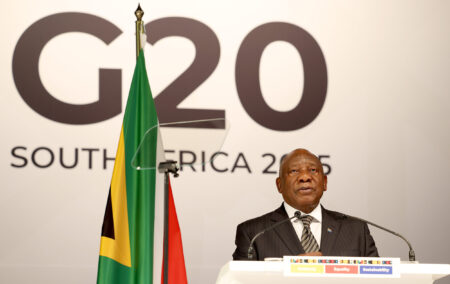
South Africa’s government takes its role on the global stage extremely seriously – in some ways, much more so than it does its domestic responsibilities – and the upcoming G20 summit was meant to be a highlight for the country, and for President Ramaphosa’s term of office.
It represented the multilateralism that South Africa has vocally supported since the 1990s. This is also the first time an African country had held the presidency, and it was a moment viewed by the government as a priceless opportunity to influence the global agenda. Yet indications are that this is not working out as well as had been hoped.
The G20 is an odd form of international body. Unlike the United Nations, it is less a formal organisation established by treaty and accession than a free colloquium of countries (and with the European Union and African Union, of regional bodies). There are no fixed rules for accession, for membership or for exit.
Yet the participating countries account for more than half the world’s population (closer to 80% if the total populations of the EU and AU are included) and around 85% of global GDP.
Its origins were the response to a series of destabilising economic crises in the 1990s, as well as a recognition that the world economy was changing. The G7 – a precursor body, albeit one still in existence today – had been established in the 1970s to bring together the world’s largest developed economies; this was increasingly not reflective of the weight of world economy, as “developing” countries were making a growing contribution to global systems. (Indeed, financial crises with worldwide impacts had arisen in such economies, in Mexico, in East Asia, in Russia and in Argentina.)
The solution was to expand the forum to include other significant economies, bringing together key players in the developed and developing world.
As a 2004 report by the US-based Brookings Institution put it: “A high-level global political forum in which the leaders of a representative group of countries give serious attention to global strategic and systemic issues that cut across the traditional roles and mandates of international institutions and provide broad guidance to them is essential, and an enhanced G20 is the right forum for this purpose. At the highest political level, there is no other representative forum mandated to address these inter-sectoral and inter-institutional issues, which are part of the G20’s founding principles.”
Flagship event
Initially, the G20 brought together finance ministers, though since 2008, its flagship event has been a summit of Heads of State – this being the event that Johannesburg will host.
It’s a matter of debate just how much the G20 has achieved. It is generally recognised that its signature achievements have been on the terrain for which it was originally established: managing the global financial system. Its response to the 2008 financial crisis included reaching consensus on measures to stabilise financial markets and provide stimuli for global growth. The G20 went on in subsequent years to introduce measures to enhance financial regulation.
But the G20 has also seen a considerable expansion of its remit, taking on a number of global challenges such as climate change, health, food security, and corruption. It has also gradually drawn in subsidiary fora, such as the B20 (for business), the T20 (for think tanks) and the Y20 (for youth).
This mandate creep has worked against coherence and consensus, and some participants have bemoaned the failure of their interests to be taken up in official commitments. For example, although the Y20 has been in existence since 2010, none of its communiqués or recommendations have made it into official declarations.
The declarations themselves tend to be broad enough to be acceptable to all participants, and so to avoid contention and to reflect whatever meagre consensus may be possible. There is a great deal of acknowledging, recalling, and recognising, and pledges for cooperation and largely non-specific commitments to action. Conflicts that have broken out in recent years (notably the Russian invasion of Ukraine) have placed an additional strain on the G20; last year’s declaration defaulted to “[reiterating] our national positions and resolutions adopted at the UN Security Council and the UN General Assembly and underscore that all states must act in a manner consistent with the Purposes and Principles of the UN Charter in its entirety.”
Like most global institutions, the G20’s influence has been variable at best, and invariably of secondary importance to the positions taken by countries, as well as by more cohesive blocs.
Heavy-hitting group
By virtue of its composition, the G20 is an important forum. Bringing together a hard-hitting group of national leaders as it does, its most valuable contribution – outside, perhaps, of dedicated crisis response, as in its response to the 2008 financial crisis – is as a sort of incubator of ideas. In particular, it allows the presiding state to set a theme and an agenda.
It has given this opportunity to a select group of developing (“Global South”) countries: South Africa follows Brazil, India and Indonesia in doing so. Each has been able to place matters before the forum that are of concern to them, such as social inclusion, meeting the Sustainable Development Goals, reform of international institutions and climate financing.
South Africa has leant into this. Its chosen theme – Solidarity, Equality, Sustainability – would not be out of place in its domestic political milieu. These are ideologically loaded ideas, for better or worse. Just as the South African state’s objective is a levelling across race groups and gender categories in the country, so it seeks to promote this among states. “Solidarity” will be required to ensure that the more affluent parts of the world assist the less affluent to make their developmental journey. At times, this has been described as “resource transfers”, although the vision is more expansive, seeking greater representation and influence by the Global South – and especially for Africa – in such bodies as the United Nations Security Council and the World Bank. This is all part of South Africa’s commitment to multilateralism.
South Africa regards itself as a norm entrepreneur, a country that punches above its weight and exercises an outsized influence on the ideas animating global governance and international relations. The G20 presented South Africa with the chance to do this, and it had big ambitions. In December last year, President Ramaphosa announced: “We will build on previous presidencies and provide momentum to existing structures and processes. We will reflect on the impact of the G20 over the last 20 years and positioning it to enhance its impact over the next 20-year cycle.”
Overshadowed
Looking at the past year, it’s hard to believe that it has succeeded. Most obviously, South Africa has found itself in the crosshairs of the United States, and its presidency has been overshadowed by the refusal of the US to participate. At the outset, US Secretary of State Marco Rubio dismissed South Africa’s chosen theme as an expression of the fraught “Diversity, Equity, Inclusion” thinking that had become so divisive in the US. (The Economist ran a piece in February entitled “For Donald Trump, South Africa is DEI in the form of a country”.)
Despite personal approaches to President Trump by President Ramaphosa, he has refused to attend the summit and recently withdrew the US from it entirely. It’s not even clear whether the US will have embassy representatives there, and how the Presidency will be transferred to it (the US is scheduled to hold the Presidency next year). Indeed, it is not beyond conceivable that the US might attempt to exclude South Africa from next year’s G20 activities.
In any event, close to two decades of indifferent economic growth, fraying domestic governance and declining global standing have placed a question mark over whether South Africa, objectively, can still make a claim to membership of this group.
Of course, the summit will go ahead, but without the world’s premier economy it will suffer a major credibility challenge. Perhaps it’s not at risk of a thunderous collapse, but there is a risk of the summit turning out to be a damp squib. (Optimists might however suggest that without the US, a consensus declaration would be easier to come up with, although there are enough issues of contention among the remaining attendees to keep this process a complicated one.)
Adding insult to injury is that civil society groups have seen the G20 as an opportunity to pressure South Africa’s government when the eyes of the world are upon it. Embarrassment before its global peers may well be more painful for the government than the disapproval of the people to whom it is nominally accountable. Most prominently, the Solidarity Movement has installed large banners on the route to be taken by delegates to welcome them to the “most race-regulated country in the world”.
National shutdown
Women for Change has called for a national shutdown at this time: “We call on all women and members of the LGBTQI+ community across South Africa to refrain from all paid and unpaid work in workplaces, universities, homes, and communities to demonstrate the economic and social impact of their absence. Because until South Africa stops burying a woman every 2.5 hours, the G20 cannot speak of growth and progress.”
The Institute of Race Relations has leveraged the event in its campaign against racial classification by publishing memes on social media asking how each of the visiting dignitaries would be classified.
Operation Dudula will be protesting pretty much everything in South Africa, not least illegal immigration: “Let the visitors know our plight!”
There have also been acts of outright vandalism of G20 signage. Photos online indicate that among the sundry obscenities spray-painted into them is the word “Jobs”. This is revealing, as is the venomous cynicism voiced by Johannesburgers, as select routes in the city are spruced up for the summit. Few expect the improvements to be maintained.
No doubt, all this is grating to a government that has invested so much in this event. But it must also be remembered that this state of affairs reflects in large part the outcome of long-standing
policy choices and pathologies. South Africa has taken a hostile position towards the US for the better part of two decades, without the countervailing diplomatic competence to maintain the relationship. Trump has acted on this – intemperately certainly, and counterproductively – but there is no gainsaying that South Africa bears a great deal of responsibility for what is now unfolding.
And amid the tensions over the last year, South Africa has not even been able to appoint an ambassador to the US.
Racial nationalism
Similarly, a politics inflected with racial nationalism, and a governance infected with incompetence could only be expected to invite the sort of oppositional performativity that it is facing, domestically and internationally. As The Economist said in its February contribution: “While Donald Trump has told some lies about South Africa, he has hit on some truths, too.”
And perhaps what is taking place reflects more than the failings of South Africa’s G20 presidency, or US discontent, but a shift in global dynamics. Trump’s withdrawal of US representation from the summit denotes not only displeasure with South Africa, but a disregard for groups like the G20 – and for multilateral action more broadly. America First can be expected to be understood in terms of what benefits America. Its engagement with such fora will be based on that calculation. Trump has said he looks forward to hosting next year’s G20 in Miami: if the G20 is useful to his agenda, he will involve the US in it; if not, there is scant commitment to it or to the ideals that underpin it. There is no guarantee that a post-Trump US would act differently, and none at all that the posture towards South Africa (under a President Marco Rubio, for example) will change.
Not that this is entirely a US phenomenon. Russia continues its war on Ukraine, while an unsettled Europe has to look towards its own interests in a possible future conflict. China rattles its sabre in East Asia, not just against Taiwan, but against a number of states against whom it has maritime claims. This has become increasingly aggressive. (South Africa has shown little criticism of the former, and as good as nothing to say on the latter – except to discover the virtues of bilateralism, in this case.)
Calls into question
This calls into question the future of the G20 (as currently constituted), and of bodies like it.
Meanwhile, a potentially transformative development in Africa – the African Continental Free Trade Area – struggles to be actualised. There are inept and indifferent governments, interests vested in maintaining control of cross-border movement, security hazards, and poor infrastructure. South Africa, for its part, is not averse to tariffs and trade-constricting measures.
So perhaps South Africa’s real legacy in the G20 will be as the country that presided over the beginning of its decline. Perhaps this is a signature moment in which the world’s pendulum swings away from the multilateralism in which South Africa has invested so much. And the past year has made it apparent that South Africa is not prepared for this future.
[Image: https://www.flickr.com/photos/governmentza/54350981557]
If you like what you have just read, support the Daily Friend