

So there I was, doomscrolling on my “For you” page on Twitter, when I chanced upon an article by Hermann Pretorius, published by the Daily Friend (Race and redress: what the Constitution actually says), in which he refers to a recent exchange we had on equality, foundational constitutional values, and redress.
Pretorius, who heads strategic communications at the Institute of Race Relations (IRR), sought to use that exchange to advance his thesis that the Constitution prohibits the taking of “race-based” measures designed to achieve equality.
Had the article presented my arguments accurately, and placed our exchange in its proper context, I would probably have let it go. But unfortunately it didn’t. So here I am, on a cold and wet Sunday morning, penning a response.
So where does one even start? As Julie Andrews’ Maria tells us, let’s start at the very beginning, which – apparently – is a very good place to start. In this case, that’s the IRR’s Index of Race Law: “An Index of Legislated Colour Discrimination in South Africa”. The IRR states that “145 … racial Acts of Parliament are operative today”, of which nine “have been deracialised since they were originally adopted as race laws.”
Like a handful of others, I have spent a bit of time analysing some of these laws. I have deliberately not considered laws like the Employment Equity Act and the BBBEE Act, because it’s pretty clear why they would be considered by the IRR to be “race” laws. Instead, I’ve looked at others, many of which do no more than require a Minister, when appointing members of a board of a statutory council, to consider representivity.
Increasingly annoyed by the noise about “the 145 race laws”, described by many as actively discriminating against white people, I posted this comment on Twitter:
“This entire ‘race’ law narrative is just so intellectually dishonest. Just say you’re against the concept of substantive equality, as entrenched in section 9(2) of the Constitution, and as recognised as a foundational value in section 1(a).”
Pretorius was quick to respond, reposting my comment with his take: “Advocate at the Johannesburg Bar conveniently ignores Section 1(b) of the Constitution. Virtue signalling must be one helluva drug.” This led to the following exchange:

In a separate response to my post suggesting that he had learnt nothing at law school, Pretorius again resorted to the quote tweet response (which is ordinarily used to speak to one’s Twitter followers, rather than to engage in dialogue). He wrote:
“This weak attempt at a rebuttal exposes the poverty of the racialist thinking: only new racial discrimination can, in their view, offer a route out of the historic injustices of past racial discrimination. A fundamental error of both constitutional grasp and economics.”
This gave rise to the following exchange:

By that point, I was done with the debate – until I chanced upon the Daily Friend article, in which Pretorius expands on his analysis of section 1 of the Constitution. And that, with respect, is where it all goes horribly pear-shaped for him. Central to his thesis is his understanding that provisions of the Bill of Rights must be read as being subject to compliance with section 1 of the Constitution, which – in his view – sits at the top of a hierarchy of constitutional provisions.
But that is not how constitutional interpretation works. As the apex court has made clear, all provisions of the Constitution must be read together, harmoniously. In such a context, one cannot look to section 1(b)’s recognition of non-racialism as a ban on considerations of race, when section 1(a) recognises not equality, but the achievement of equality, as another foundational value, and section 9(2) expressly permits the state to take “legislative and other measures designed to protect or advance persons, or categories of persons, disadvantaged by unfair discrimination”. It does so against the backdrop of race being the primary basis for unfair discrimination in the past.
So how does one reconcile the three sections? Here’s what I said in response to another post that took issue with the way Pretorius understands redress:
“The text of section 1(a) clearly contemplates redress, referring to ‘the achievement of equality’, and not just ‘equality’. My understanding is that a truly non-racial society is unachievable without taking the steps contemplated by section 9(2) to achieve equality.”
Such an approach is squarely in line with what Justice Moseneke held in Minister of Finance and Other v Van Heerden 2004 (6) SA 121 (CC):
“The jurisprudence of this Court makes plain that the proper reach of the equality right must be determined by reference to our history and the underlying values of the Constitution. As we have seen a major constitutional object is the creation of a non-racial and non-sexist egalitarian society underpinned by human dignity, the rule of law, a democratic ethos and human rights. From there emerges a conception of equality that goes beyond mere formal equality and mere non-discrimination which requires identical treatment, whatever the starting point or impact.”
“Determining whether a measure will in the long run promote the achievement of equality requires an appreciation of the effect of the measure in the context of our broader society. It must be accepted that the achievement of this goal may often come at a price for those who were previously advantaged. Action needs to be taken to advance the position of those who have suffered unfair discrimination in the past. …However, it is also clear that the long-term goal of our society is a non-racial, non-sexist society in which each person will be recognised and treated as a human being of equal worth and dignity. … In assessing therefore whether a measure will in the long-term promote equality, we must bear in mind this constitutional vision.”
In linking the measures that may be taken to patterns of unfair discrimination, section 9(2) makes it clear that they may be based not only on considerations of race, but also sex, gender, and disability, and all other grounds of non-discrimination contemplated by section 9(3) of the Constitution. Of course, such measures must be both rational and reasonable. But their taking, as a matter of principle, is not only constitutionally permissible, but – in appropriate circumstances – may also be required.
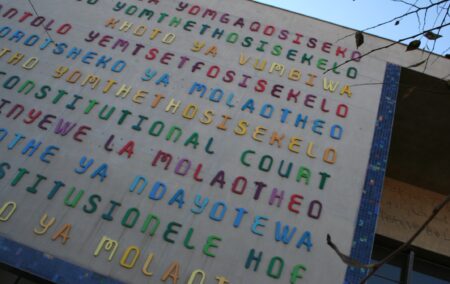
[Image: By André-Pierre from Stellenbosch, South Africa. – Constitutional Court Building., CC BY 2.0, https://commons.wikimedia.org/w/index.php?curid=5608955]
The views of the writer are not necessarily the views of the Daily Friend or the IRR.
If you like what you have just read, support the Daily Friend