

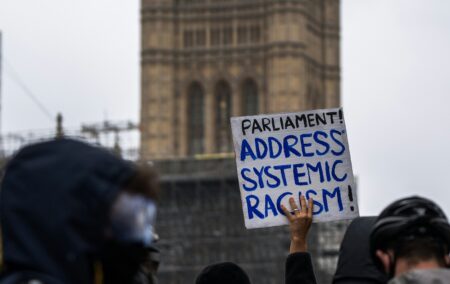
In 2019, a white, former Labour MP called Angela Smith decided she was fed up with racism, and wanted to tell everyone that it was giving her a rash, so she got herself a slot on BBC lunchtime television. Given the chance to speak, she declared: “It’s difficult to get a job, if you’re a working-class BME woman, it’s difficult, you know, even if you have a funny tinge…it’s difficult.”
Pandemonium ensued but Angela was puzzled: what had she said that was wrong? It was her idea to speak out against prejudice in the first place but here she was, at once accused of it. Alas, rather than telling everyone about her plans to get a nice Eskimo family from Greenland to make and subsequently live inside an igloo on her lawn, where she could shriek at passing strangers about her passionate love of diversity while pointing to the structure, –– she quit politics.
Unlike in SA, the UK appears to be gagging for B-BBEE legislation. With increasing frequency, internships are exclusive to Black Minority Ethnic (BME) candidates – particularly in media and the civil service, with the BBC, ITV and MI6 having all been exposed.
In 2023, Cambridge University restricted a post-graduate course to BME applicants. The appointment of the leader of the Conservatives last year was said to come down to a battle of immutable characteristics – as in Joe Biden’s conviction that his nominee to assume a vacant seat at the Supreme Court had to be – just had to be – a black woman.
At Twickenham recently, a white supporter is reported to have told an interviewer that “he wished to see a whole team of Immanuel Feyi Wabosos” (referring to England rugby’s left wing). When asked if he meant he wished to see a whole team of players as talented as Immanuel Feyi Waboso, he replied, “Nah”. He just wanted to see a team of black players.
The findings of the survey published by the Institute for Race Relations (IRR) last week regarding South African attitudes are bewildering – but only if you’re modern English. 92% of respondents from the country US President Donald Trump has previously dismissed as “DEI ground zero” want race-based sporting selection policies terminated. Whether they interpret them as not working, or whether they instinctively interpret them as obstacles to real progress, or whether real cohesion pales in comparison to the explicit desire pronounced in the survey, these things are just not wanted.
Some awkward flaws
There are some awkward flaws in the UK’s enthusiasm, the first of which involves data: only 18% of the country is BME. Extrapolated, this means there wouldn’t be enough candidates to occupy every single executive position or occupy every premier sporting team. However, political will, of which there appears to be no shortage, could see a rule adjustment where 15-year-olds are permitted to join the boards of banks and utilities. Another flaw is that cosmetics cannot (yet) be interpreted as growth.
But the most obvious flaw is the pig-headed defiance of precedent; it’s not just that these things don’t work, it’s the conviction of their adherents that if they’re done properly – they just somehow will work.
Bad ideas mostly emerge with even worse extensions, and as the idea of UK B-BBEE accelerates through the media and its shifty political classes, so do the calls for reparations. In 2023, a Jamaican judge called Patrick Robinson, sitting at The Hague, decided one morning that the UK’s historical role in slavery made it liable for reparations. Sitting in front of a spreadsheet, he typed “$24trillion” (£18tr) into the total with an asterix next to it: “underestimated”.
Which leads to the extensions of the extensions of bad ideas. 2025, the African Union declared, was to be the “Year of Justice for Africans and People of African Descent through Reparations”. Now, some young people – Amnesty International profiles and recipients of grants from USAid and Open Society and the Gates Foundation – have conjured up an even more cunning plan: slavery reparations are actually colonialism reparations are actually just climate justice.
This somersaulting grievance Venn diagram is precisely what happens when a culture is contaminated with “race-based” obsessions.
As it happens, the UK is probably at one of its lowest points of social cohesion. Unfettered immigration and “multiculturalism” were used not as societal ambitions, but as political tools, as one speech-writer for a former Prime Minister admitted. There has always been a huge amount of political currency in being seen to possess edgy views, no matter the material consequences. This is something which flourishes to this day.
Mass lobotomies
What the UK really needs, as it relates to its race-based obsessions, is a national IRR-findings workshop, followed by a roadshow; and if that doesn’t work, mass lobotomies for its worst offenders.
But were it to take seriously the broader implications of the survey, it will see that whilst “race-based” sounds fashionable, and all the clever people teaching at universities and all the activist groups and shape-shifting politicians love it, in its most emphasized use-case – South Africa – it failed to convince let alone deliver, leaving people unhappy, suspicious and feeling disenfranchised. It over-promoted and over-blanketed the term “privilege”, and, like hare-brained social engineering, became inconsistent.
Some argue that the UK’s present “race-based” obsession is actually a ruse: it wants to show those 56 Commonwealth nations and others that it isn’t actually racist, or it learned its lessons (it was actually the first country to abolish slavery) as a way to avoid footing Judge Robinson’s “underestimated” bill. In the unlikely case of that being true-ish, clearly no consideration has been afforded to casualties like Ms. Smith, thus establishing the possibility that the country won’t just end up broke, but irreparably stupid too.
[Image: James Eades on Unsplash]
The views of the writer are not necessarily the views of the Daily Friend or the IRR.
If you like what you have just read, support the Daily Friend