


In the following two pieces, I examine the state of manufacturing in the US and its competitive position. Can America compete with China, the world’s dominant industrial power?
Fifty years ago, the US was the undisputed leader in manufacturing. More recently there have been notable actual or near failures of iconic American companies – Eastman Kodak, Xerox, Bethlehem Steel, Motorola.
This month, I travelled to the industrial American Midwest to visit two important companies – one making cars, the other making bicycles – that may provide clues as to where US manufacturing is headed.
Making cars in Kentucky
GEORGETOWN, Kentucky: In northern Kentucky, an hour’s drive from Louisville and also Cincinnati, 10,000 Toyota employees produce 2,000 Camrys and Rav 4s every day. The sprawling, highly automated plant is Toyota’s biggest anywhere in the world, including Japan. The Japanese car maker’s presence here has transformed bucolic Georgetown from village to boom town.

Automobiles are the backbone of most advanced economies’ industrial base. In the 1980s when many Americans feared that rising power Japan would overtake the US in manufacturing, union leader Doug Fraser beseeched Japanese car companies to go beyond having cash registers collecting money from the cars they were selling in the states. “Put factories here!” and create American jobs, said United Auto Workers Union president Fraser. The Japanese agreed. Honda was first to build a manufacturing plant near Columbus, Ohio. Cumulatively, Japanese car companies have invested $66 billion building 24 plants in 28 states. More than a third of all US-made vehicles sold in the US come from Japanese-owned assembly plants.
Touring Toyota’s Georgetown plant, hundreds of industrial robots are doing much of the physical work of lifting, welding, painting and moving car bodies along upper and lower level assembly lines. Autonomous delivery robots carry supplies to work stations. Riding the tram that transports visitors through the plant, I’m reminded of inventor Thomas Edison’s prediction from 1910 that “there will be no manual labor in the factories of the future”. The only human tasks, he said, will be tending the machines that do the work. That’s not entirely the case at Toyota, but it doesn’t seem far-fetched.
Toyota is bullish on US manufacturing. In nearby North Carolina it has just opened a $14 billion plant that will supply batteries to Georgetown where preparations are underway to build an all-electric sport utility vehicle. The Toyota North Carolina factory will employ 5,000 workers. The company says it will invest another $10 billion in the US over the next five years.

Toyota’s global mantra is “build where you sell”. Its 11 US manufacturing facilities are mostly exempt from President Trump’s tariffs. During his recent visit to Japan, Trump scaled back US tariffs on Japanese imports from 25% to 15%. In return, Japan has committed to invest $550 billion in the United States by 2029.
Harvard University economist Robert Lawrence argues that manufacturing employment as a share of total US employment will continue to shrink as it has for 40 years. In a recent book, Lawrence cites data that in 1970 manufacturing accounted for 30% of American jobs. By 2010 it accounted for only 10%. From 2000 to 2010 America lost nearly six million industrial jobs as the economy accelerated its shift to services.
Lawrence concludes there will be no industrial renaissance in the US and President Trump’s plan to re-shore manufacturing will fail.
From my visit to the industrial Midwest, I’m convinced that the US will continue to be a major industrial power. GE jet engines are built in Cincinnati, Cummins diesel engines in Columbus, Indiana, Kenworth heavy trucks in Chillicothe, Ohio, and General Motors Corvettes in Louisville.
China has become the world’s leading manufacturer, but the United States remains very much a major player.
Building bicycles in Indiana
SEYMOUR, Indiana: Guardian Bikes executive Sam Markel keeps on his wall a letter from an analyst who warns there is no way Guardian can win building bicycles for children. The correspondent argues that market leader China has insurmountable competitive advantages – lower costs, known brands, and distribution in big box retailers.
The southern Indiana start-up is determined to prove the analyst wrong. Its manufacturing operation in small town Seymour is buzzing. Some 250 employees are working two shifts producing 2,000 children’s bikes daily. Guardian bikes are sold only online, thus are not available in stores. This pre-Christmas season is its busiest time. Guardian bikes sell for between $150 and $370 and come with a 12-month warranty. Home delivery is guaranteed within two days of placing an order.
Ninety percent of the bikes sold in the United States come from Asia. Iconic American names like Huffy, Schwinn and Cannondale are built in China or Southeast Asia. Can bike manufacturing be re-shored to the US? Perhaps, but it won’t be easy. Essential bike components are no longer made here – drive trains, tires, pedals and brake sets. To change that Guardian is investing $19 million dollars in automated equipment. Already most of the steel tubes in Guardian bike frames are manufactured in the Midwest. They are cut and sized in Seymour.

Guardian began making bikes in Indiana in 2022. Company co-founder 37-year-old Brian Riley has already scored impressive wins. Texas billionaire, basketball-team owner and television personality Mark Cuban invested $500,000 of seed money for Guardian manufacturing and he recently invested more, boosting his ownership share in the privately held company. JP Morgan, America’s biggest bank, has opened a $19 million line of credit for Guardian’s capital expansion into robotic welding, laser-cutting technology and logistics. In three years, Guardian sales have soared from $11 million to $140 million.

Guardian is being helped by President Trump’s tariffs. Currently Chinese bikes are tariffed at levels up to 60%. This includes an existing 25% tariff on steel and since April a 19% reciprocal tariff. Guardian would like the steel tariffs increased to 50%.
While tariffs may be good for Guardian they are devastating for bicycle importers and retailers. A trade association says the punitive tariffs “are disrupting every link in the bicycle supply chain, driving up costs, complicating sourcing, squeezing margins, and shaking consumer confidence”.
The post-2020 pandemic period has been brutal for US bike shops. In the first half of this year imports were down 25% overall and down 42% from China. Bicycle prices are rising sharply and only electric (e-bike) sales are increasing. All e-bikes sold in the States are imported.
Bike shops are unhappy that Guardian favors high tariffs and they’re uncomfortable with the direct-to-consumer business model that they say dampens their sales. Some bike shops refuse to service Guardian bikes.
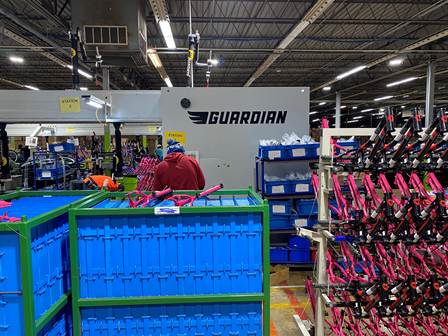
Bicycles are part of a global supply chain that has been disrupted by the Trump tariffs. Even Guardian, with its determination to re-shore bike manufacturing, imports tires from Brazil, pedals from India and other components from China.
Can the United States compete with China in bicycle manufacturing? Without tariffs, probably not.
[Images: Barry D Wood]
The views of the writer are not necessarily the views of the Daily Friend or the IRR.
If you like what you have just read, support the Daily Friend