

In an article for The Common Sense, Frans Cronjé argues that America’s foreign policy is a strategic necessity to “restore America”.
Cronjé’s political analysis is usually sensible and uncommonly perspicacious.
A scenario planner by trade, Cronjé is the head of the Social Research Foundation, and a former CEO of the Institute of Race Relations. I have tremendous respect for him and his work. (Full disclosure: I do occasional work for Cronjé, and he recruited me to the IRR in 2020.)
It came as a surprise to me, then, to read what amounts to a robust defence of the foreign policy of the United States, under Cronjé’s byline.
Cronjé casts it in terms of realpolitik, and the necessity of a hegemonic superpower to project credible power in defence of its own interests. He argues that peace is produced not by goodwill, but by “deterrence, by credible consequences, and by a clear sense that the strongest actor will not outsource its strategy to endless process”.
Agreement
There are several points on which I agree with Cronjé.
I agree that America, the broader West, and the United Nations, have come to be, and be seen as, weak and dithering.
The UN, dependent as it is on majority votes in the General Assembly, or unanimous votes in the Security Council, has proven unable to act in defence of democracy, human rights, and the peaceful resolution of international disputes.
Many Western nations have indeed, as Cronjé charges, been complacent about the victory of liberal democracy in the Cold War, and have been free riders on the implicit security umbrella that the US provided.
The US itself has been reluctant to act, and its internal culture wars have been read by foreign adversaries as weakness.
I agree that the US and all of the liberal democratic nations of the West should maintain credible deterrence against threats from authoritarian nations like China, Russia and Iran.
I agree they should be able to back up soft power and diplomacy with hard power, if necessary, and that each nation should carry a fair share of the financial burden of maintaining that power.
I agree that both allies and enemies ought to be able to rely on the US to act when it says it will act.
I agree that the US government and public institutions needed to ditch preferential treatment on the basis of race, gender, and other characteristics, in favour of a strict meritocracy in which all people are treated equally.
I agree that abundant, affordable and secure energy supply is the cornerstone of economic prosperity, and that the green lobby has hamstrung America’s economy, and that of other Western nations.
I am under no illusion that “American influence is best preserved through reassurance, process, and the careful avoidance of friction,” as Cronjé puts it.
And yet I have several bones to pick with his argument.
Consistency
Cronjé seems to suggest that US foreign policy is about defining what it will and will not tolerate. Yet its actions do not bear this out.
Its tariff policies have been nothing if not unpredictable, for example. Whenever its president sees something shiny that he wants, he throws tariffs at its owner until the owner relents.
The US has murdered people on the high seas and toppled a foreign head of state, on the grounds that they are drug traffickers, yet Donald Trump last November unconditionally pardoned the former president of Honduras, Juan Orlando Hernández, who had been convicted of large-scale cocaine trafficking and had served only one year of his 40-year sentence.
Instead of bolstering America’s reputation to do as it says it will do, memes involving tacos have been circulating. TACO, for “Trump Always Chickens Out”.
Bullying and empire
Cronjé argues that describing Trump’s foreign policy as bullying is “a slur”. He writes: “It is more akin to a renewed willingness to bring hard power forward fast in order to give impetus to negotiations.”
Yet that sounds like the very definition of bullying. If a mafia thug produced a hammer “in order to give impetus to negotiations”, there is no doubt that the negotiatee would view that as extortion, coercion, a threat, or indeed, “bullying”.
He says that America’s actions are not born of “imperial nostalgia”, yet its use of coercive economic and military power speak to what scholars call “informal empire”.
To summarise Atul Kohli, a widely cited professor of politics and international affairs at Princeton University, from his book, Imperialism and the Developing World, informal empire emerges from three conditions in the relationship between what he calls “metropolitan powers” and “peripheral countries”.
First, the imperial metropole does not control the peripheral country directly, but it maintains effective control or veto power over policies that infringe on the real or perceived interests of the metropole. Second, while the relationship may have come about under duress, it is usually maintained as a “clientelistic relationship” between elites in each country. And third, when the relationship of domination is challenged, the metropolitan power is in a position to use coercion, whether through gun boats, regime change, or even organising multilateral pressure.
Kohli writes: “The use of coercion – overt, covert, or via latent threat – helps distinguish cases of informal empire from mere exercise of influence by metropolitan powers over peripheral countries.”
This is a pretty on-the-nose description of the Trump administration’s foreign policy.
It isn’t about conquest, Cronjé avers. And yet, despite the fact that the US has a virtually unlimited right to station troops in Greenland, Trump is adamant that Denmark, a NATO ally that has never harmed the US and has always fought alongside it, must cede ownership of Greenland to the US.
Peacemaker
Cronjé argues that peace is won through respect, not affection, which is true.
The ability to back diplomacy with power ”tends to reduce risk because it narrows uncertainty,” which is “why a firmer American posture can win respect from foes and allies alike. That logic applies to the ending of recent conflicts in the Middle East and Europe.”
Trump’s role in supposedly ending conflicts is wildly overstated, by Trump himself and his minions. He claims to have ended eight wars, but a few of them weren’t in fact wars, several left much work to be done, and most of the ceasefires Trump claims to have brokered have not held.
By going around claiming to have done more than enough to win a Nobel Peace Prize; by accepting a “Peace Prize” that FIFA concocted just for Trump; by accepting her Nobel Peace Prize medal from its winner, María Corina Machado, when she clearly offered it solely to flatter his ego; by writing to the Norwegian prime minister, complaining that his country denied him the Nobel, when in fact it is awarded by a private organisation in Sweden; by claiming that there are “no written documents” regarding Denmark’s ownership of Greenland despite the fact that the US signed a declaration in 1916 granting Denmark unfettered control over Greenland in return for ceding the Danish West-Indian Islands (now the US Virgin Islands) to the US; by building a ballroom bigger than the White House, and decorating the Oval Office with a profusion of faux-gold mouldings straight from Ali Express; by constantly insulting former presidents and people who challenge or disagree with him; by bragging about his own greatness… Trump is not earning respect.
Never has an American president been more disrespected (and I haven’t forgotten about George W Bush). Trump is widely viewed as a narcissistic, perverted, dishonest, unstable and tasteless clown.
Never has America been less trusted by its allies. Where once, European NATO members were intent on “de-risking” their economies from China, now they are all talking about “de-risking” their economies from the US.
America’s enemies do not respect it. They fear its military power and the capriciousness of its leader perhaps, but they certainly do not respect it. In fact, they are quietly cheering as the Trump administration takes a sledgehammer to America’s economy, its bureaucracy, and its democratic institutions. They are all lining up to manipulate Trump by flattering his ego with gifts and made-up honours.
South Korea gifted him a golden crown. Trump thought it a great honour.
War for oil
While I agree entirely that energy policy is the key to a dynamic economy, which in turn can sustain a powerful military, I cannot agree that this fact alone legitimises any foreign policy measures to secure energy resources.
America does not have the right to claim another country’s resources simply on the grounds that it feels it needs them. Suggesting otherwise reduces foreign policy to a simple global resource war.
While military action could be justified to protect legitimate, voluntary trade between free peoples, it can never be justified simply on the grounds of needing to secure access to resources.
Resources can be bought. Taking them by force is a violation not only of sovereignty, but of property rights.
Trade deficits
A related issue is Cronjé’s claim that it is wrong to assume “America can absorb trade imbalances… and hostile economic practices”.
This suggests he believes the Trump administration’s assertion that trade deficits are a sign that other countries are “taking advantage” of the US. Nothing could be further from the truth.
The belief that trade imbalances are harmful is based on the mistake of accounting only for financial flows in trade. When more money flows out than comes in, so the logic goes, this harms the economy and unduly benefits trading partners.
What this view does not account for is the value of the goods or services that are bought with that money, which flows in the opposite direction.
In any voluntary transaction, both sides become relatively better off, because one side values the product or service more than the money they pay, while the other side values it less.
The only reason to export goods and services is to earn foreign currency. Currency, however, does not make anyone better off. You cannot eat gold. What makes people better off is the stuff that can be bought with that currency – i.e. imports.
For a poor country, or a small one, trade deficits merely mean that they cannot earn enough foreign currency to spend on imports.
That the US can afford to import more than it exports is not a sign of American weakness. It is a sign of American economic strength.
It demonstrates that its economy is productive enough that it generates an excess that can be used to purchase goods and services from abroad. It demonstrates that its own currency is desirable enough that other countries are willing to accept it, in the belief that they can, in future, spend it on American exports.
These foreign exporters, by accepting dollars, are essentially giving America credit. That America runs a trade deficit with most other countries actually means that the US is taking advantage of its trading partners, not the other way around.
Trying to balance trade through tariffs might raise tax revenue for the government, but that is not a benefit for the American people. It comes at the cost of the American people. What Trump views as corrective actions against “hostile economic practices” would actually make Americans poorer, not richer.
Mercantilism is another characteristic of informal empire, by the way. The dominant power’s commitment to open markets and free trade is selective, and extends only as far as politically connected producers will allow.
I can’t see how a foreign policy beholden to big business and economic fallacies is justifiable.
Free speech
“A society that returns to merit, equality before the law, and freedom of speech strengthens its internal cohesion,” writes Cronjé.
None of those are features of Trump’s America, however. Trump values loyalty, not merit. He values obedience, not freedom.
Trump claims to defend freedom of speech, but in fact defends it only for his supporters. The administration has fired, or caused to be fired, numerous people merely for expressing political opinions. US federal agents have responded with violence to peaceful protests. The US has revoked visas, or refused to issue them, purely on the basis of speech that runs counter to MAGA doctrine, and should be protected under the First Amendment.
That’s not freedom of speech. That is its exact opposite.
Trump does not seek equality before the law, but seeks precedence for “patriots”, nationalists and loyalists, and seeks to marginalise those who do not fit in the traditional conservative mould – like LGBTQ+ people, Muslims, atheists and immigrants.
Internal cohesion
Cronjé mentions “internal cohesion”. Does cohesion justify unleashing the military against civilians? Does it justify warrantless door-to-door searches, and disappearing people – immigrants and citizens alike – into concentration camps with no legal recourse, in violation of habeas corpus?
If there is a lack of internal cohesion, it has been exacerbated and exploited by the Trump administration. Trump characterises broad swathes of his political opposition as “the enemy within” and “domestic terrorists”. The demonisation of out-groups by Trump’s MAGA movement is strongly reminiscent of previous fascist movements.
This is not a movement that seeks “internal cohesion”. It is a movement that seeks conformity and compliance. It is not a movement that advances freedom of any sort. It is a strongly authoritarian movement.
Cronjé says: “Allies and adversaries watch domestic coherence. They do not need to like a leader to respect a country that looks capable of acting.”
One could say the exact same thing about Nazi Germany. “Oh, I don’t particularly like the fellow with the toothbrush mustache, but the Germans are certainly quite coherent, Sieg Heiling in unison. That country sure looks capable of acting!”
This isn’t about not liking Trump, though his character does stink to high heaven. This is about his actual policies. Allies and adversaries don’t like what Trump does. And they don’t respect him for being bold and forceful about it.
Principles
“In practice this is how durable orders are built, not through sentiment, but through credible power guided by clear principles,” Cronjé writes.
Here we get to the heart of my disagreement with Cronjé. I agree that sentimentality has never built a durable order. I agree that it requires credible power. I agree that such power must be guided by clear principles.
I do not, however, agree that the power of Trump’s America is guided by clear principles.
It has thrown principles to the wind in pursuit of naked power, rabid nationalism, mercantilist economics, hateful intolerance and xenophobia, religious fundamentalism, a veritable police state, and mercenary self-interest (not to mention a pathological deference to a childish megalomaniac of questionable intelligence and sanity).
Cronjé says, “The strategic direction is coherent and in many key respects correct.”
I respectfully disagree on both counts.
I would welcome a global policeman, as long as that policeman is honest, fair and benevolent, and upholds liberal democratic principles at home and abroad. If the US exercised its considerable power in the furtherance of democracy, human rights, open markets and free trade, I would be all for it, and sovereignty be damned.
But Trump doesn’t even seek those things for his own citizens, let alone the rest of the world.
Without the guiding principles, Cronjé’s argument devolves into nothing more than a defence of Machiavellian power politics. That might be a realistic assessment of the perilous state of the world, but aspirational it is not.
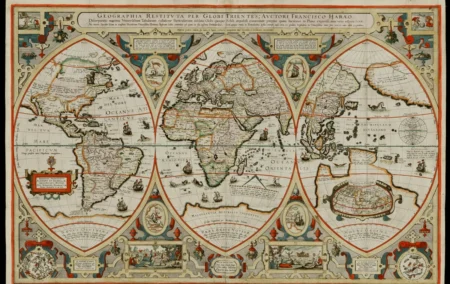
[Image: The world according to Trump, as foreseen by Franciscus Verhaer in 1618. Public domain image.]
The views of the writer are not necessarily the views of the Daily Friend or the IRR.
If you like what you have just read, support the Daily Friend