

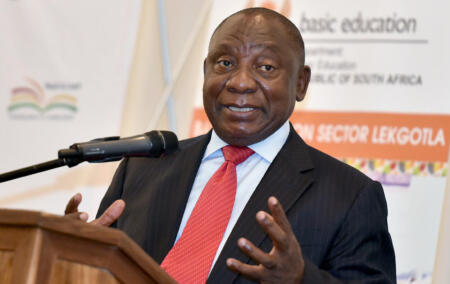
In last week’s letter to the country, President Cyril Ramaphosa set put a positive picture of South Africa’s economy, and with some justification.
South Africa is off the Financial Action Task Force’s Grey List, has enjoyed four quarters of growth, seen some improvement in its unemployment rate, as well as a decline in the proportion of those living in poverty. “We must,” he said, “seize the momentum we built and translate this into long-term gains for our economy.”
Economic growth is an existential matter, and this will be impossible without the engine of an expanding business sector. President Ramaphosa went on to discuss the recommendations of the Presidential Economic Advisory Council, (a group of “respected local and international economists, academics and practitioners” assembled to provide advice on policy). These fell into two baskets: increase spending on infrastructure; and reduce the costs of doing business. This would “translate recent positive developments into enduring growth.”
This is sound advice to be sure, and hardly anything we’ve not heard repeatedly before. In fact, these recommendations are essentially parts of the same whole. Lowering the costs of doing business is intimately associated with the state of a jurisdiction’s infrastructure, but extends to such matters as the efficiency of supply chains, the quality of governance and the administrative burden imposed on companies.
In South Africa, failings across these areas have cumulatively created a cost environment that is a severe disincentive to business – this has been covered extensively in the Institute’s Blueprint for Growth papers.
Thus, according to a World Bank report from 2023, the cost of crime on the country amounted to a staggering 9.6% of GDP. Of these costs, over two thirds were borne by business in direct losses, extortion, security spending (businesses having to commit 2.9% of GDP on security spending) as well as in lost opportunities.
Similarly, infrastructure failings – power, logistics, water – have struck both at firms’ operations, and required substantial outlays to compensate. The numbers are enormous. Most obviously, a CSIR report last year said that the load-shedding crisis that persisted from 2007 to 2024 cost the economy a cumulative R5.7 trillion rand (the high water mark was in 2024, when the bill came to R2.9 trillion).
Prof Jan Havenga of Stellenbosch University estimated in 2023 that dysfunction in Transnet cost the country R1 billion per day, and that around half the goods transported on the N1 and N3 highways (in other words, from Cape Town to Zimbabwe via Mangaung and Johannesburg, and from Johannesburg to Durban) could and should be moved more efficiently by rail.
For individual firms these phenomena manifest in extensive outlays that would otherwise not be necessary: private security (and in some cases, under-the-counter payments to criminal syndicates), off-grid power supplies, expensive long-haul transport services – and even backup water supplies. Failing to take these measures can have ruinous consequences, while taking them can be ruinously expensive. At best they represent redundant expenditure that might have been invested in productive activity. In any event, they make doing business more expensive, more difficult, and South Africa a less attractive business proposition.
These are, of course, big society-wide issues. At a pinch, they might be explained as the feedthrough consequences of social trends, of past underinvestment or the fallout from state capture. In other words, the costs they impose on business are in a sense unintended or unforeseen. We’ll do better in future, we promise.
The same cannot be said for another contributor to business costs, regulation.
Regulation is necessary to secure the common good in a society. But it must be prudently and judiciously applied, matching the scale of its intrusion to the (desirable) outcomes it actually produces – and not simply to its nominal objectives.
One of the few attempts to quantify what regulation costs South Africa was produced in 2004 by SBP (formerly known as the Small Business Project). It estimated at the time the cost of regulations and compliance at some R79bn or 6.5% of GDP. This placed it well ahead of many comparator jurisdictions. This figure is 20 years old, though the environment it portrays remains familiar.
At issue is not just the volume of regulation demanded by various agencies, but also inefficiencies in processing them. Compliance was frequently difficult. A study published in 2019 by Cecile Nieuwenhuizen concluded that businesses viewed all of this – the regulations and attempting to adhere to them – as “burdensome, both in terms of time and cost”.
The Small Business Initiative brought this up again in a 2021 report revealingly entitled Tackling the “Disabling Environment” to boost Economic Growth, Small Business and Jobs. Despite decades of pledges – indeed, from before the transition to democracy – the overall trend was that of deterioration, with smaller firms bearing the brunt of an inappropriate regulatory environment. “South Africa”, it commented, “finds itself in the paradoxical position of being overregulated and under governed by diminished and unproductive state capability.”
SBI argued that it was not always clear why regulations were introduced and what they sought to achieve. South Africa in theory has a system to anticipate consequences – Socio-Economic Impact Assessments. In practice, these have often served to justify proposed interventions, rather than analysing them. Moreover, the implications of a given law or policy for economic and investment outcomes is merely one objective among several, and not necessarily the most important one. The guidelines candidly acknowledge that there are likely to be winners and losers in any policy.
South Africa has chosen this course, largely disregarding what it means for doing business. Indeed, the viability of actual enterprises and their expansion have by a considerable measure been a secondary concern after the imperatives of various other policy and ideological programmes and with scant concern for the capacity of a frail state to oversee them.
Nor, it seems, is there much appetite to change course, irrespective of the advice of any advisory body. True enough, some important work has been done on dealing with particular hindrances through Operation Vulindlela, although these have tended to address the less contentious and more technocratic problems, visas being a prime example. Little has been done, nor has there been any appreciable willingness to countenance change, in labour market or racial preferencing policy, nor indeed to step back unambiguously from behind-the-scenes initiatives like the ANC’s cadre deployment, which have sapped public administration of much of its potential.
Indeed, much of South Africa’s discourse over the past seven years has been dominated by the government, the ANC and its allies threatening property rights through expropriation without compensation – pretty much the most severe cost a state could think of imposing on any economic activity.
Ironically, in the two weeks before the President’s letter was published, “designated employers” were required to submit their first reports to the Department of Labour under the new amendments to the Employment Equity Act. Effectively, they are now working under state-imposed racial quotas, backed by fines that could shut offending firms down. Far from lowering the costs of doing business, this raises them to an existential pitch. Intentionally so, as the former Minister of Employment and Labour pledged to be “very hard on employers”.
More than this, a proposed Business Licencing Bill would introduce an extensive and intrusive framework, compelling every business in every area of the economy designated by the Minister. Licences would need to be renewed periodically, with special provisions for foreign nationals. It would make municipalities – a particularly weak link in the governance system – responsible for issuing them. The Bill is also in parts vague and open to interpretation.
As my colleague Anthea Jeffery put in in the Institute’s submission: “Against this background, the Bill is one of the worst interventions that could possibly be made. Far from encouraging investment, growth and jobs, it will send a message to all enterprises, both large and small, that the business environment in South Africa is even more hostile and adverse to private enterprise. Far from reducing red tape, as President Cyril Ramaphosa has pledged to do, the Bill will usher in a new layer of licensing regulation that is mostly unnecessary, generally serves no legitimate governmental purpose, and is likely to be plagued by inefficiency and corruption.”
Very hard indeed.
So, President Ramaphosa can quite legitimately point to the progress that recent months have seen – even though projections for growth last year only come in at around 1.5%, unemployment remained at 31.9%, and two thirds of South Africans lived in poverty (in terms of the Upper Bound Limit, R 2 635 a month).
He is also entirely correct to emphasise the need to lower the costs of doing business; in fact, to enhance the business environment as a whole. But as long as official policy continues to make the business-hostile choices it does, to codify them into policy, to pass them into law and to define them in regulation, his words will lack credibility.
[Image: https://www.flickr.com/photos/governmentza/32950016558]
If you like what you have just read, support the Daily Friend